Mapped: How late in pregnancy states allow abortions

Add Axios as your preferred source to
see more of our stories on Google.
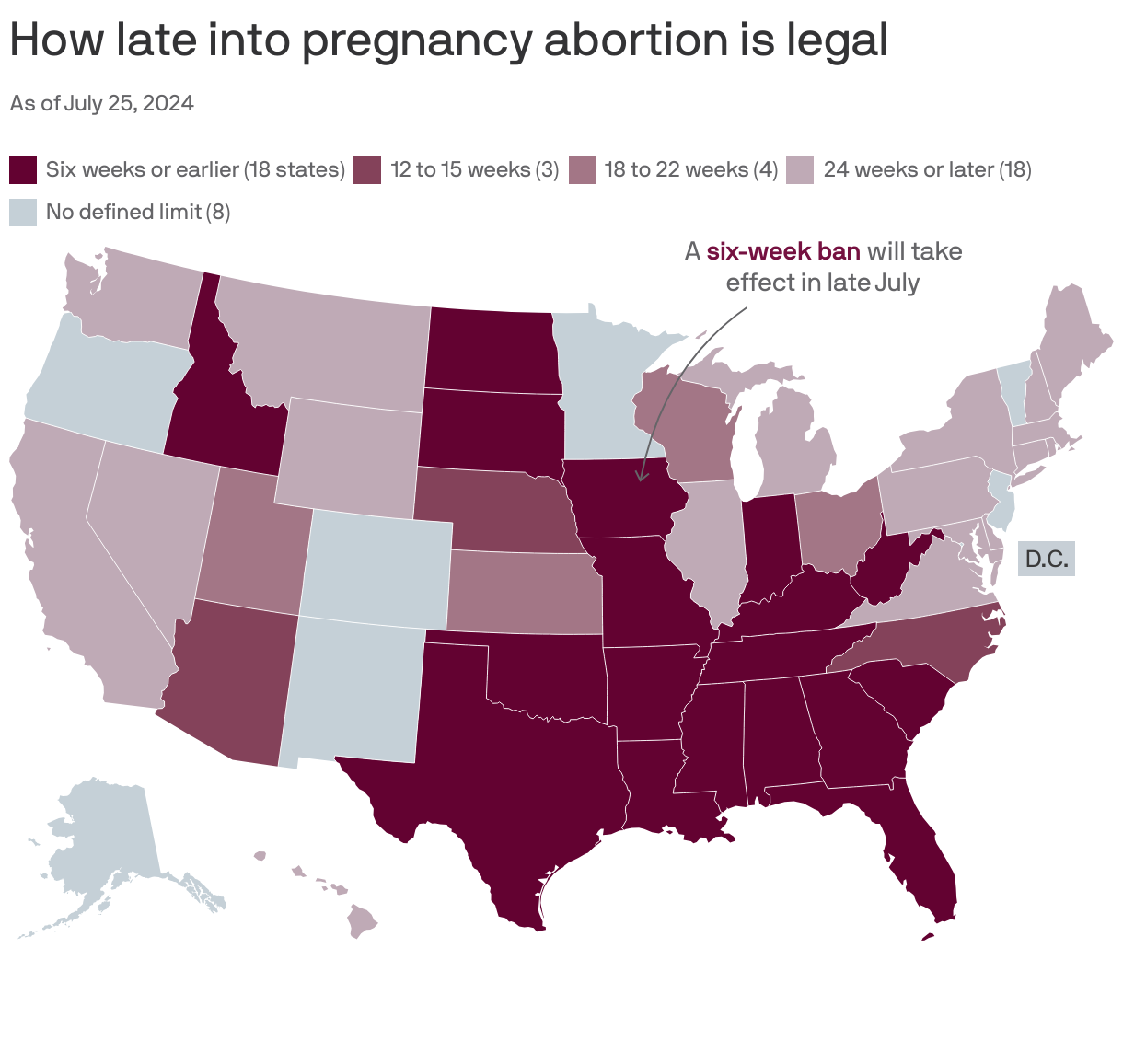
State laws surrounding abortion have been in flux since since the Supreme Court overturned Roe v. Wade nearly two years ago.
The big picture: The battle over abortion access remains in some states, where anti-abortion and pro-choice advocates are engaged in a tug-of-war over the specific legalities and limits of the procedure.
- The Iowa Supreme Court ruled in late June that a ban on most abortions after six weeks of pregnancy will take effect by mid-July.
- A six-week ban on the procedure took effect in Florida in May, but abortion rights will be back on ballots in the state this November.
Meanwhile, more than 1 million abortions took place in the U.S. health care system last year. That's the highest number in more than a decade, per the Guttmacher Institute, a research organization that supports abortion rights.
Zoom in: States vary on the gestational limits of abortion, but 14 states have laws in effect banning nearly all abortions starting at fertilization.
- Six weeks: Florida, South Carolina and Georgia are the only states that have laws in effect banning abortions when cardiac activity has been detected in an embryo, which is at around six weeks.
- 12 weeks: Nebraska and North Carolina are the two states that currently ban abortion at the 12-week mark.
- 15 weeks: Arizona currently bans abortion at 15 weeks. The state Supreme Court in April upheld a near-total abortion ban, but Gov. Katie Hobbs signed a bill in May to repeal it. The move will allow a 2022 law permitting abortions through 15 weeks of pregnancy to take effect. However, since the repeal will not take effect until at least Sept. 26, the near-total ban may be enforced this summer.
- 18 weeks: Utah is the only state that currently bans abortion at 18 weeks of pregnancy.
- 20 weeks: Iowa bans abortion starting at 20 weeks post-fertilization.
- 22 weeks: Kansas and Ohio ban abortions at 22 weeks of pregnancy.
In Wisconsin, abortions are banned at 20 or more weeks postfertilization (22 weeks after the last menstrual period).
Zoom out: More than half of states have restrictions in place only at or after viability, or have no limit at all.
- 24 weeks or later: Four states ban abortions starting at 24 weeks of pregnancy.
- Viability: More than a dozen states ban abortions after the fetus is considered viable. Some laws that don't specify a limit say it's up to the abortion provider's "judgment" to determine whether a fetus is viable.
- Third trimester: Virginia is the only state that prohibits abortions starting in the pregnancy's third trimester, which starts at around 25 weeks, per Guttmacher.
No limit: Six states and Washington, D.C., do not impose any term restrictions.
Of note: Most states with restrictions have exceptions, including to preserve a pregnant person's life or health, though they are often narrowly defined.
- The Texas Supreme Court in late May unanimously rejected a lawsuit over abortion ban exceptions.
Go deeper: Where abortion is on the ballot in November
