Where abortion is on the ballot in November

Add Axios as your preferred source to
see more of our stories on Google.
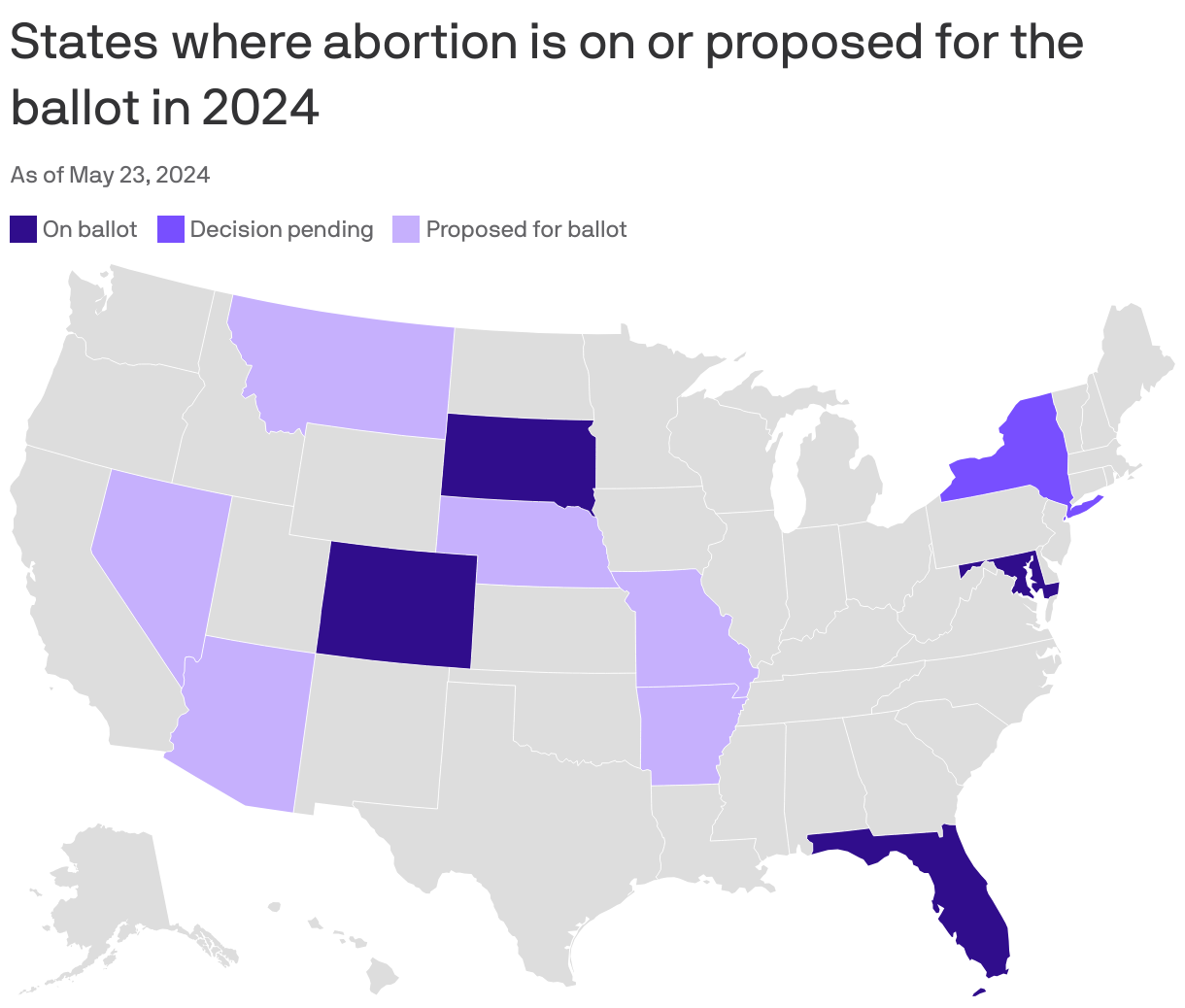
A slew of states put abortion on the ballot for voters in November — a winning issue for Democrats in the post-Roe era.
The big picture: Ten states green-lit abortion-related ballot questions, while others — like Arkansas, Iowa, Pennsylvania and Maine — faced significant hurdles that ultimately prevented voters from weighing in on proposed measures.
- Here's a state by state snapshot:
Florida
The Florida Supreme Court ruled earlier this year that voters in Florida will have a chance this November to enshrine abortion access until fetal viability — around 24–28 weeks of pregnancy — in the state constitution.
- A six-week ban on the procedure took effect in May after the state Supreme Court cleared the way for it — drastically reducing access to the procedure for those in Florida and also people in neighboring states.
- "We haven't seen this setup yet in which people will be living under a very strict abortion law and then head to the polls to vote on essentially overturning that," Laurie Sobel, associate director of women's health policy at KFF, told Axios.
Maryland
The Maryland Right to Reproductive Freedom Amendment would add a new article to the state constitution's Declaration of Rights to guarantee the right to reproductive freedom, defined to include "the ability to make and effectuate decisions to prevent, continue, or end one's own pregnancy."
- Abortion is currently legal in Maryland until viability. It's legal after viability if the woman's life or health is endangered or there is a fetal anomaly.
South Dakota
Organizers in South Dakota collected enough signature to get an abortion rights measure on the ballot in a state where the procedure is currently banned, except to save the life of a pregnant person.
- "Amendment G" would provide a trimester framework in the state constitution for regulating abortion.
The amendment would hold that during the first trimester, the state would be prohibited from regulating a woman's decision to have an abortion.
- During the second trimester, the state would be able to regulate abortion but "only in ways that are reasonably related to the physical health of the pregnant woman."
- During the third trimester, the state would be able to regulate or prohibit abortion, except "when abortion is necessary, in the medical judgment of the woman's physician, to preserve the life and health of the pregnant woman."
- The measure is expected to face pushback and legal challenges in the conservative state. Opponents have until June 17 to file a challenge to the measure.
Colorado
While abortion is protected in Colorado under a 2022 law, voters will decide whether to strengthen the protections in the state constitution.
- A coalition of abortion rights advocates said they collected the number of signatures required to qualify Proposed Initiative 89 for the November ballot. The measure would enshrine the unfettered right to access abortion in the state constitution and remove the current prohibition on using taxpayer dollars to pay for the care.
- If approved, the measure would allow roughly 1 million local and state government employees and people on Medicaid to use insurance to cover abortion services.
Meanwhile, anti-abortion advocates did not collect enough signatures to get the Colorado Life Initiative on the ballot. The measure sought to ban all types of abortion services without exception, prohibit certain birth control and allow prosecution for murder.
Nevada
The Nevada Right to Reproductive Freedom Amendment would protect the right to an abortion in a state where the procedure is already legal up until 24 weeks of pregnancy.
- Following a challenge on the scope of the amendment, the state Supreme Court ruled on April 18 that the language of the petition meets Nevada's legal requirements for a ballot measure.
- But organizers, in the meantime, started gathering signatures for a narrower version of the measure that just protects abortion access.
- Nevadans for Reproductive Freedom said in May that they had collected double the amount of signatures that were required by June 26, and the proposed amendment was officially certified for the ballot at the end of June.
Yes, but: If the measure passes, it will have to be voted on again in 2026 before it can be added to the state constitution due to Nevada law.
Arizona
The Arizona Supreme Court in April upheld a near-total abortion ban, with exceptions only to save the mother's life. The state's high court agreed in May to delay enforcement for another 90 days.
- Democrats and abortion rights advocates garnered enough signatures for a ballot measure that would permit abortions up to the point of fetal viability, around 24 weeks of pregnancy, which had been Arizona law before the end of Roe.
- The Arizona secretary of state's office announced in August that the Arizona Abortion Access Act, which received about 578,000 certified signatures, will be on the ballot this election cycle as "Proposition 139."
Yes, but there is a remaining lawsuit that could disqualify the initiative, though it's unlikely.
- A state Supreme Court decision is expected in late August.
Missouri
Missouri voters this November will decide on whether they want to guarantee a right to abortion through a constitutional amendment. The ballot measure garnered enough signatures to make it onto the ballot, the secretary of state's office announced on Aug. 13.
The state effectively banned abortions after Roe was overturned.
- The proposed amendment would have the Missouri Constitution provide the right to reproductive freedom, defined as "the right to make and carry out decisions about all matters relating to reproductive health care, including but not limited to prenatal care, childbirth, postpartum care, birth control, abortion care, miscarriage care, and respectful birthing conditions."
- If passed, the state legislature would be allowed to enact laws that regulate abortion after fetal viability.
Montana
In August, Montana became the eighth state to put the issue of abortion on the ballot.
- The groups working to put the state constitutional amendment protecting abortion rights on Montana's ballot had until June 21 to collect more than 60,000 valid signatures.
- The proposed amendment would prohibit "the government from denying or burdening the right to abortion before fetal viability."
- Though Montana is a conservative state, voters rejected a 2022 measure meant to restrict some abortion rights.
The intrigue: Putting the initiative before voters could help bolster turnout that buoys the re-election bid of Sen. Jon Tester (D-Mont.).
New York
Voters will decide whether to amend the state constitution to add language related to pregnancy and personal freedom.
- The state's Court of Appeals ruled in July that the measure will indeed be on the ballot after earlier challenges.
- Additional litigation was filed over the proposal but it ultimately made it onto the ballot, the New York State Board of Elections told Axios in October.
Zoom in: While not explicitly about abortion, the Equal Protection of Law Amendment is designed to ensure people can't be denied rights based on their "pregnancy, pregnancy outcomes, and reproductive healthcare and autonomy," along with other classes like ethnicity, disability, age, sex and sexual orientation.
- The ballot measure, if approved by voters, would add protections from future threats in a state where abortion is already legal up to 24 weeks post-fertilization.
- "Embedding these protections within our state constitution insulates us from the political winds that seek to ban, eliminate or reduce access to abortion care through changes to the state law," according to New Yorkers for Equal Rights, the coalition pushing to pass the amendment.
Nebraska
Voters in the state will have two competing measures relating to abortion on the ballot. Abortion is currently legal in the state up to the 12th week of pregnancy.
- The Right to Abortion Initiative would add an amendment to the state constitution to establish a right to abortion until fetal viability or when needed to protect the life or health of the pregnant person.
- The Protect Women and Children initiative would amend the state constitution to prohibit abortions after the first trimester unless necessitated by a medical emergency or unless the pregnancy is a result of sexual assault or incest.
- "As far as the Nebraska Secretary of State's office is aware, Nebraska has never before had two conflicting petition efforts make the same ballot," the office said in August when announcing both measures had been certified.
Editor's note: This story has been updated with additional developments and cuts to unsuccessful proposed ballot measures.
