More than 171,000 people traveled out-of-state for abortions last year

Add Axios as your preferred source to
see more of our stories on Google.
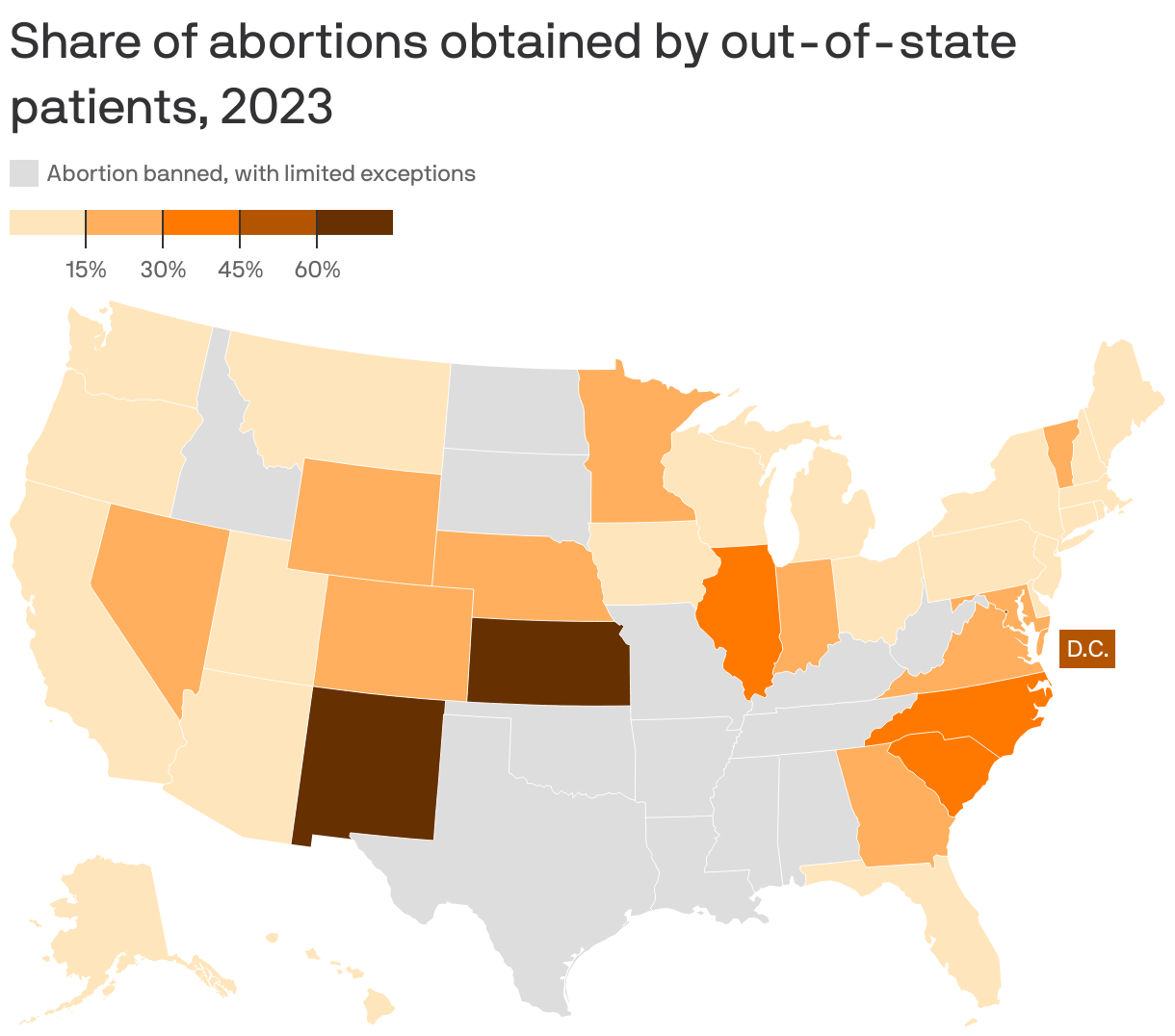
Some 171,300 patients traveled out-of-state for abortions last year, new data estimates from the Guttmacher Institute show.
The big picture: State abortion bans that took effect in the post-Roe era have severely curbed access to reproductive care across the U.S.
- More than one million clinician-provided abortions took place in states without a total ban in 2023 — the first full year after Roe v. Wade was overturned. That's the highest number in more than a decade.
- Out-of-state travel for abortions, including for the procedure or to obtain abortion pills, more than doubled from 2020 to 2023.
State of play: States like Illinois and Florida that border those with strict abortion limits saw big increases as they served as safe havens for patients post-Roe.
- Florida has since instated a new abortion law — one of the strictest in the nation — that has dramatically changed its role as a refuge for people seeking care in the U.S. South.
By the numbers: More than 37,000 people went to Illinois to get an abortion last year, the data shows. The state allows abortions before fetal viability, generally 24–26 weeks of pregnancy.
- Another 15,800 patients went to North Carolina, which allows access up to 12 weeks of pregnancy.
- Some 14,900 people traveled to New Mexico for an abortion, a state that does not impose any term restrictions.
Zoom in: People driving the longest distances to get an abortion are more likely to come from congressional districts with lower incomes and more diverse populations, according to data analysis by the left-leaning Center for American Progress.
Zoom out: The U.S. Supreme Court on Thursday threw out its biggest abortion-related case since overturning Roe v. Wade two years ago, effectively preserving access to medication abortion, which accounts for 63% of abortions in the country.
- The pills are increasingly prescribed online and mailed to patients after the FDA eliminated the requirement that they be picked up in person.
Go deeper:
