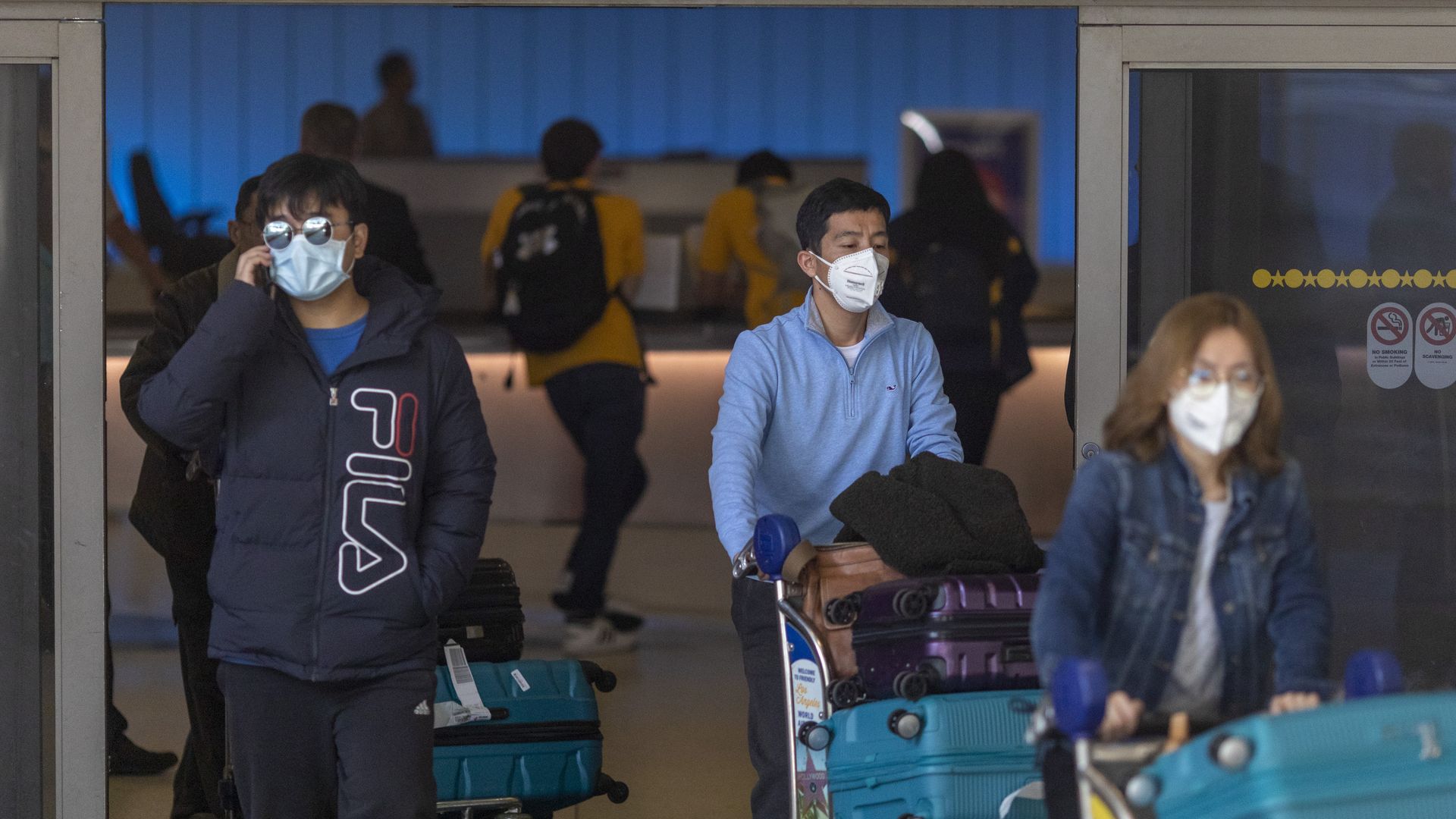
An adult in Wisconsin with a history of travel to Beijing, China, has contracted the coronavirus, the state health department and Centers for Disease Control and Prevention confirmed on Wednesday.
What's happening: The individual, who is currently isolated at home, "was exposed to known cases" of 2019-nCoV while in China. Immediate health risk to the general public in Wisconsin is low, the state health department said.
Four planes will arrive at four different military bases in the U.S. this week, carrying American passengers from Wuhan, China, the Centers for Disease Control and Prevention said Wednesday.
The big picture: Upon landing, the CDC will evaluate the passengers and issue quarantine orders starting from the day the flights took off through 14 days thereafter. Already, one plane landed in the U.S. last week. The total number of passengers has not yet been released.
Why it matters: There is a growing national effort to address homelessness, but access to services that deal with both issues is complicated. Domestic violence is often addressed separately, even though the two struggles are frequently intertwined, the NCFH writes.
After a high-level meeting to address the deadly coronavirus, China's leaders are prescribing even tighter information controls around the outbreak.
Why it matters: The suppression of vital information about the coronavirus during its earliest weeks of transmission contributed to the devastating epidemic China is now facing.
As confirmed cases of coronavirus increase around the globe, billionaires and multinational corporations around the world are deploying their dollars to help health authorities combat the disease.
Why it matters: Investors and businesses fear that the virus if not contained could wreak havoc on the global economy by cutting into China's 2020 growth, Axios' Dion Rabouin and Joann Muller report.
The novel coronavirus outbreak has continued its global rampage, but experts are beginning to see signs of improvement in detection and treatment on the horizon.
Driving the news: S&P Global announced Tuesday it expects the crisis will "stabilize globally in April 2020, with virtually no new transmissions in May. Our worst-case projection holds that the virus stops spreading in late May, and optimistically in March."
The demand for nurse practitioners has exploded recently.
By the numbers: The number of nurse practitioners more than doubled from 2010 to 2017, far outpacing the number of new doctors or registered nurses, according to a study published this week in Health Affairs.
President Trump claimed last night during the State of the Union that he will "always protect patients with pre-existing conditions" — a statement that's misleading at best.
Why it matters: Pre-existing conditions protections are popular, and both parties are trying to claim credit for them. But only one of the parties has a track record of defending those protections, and it's not the GOP.
Researchers continue delving into the coronavirus that struck China and is spreading globally will reach the dreaded pandemic stage.
The big question:Concern has been growing over whether the virus will spark a pandemic, which would likely kill multitudes and decimate economies. So far the outbreak is largely contained to China and hasn't spread from person-to-person consistently, Anthony Fauci of the National Institute of Allergy and Infectious Diseases tells Axios.
Adults in the U.S. are visiting primary care doctors less often, according to a new study in the Annals of Internal Medicine, which could foreshadow worse health outcomes and higher costs.
By the numbers: The study, which focused on adults enrolled with a large commercial insurer, found that, between 2008 and 2016, visits to primary care physicians declined by 24.2%, and nearly half of adults didn't visit one in any given year by the end of the time frame.
Areas hit hardest by the opioid epidemic still struggle with access to buprenorphine, used to treat addiction according to a recent report by the Department of Health and Human Services' internal watchdog.
Where it stands: The federal government has expanded the list of which providers can prescribe buprenorphine, as well as the number of patients those providers can treat.
Iowa Democrats reported Monday that their biggest priorities were beating President Trump and health care — but the meltdown of their election reporting systems left their presidential choices unresolved.
Why it matters: We've been writing for months that Democrats have a major choice ahead, either picking an advocate of Medicare for All — and siding with the plan that's less popular with the rest of the country — or a public option advocate.
Seniors who have supplemental coverage for vision, dental and hearing benefits still pay a lot out of pocket for those services, according to a study published in Health Affairs this week.
By the numbers: Medicare beneficiaries with coverage overall still had out-of-pocket expenses that made up 70% of their dental spending, 62% of vision spending and 79% of hearing spending, per data taken from the 2016 Cost Supplement to the Medicare Current Beneficiary Survey.
Why it matters: The second reported death outside of mainland China came as over 2,400 Hong Kong medical workers went on strike to demand authorities fully close the border with mainland China to stop the spread of the virus, per the South China Morning Post.