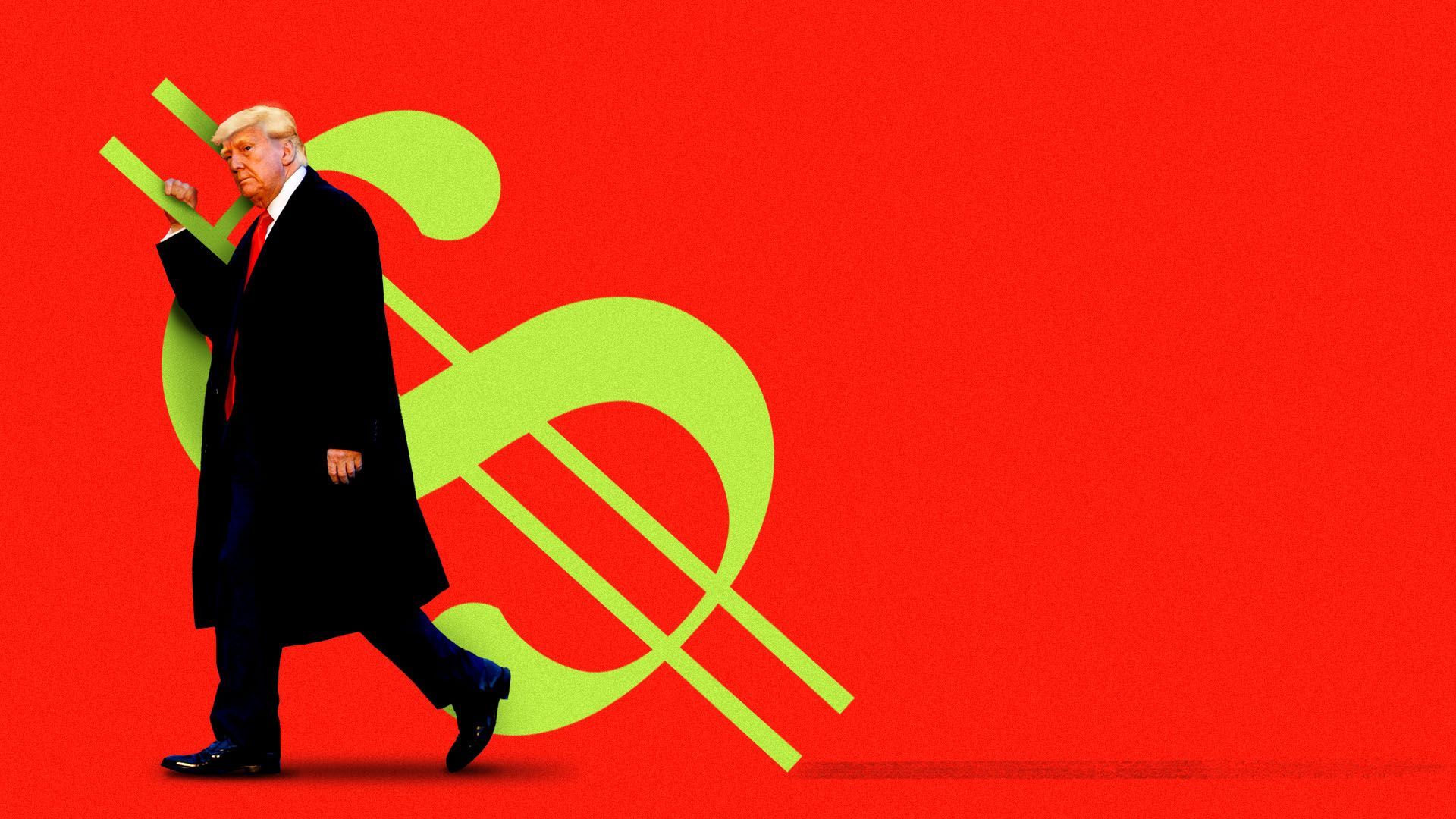
U.S. restaurants are asking President Trump for "targeted relief" from his immigration crackdown.
Why it matters: The president recently signaled a willingness to cut some slack for farms and hotels, saying, "our very aggressive policy on immigration is taking very good, long time workers away from them."
On Tuesday, the National Restaurant Association sent a letter to Trump saying that its industry needs a break too.
"As you recognize, the workforce challenges facing farms and hotels also extend to the restaurant industry," the trade group's CEO, Michelle Korsmo, said in the letter co-signed by state hospitality associations and obtained by Axios.
Egg surcharges are disappearing from restaurant menus as fast as they appeared.
🍳 Denny's confirmed today that it would drop the fee from its menu, following in the footsteps of competitor Waffle House, AP reports.
State of play: After peaking earlier this year amid a surge of avian influenza, egg prices have been falling as bird flu cases subside and egg imports rise.
The bottom line: Egg prices hit a record high of $6.23 per dozen in March but fell to $4.55 in May, AP notes.
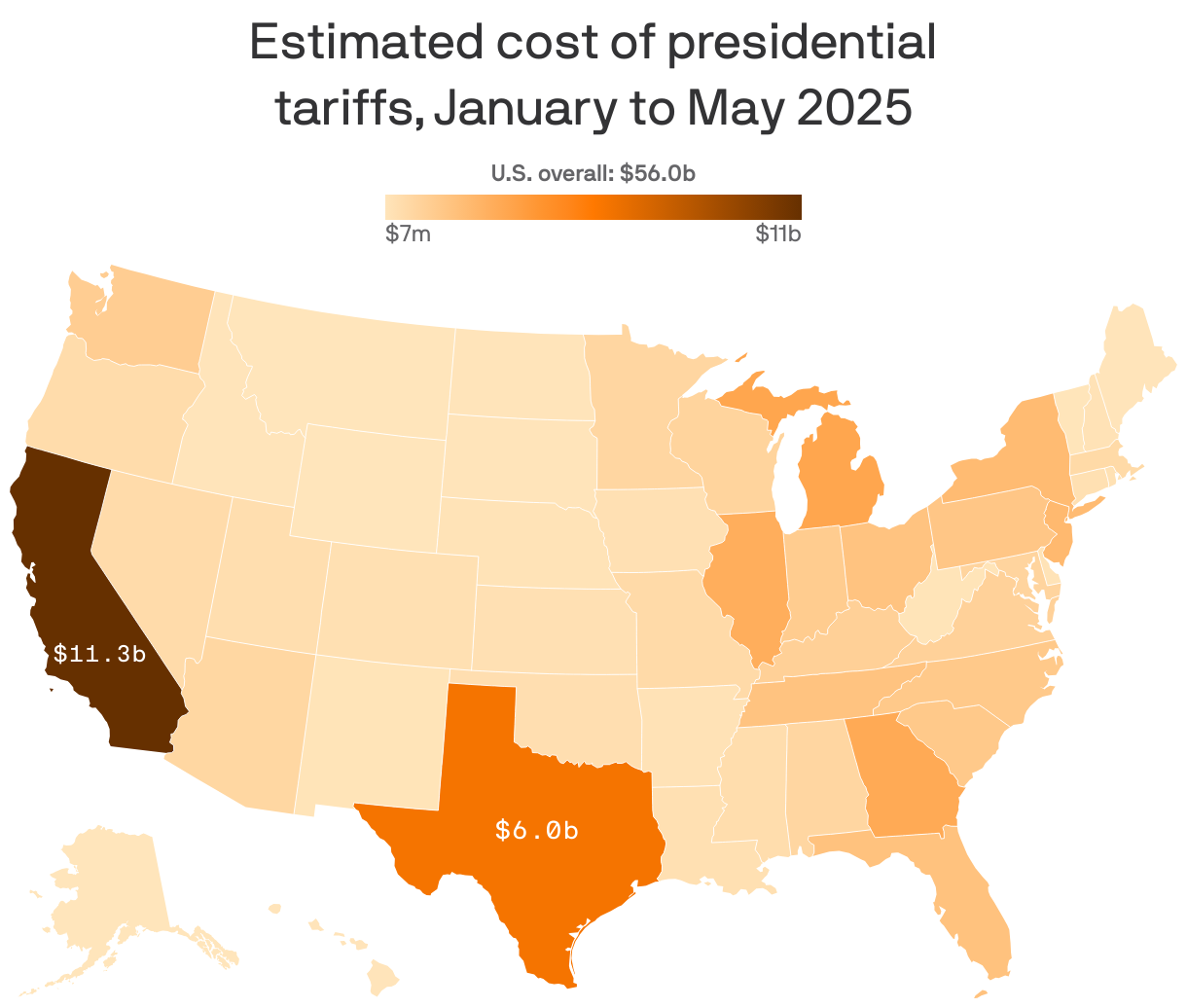
Tariffs imposed by President Trump have generated tens of billions of dollars in revenue for the government — but the burden falls far from equally on different states.
The big picture: Who pays for tariffs is a long-settled issue — American businesses do, to the tune of billions of dollars, in places like California and Texas especially.
Why it matters: Cookout costs increased at a 12.7% annualized rate since President Trump announced the "Liberation Day" tariffs, analysis by the Joint Economic Committee's minority arm found.
Your July 4 fireworks and barbecues may be indoors this year — depending on the weather.
Why it matters: Scorching hot temperatures and widespread thunderstorms may disrupt your festivitiesor cause travel delays for the record-number of people hitting the road this holiday weekend.
The U.S. is very much sitting out the move to digital fiat money, but projects are taking off around the globe.
What we're watching: Central bank digital currency is either the natural evolution of money as we know it into the digital age, or the final step into a total surveillance dystopia.
💭 Our thought bubble: Why not both?
The latest: The Atlantic Council has been tracking developments in the digitization of money for years, and it just released an update to its tracker.
Right now, a record 49 countries have pilots.
China's digital yuan is by the far the biggest pilot. India's digital rupee is the other one.
The stereotype of the crypto voter is a white Republican who gets all their information from YouTube.
Only that last part seems to be right, though, according to new research.
The latest: Paradigm, a large VC fund focused on digital assets, has a new survey out covering people who own cryptocurrency.
The firm commissioned it from Echelon Insights, which surveyed 4,000 crypto owners online.
By the numbers: These investors are basically divided among Republicans, Democrats and those who don't affiliate with either of the major parties.
Racially, the breakdown largely mirrors U.S. demographics, with one exception: Black Americans are slightly over-represented among crypto owners, at 19% of the sample (higher than the nearly 14% of the general population).
The Bloomberg Intelligence team has had a great track record for projecting the approval of digital asset ETFs, and this week they ranked nine coins as likely to get an ETF wrapper.
The SEC also approved an ETF conversion for a fund at Grayscale that includes a combination of five cryptocurrencies (which means that XRP, SOL and ADA are now all in one ETF, alongside BTC and ETH).
The American labor market keeps hanging on, even as signs of weakness crop up.
Why it matters: Hiring is solid, defying expectations that the worrisome macroeconomic backdrop — huge uncertainty about trade, immigration, and the fiscal outlook — would keep more employers on the sidelines.
But Thursday's Bureau of Labor Statistics report stops well short of giving an "all-clear" for the economy.
United Parcel Service plans to offer buyouts to drivers, in a move that's drawing opposition from the Teamsters union that represents them.
Why it matters: UPS has been taking steps to cut costs as it seeks greater profitability, having already announced plans to slash 20,000 positions, without specifying where the cuts would take place.
The trade association representing U.S. restaurants is asking President Trump for "targeted relief" from his immigration crackdown.
Why it matters: The president recently signaled a willingness to cut some slack for farms and hotels, saying "our very aggressive policy on immigration is taking very good, long time workers away from them."
By the numbers: AI startups received 53% of all global venture capital dollars invested in the first half of 2025, according to new data from PitchBook.












/2025/07/03/1751553122667.gif?w=3840)