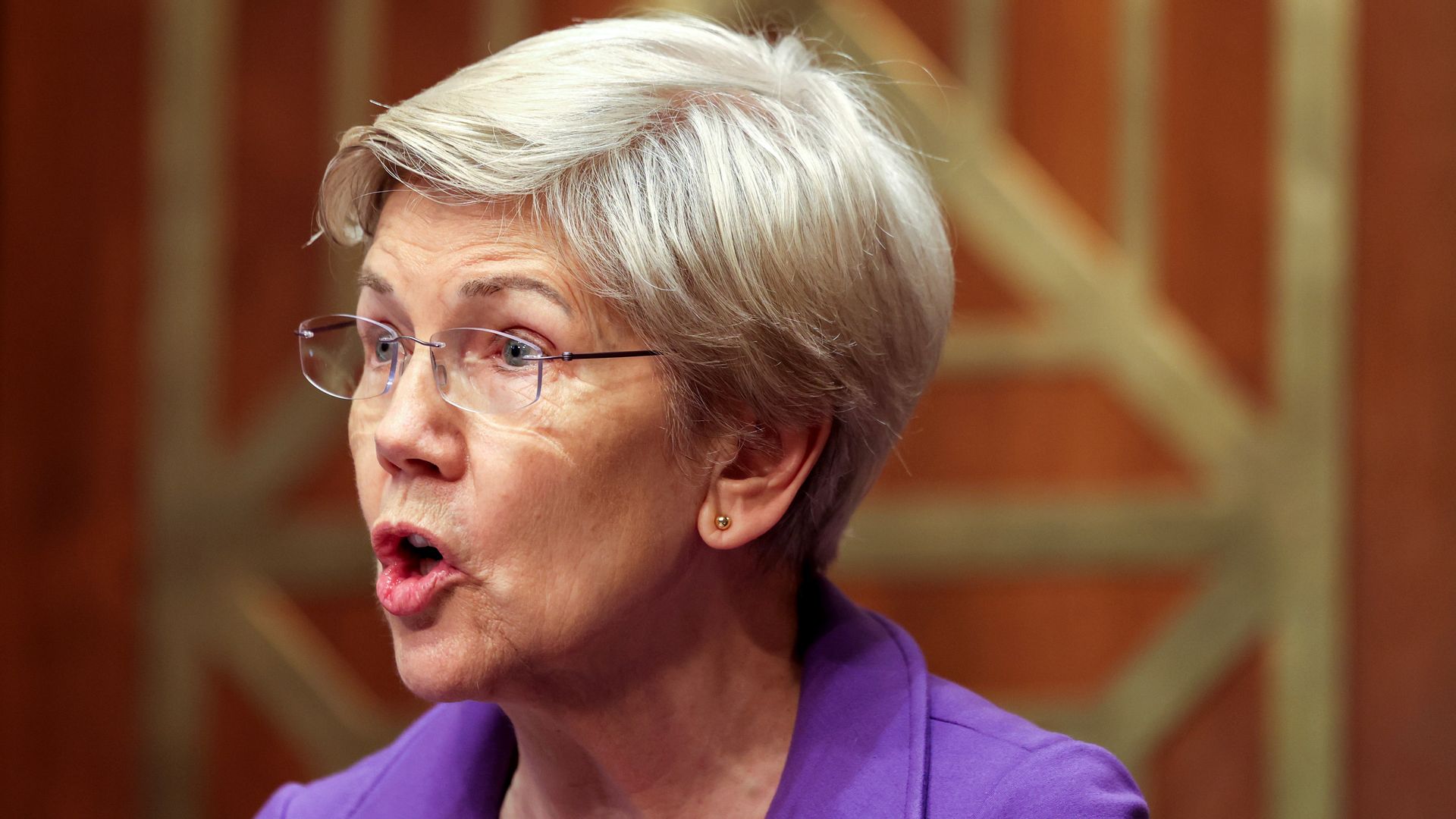
Senate Democrats will launch a war room Tuesday dedicated to fighting back against the Department of Government Efficiency's cuts to Social Security, Axios has learned.
Why it matters: The White House is planning service cuts to Social Security that current and former officials warn would break an already strained system.
Newsmax, a conservative media company that lost $55 million in the first half of 2024 on revenue of $80 million, was valued at $7.4 billion at the close of trade today, its first day as a public company.
Why it matters: That's 92% of the value of the New York Times, which made $106 million in net profit over the same period, on revenue of $1.2 billion.
The rideshare app today announced a deal to integrate OpenTable into its app.
State of play: "As a first step, our partnership with OpenTable will make it easier than ever to find and book a great restaurant and get there without a hitch," Uber CEO Dara Khosrowshahi said in a statement.
The companies did not reveal details of their arrangement, but they said it "brings additional opportunities to drive revenue" and would bring more benefits to Uber One subscribers.
Zoom in: "Uber could also gain additional access to more restaurants as it works to grow market share in food delivery, where it lags behind DoorDash," Restaurant Dive reports.
Fashion technology company CaaStle is almost broke and is accusing its founder and former CEO Christine Hunsicker of financial misconduct, Axios has learned from multiple sources.
Why it matters: CaaStle had raised over $530 million in venture capital, and its investors appear to be wiped out, in what would be one of the biggest startup frauds ever.
Canadians' desire to visit the U.S. is absolutely tanking, new data suggests.
Why it matters: President Trump's tariffs and insistence that Canada should become the 51st American state is fueling a remarkable rally-round-the-flag effect. Canadian patriotism is skyrocketing alongside disdain for all things American throughout the Great White North.
There is no port in the storm. That is the reality multinational American businesses face as they await President Trump's "Liberation Day" of sweeping new tariffs to be announced Wednesday.
Why it matters: The administration's presumed tariffs approach this week — with high import duties on pretty much all goods from pretty much all trade partners — leaves Corporate America with few good options to shift around supply chains.
Some of you really didn't like a line from Neil's weekend piece on the emergence of stagflation risk: the assertion that President Trump "inherited a shakier economy than it seemed."
We stand by the assertion.
What they're saying: "Shame on you," wrote an Axios reader named Bev in an email, one of many we received along these lines.
"Trump did not inherit a shaky economy. Trump inherited the most robust economy in the world ... and one that was getting better with every passing day."
Zoom out: It is true that the biggest-picture indicators at the tail end of the Biden administration look solid — 2.4% GDP growth in Q4, for example, and a 4.1% December unemployment rate.
Now forecasters are slashing their Q1 GDP estimates — due in part to soft consumer spending in January, just as Trump took office and before his policies had much effect. (Unusually cold January weather was a factor.)
Inflation came in warm in the first two months of 2025, even before most Trump tariffs had taken effect, a warning that inflation was not fully vanquished. The core Personal Consumption Expenditures Price Index rose at a 4.1% annual rate in January and February, the highest in a year.
Zoom in: There were also warning signs in more detailed data that conditions were not as robust at the end of former President Biden's term as the headline numbers imply.
Manufacturing was in an ongoing slump, with output contracting on a year-on-year basis every month from July to December. The Institute for Supply Management survey of manufacturers came in at 49.3 in December, just below the level of 50 that is the line between expansion and contraction.
The job market was stuck in place, with companies not firing many workers but also not doing much hiring. The rate at which employers hired in December was 3.4%; it was higher than that in every single month from March 2014 to February 2020.
Strong overall job growth in 2024 masked that it was disproportionately coming from sectors less tied to the overall business cycle, particularly state and local government and health care.
The professional and business services sector experienced year-over-year job losses every month since September 2023, and manufacturing since October 2023.
The bottom line: The economy Biden handed over to Trump was solid by some of the most important measures, but had meaningful pockets of weakness that are becoming more apparent as economic warning signs mount.
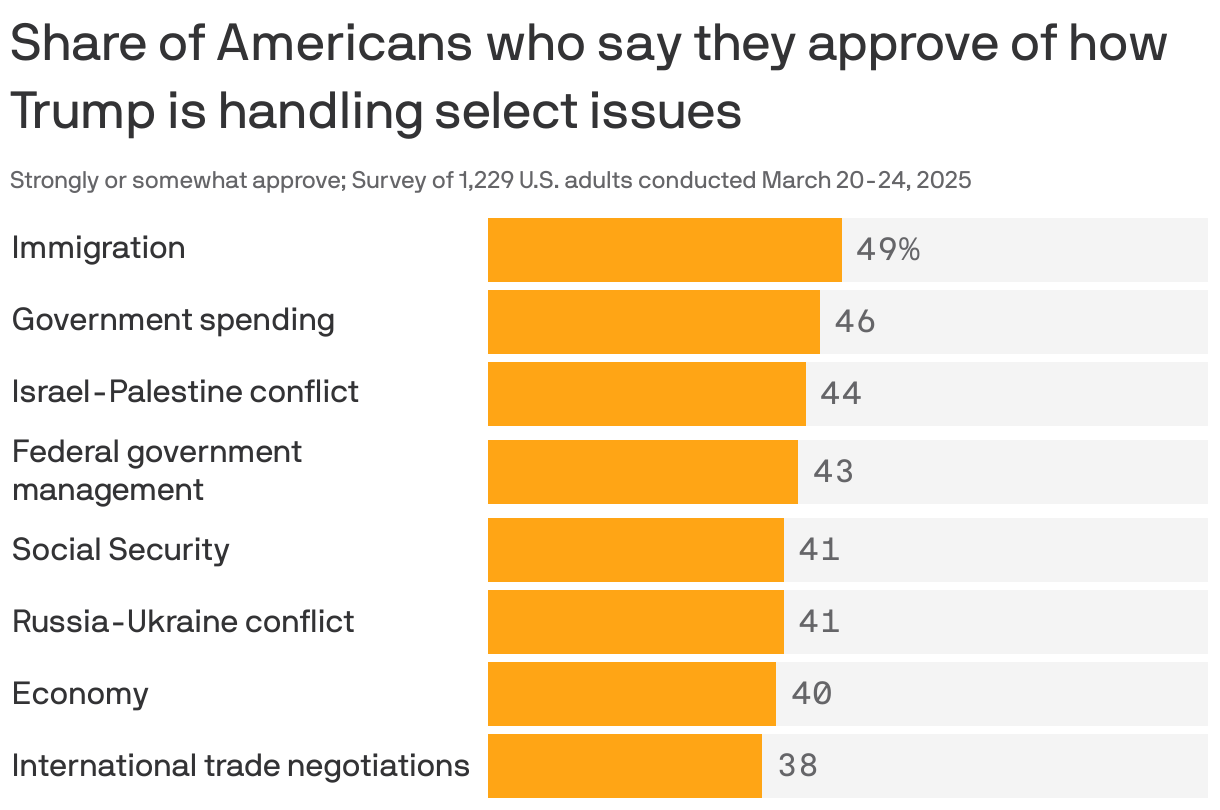
Nearly half of American adults approve of President Trump's harsh immigration crackdown, but his economic policies are unpopular, according to a Monday poll from Associated Press-NORC Center for Public Affairs Research.
Why it matters: Trump's multipronged efforts to curb immigration are the most popular aspect of his second term, but most respondents oppose his tariffs and economic policies.
President Trump on Friday granted clemency to startup founders convicted of investor fraud and three crypto exchange co-founders who had plead guilty to violating anti-money laundering laws.
Why it matters: There's never been a better time to be a white-collar crook.
Growth is slowing, inflation is creeping up, fears of a crippling 1970s-style stagflation are rising — and against that tough national backdrop, local communities are starting to feel the economic fallout from President Trump's trade policy.
Why it matters: It might be too granular to sway large national data sets, but border cities across North America are already feeling the trade war pain that could strain their budgets and threaten the broader U.S. economy.
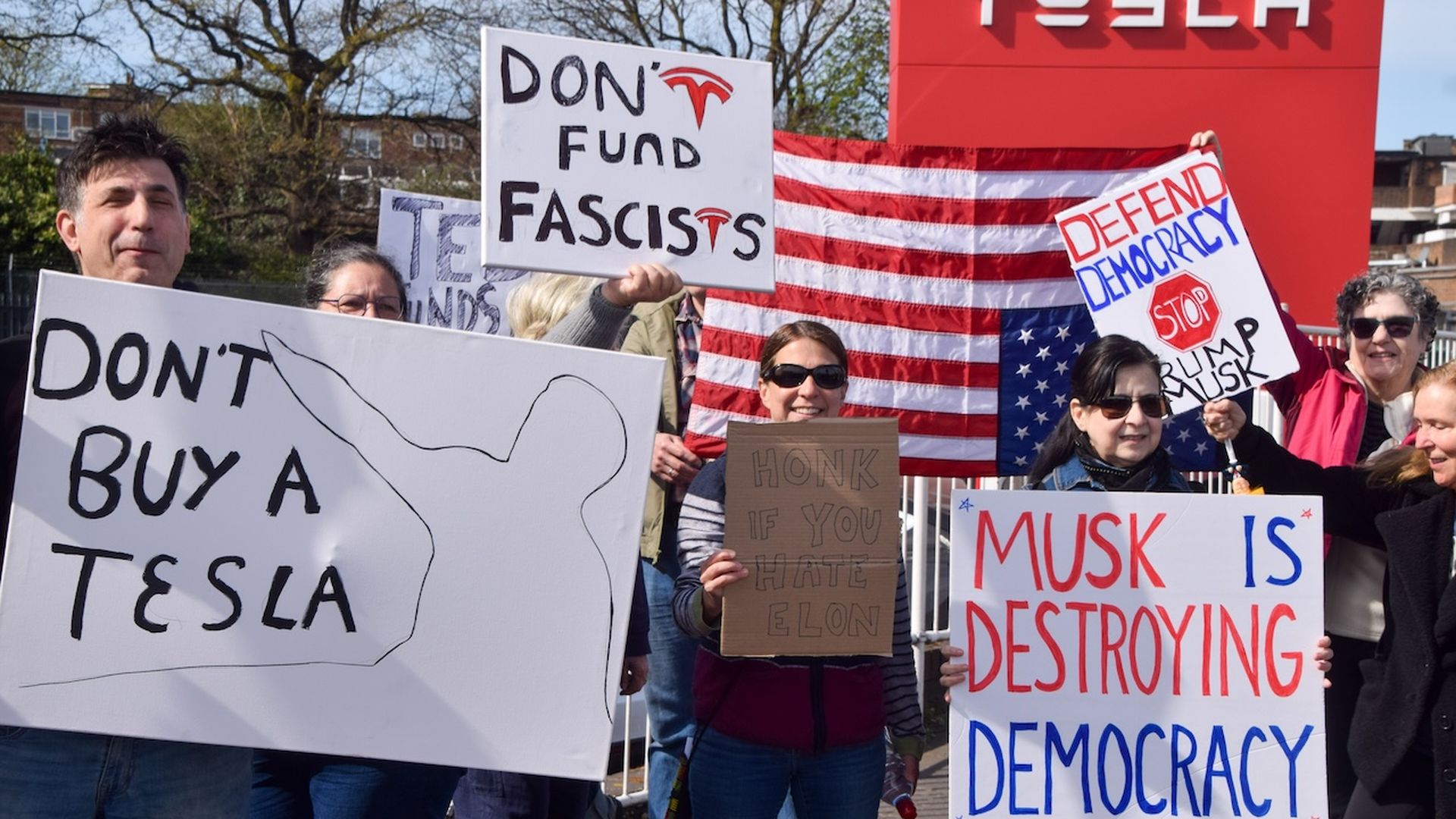
Tesla's Q1 delivery total is landing this week and will bring fresh signs that CEO Elon Musk's politics and job in Trump 2.0 are turning off more buyers than they attract.
Why it matters: Even Tesla optimists say the pioneering EV brand has an image problem.
At the heart of President Trump's latest round of tariffs is expected to be a double-digit tax on European imports, ostensibly justified by the existence of Europe's value-added tax (VAT), the continent's version of a sales tax.
Why it matters: By claiming a VAT is a kind of tariff — or even, in Trump's words, "far more punitive than a Tariff" — the U.S. is taking a maximalist and highly aggressive stance, one that's very hard to negotiate with.
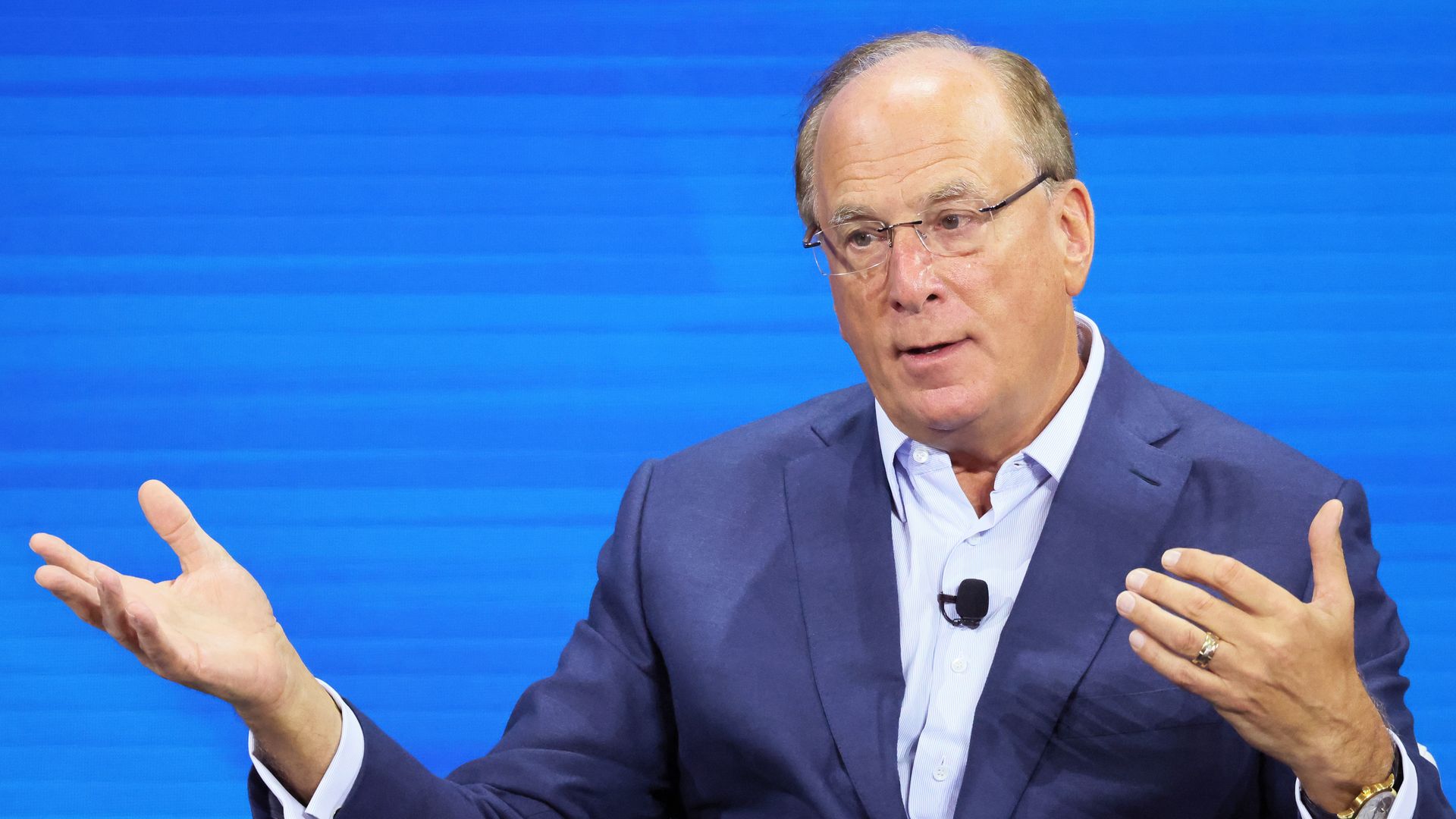
BlackRock CEO Larry Fink reassures investors that this moment of economic anxiety will pass in his annual letter out Monday morning.
Why it matters: Fink runs the world's biggest asset manager and is hugely influential — his widely read letter typically reflects the business trends of the current moment.
For the next three days, one man holds the global economy in the palm of his hands, literally and figuratively — and almost no one but him knows what will happen.
Why it matters: Every Wall Street trader and economist has "April 2" circled on their calendars. The consensus is that tariffs are coming, but the fear is in the unknown: how aggressive the measures will be.
President Trump said Sunday his reciprocal tariffs that launch this week will affect "all countries."
Why it matters: Trump is expected to announce wide-ranging levies on Wednesday, which he is calling "Liberation Day," but the administration has yet to reveal many key details of this plan or when levies will be implemented.