Tariffs show Trump is willing to cause higher prices, stock market slump


Add Axios as your preferred source to
see more of our stories on Google.
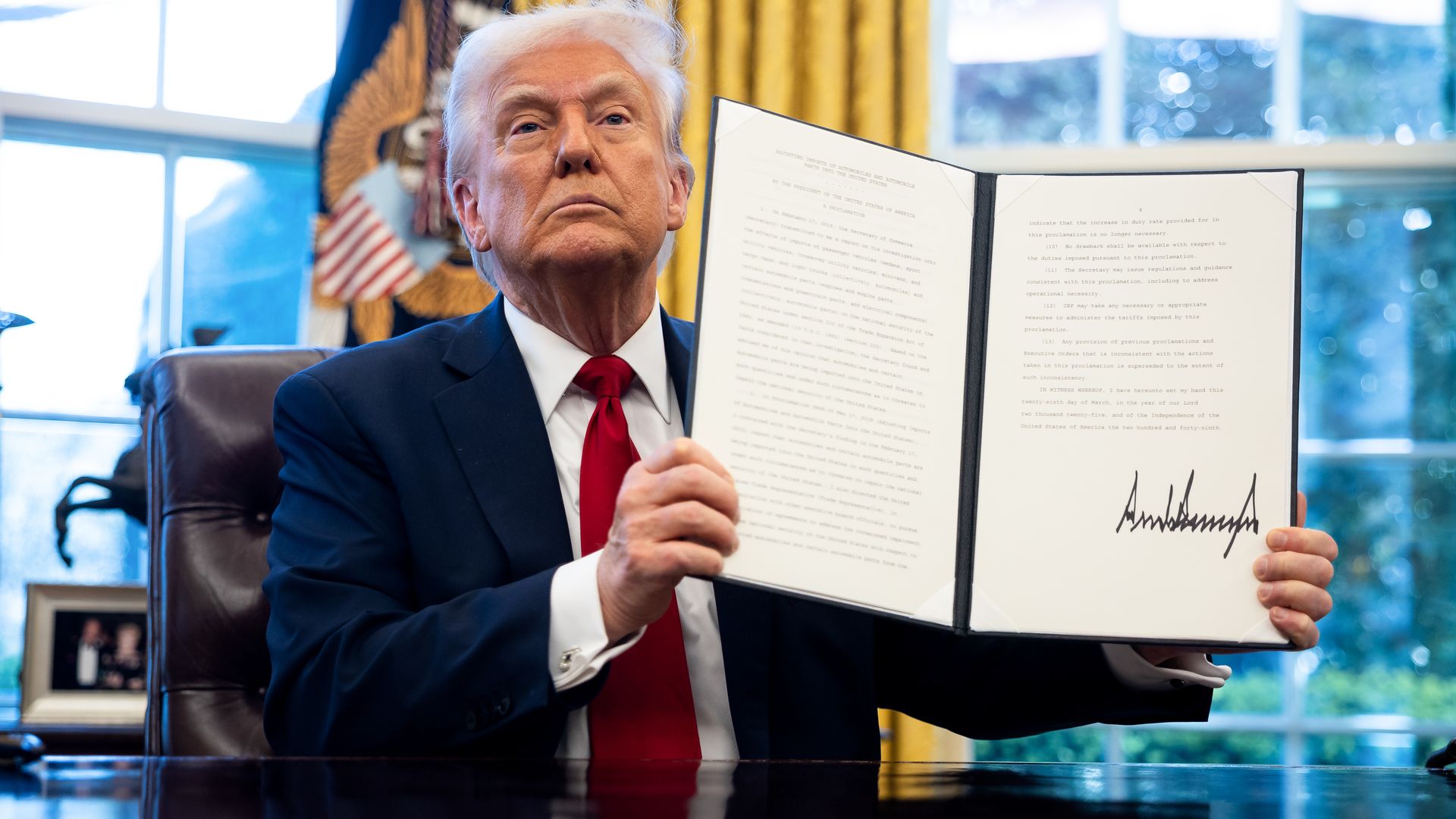
President Trump in the Oval Office after signing an executive order on auto tariffs. Photo: Francis Chung/Politico/Bloomberg via Getty Images
This week puts to rest any notion that President Trump will deploy tariffs using his limited first-term playbook. Assume there will be import taxes on all kinds of stuff, all the time, for all sorts of stated reasons, for years to come.
Why it matters: Trump's willingness to touch the hot stove of tariffs — even at the cost of higher consumer prices, a stock market slump, and disruption to America's deepest international relationships — is far higher than any president's in living memory.
- It implies more risk ahead for inflation, asset prices, and the ability of businesses to make long-term investments.
Driving the news: Wednesday's surprise announcement of a 25% tariff on imported automobiles and auto parts was just the latest in a dizzying string of escalations over the last few days.
- It follows Trump introducing the concept of "secondary tariffs" earlier in the week, threatening additional taxes on imports from China and other nations in order to coerce them into no longer importing Venezuelan oil.
- He also said he'll slap additional tariffs on Canadian and European imports if they jointly retaliate.
- He is considering new taxes on imported copper, a major raw material used in construction, transportation, electronics and machine parts.
- That's all in advance of the April 2 "Liberation Day," as Trump calls it, when he intends to announce big, new, across-the-board tariffs on imports from Europe and beyond. The exact contours of what will be announced remain murky.
What they're saying: "I think yesterday is a bigger deal than the market is making it out to be," Ajay Rajadhyaksha, global chairman of research at Barclays, told reporters on Thursday morning.
- "I think it reduces the risk that April 2 is something that markets can dismiss," he added. "I think we will be negatively surprised."
State of play: The combination of aggressive moves means that the second Trump administration is "more bearish than the sum of its parts," as Evercore ISI's Sarah Bianchi put it in a note.
- The constraints that have traditionally held back presidents in their use of unilateral authority over trade policy no longer apply.
Flashback: When the George W. Bush administration implemented steel tariffs in 2002, they were applied to a limited set of products to try to avoid the higher consumer prices or disruptions for U.S. manufacturers reliant on forms of imported steel not made domestically.
- Former President Biden's expanded China tariffs last year were limited to strategic goods like solar panels, not the broad range of imported consumer goods that fill American store shelves.
- In Trump's first term, his tariffs were applied to narrower lists of products, and after lengthy periods of study for which items should be excluded.
- He taxed imported steel and aluminum, for example, but those raw materials are a small portion of the overall cost of a car, and so the impact barely showed up in overall inflation.
The bottom line: "Trump is signaling significant pain tolerance, and we believe him," wrote Tobin Marcus, head of U.S. policy and politics at Wolfe Research, in a note.
