Inside Trump's Supreme plot on immigration

Add Axios as your preferred source to
see more of our stories on Google.
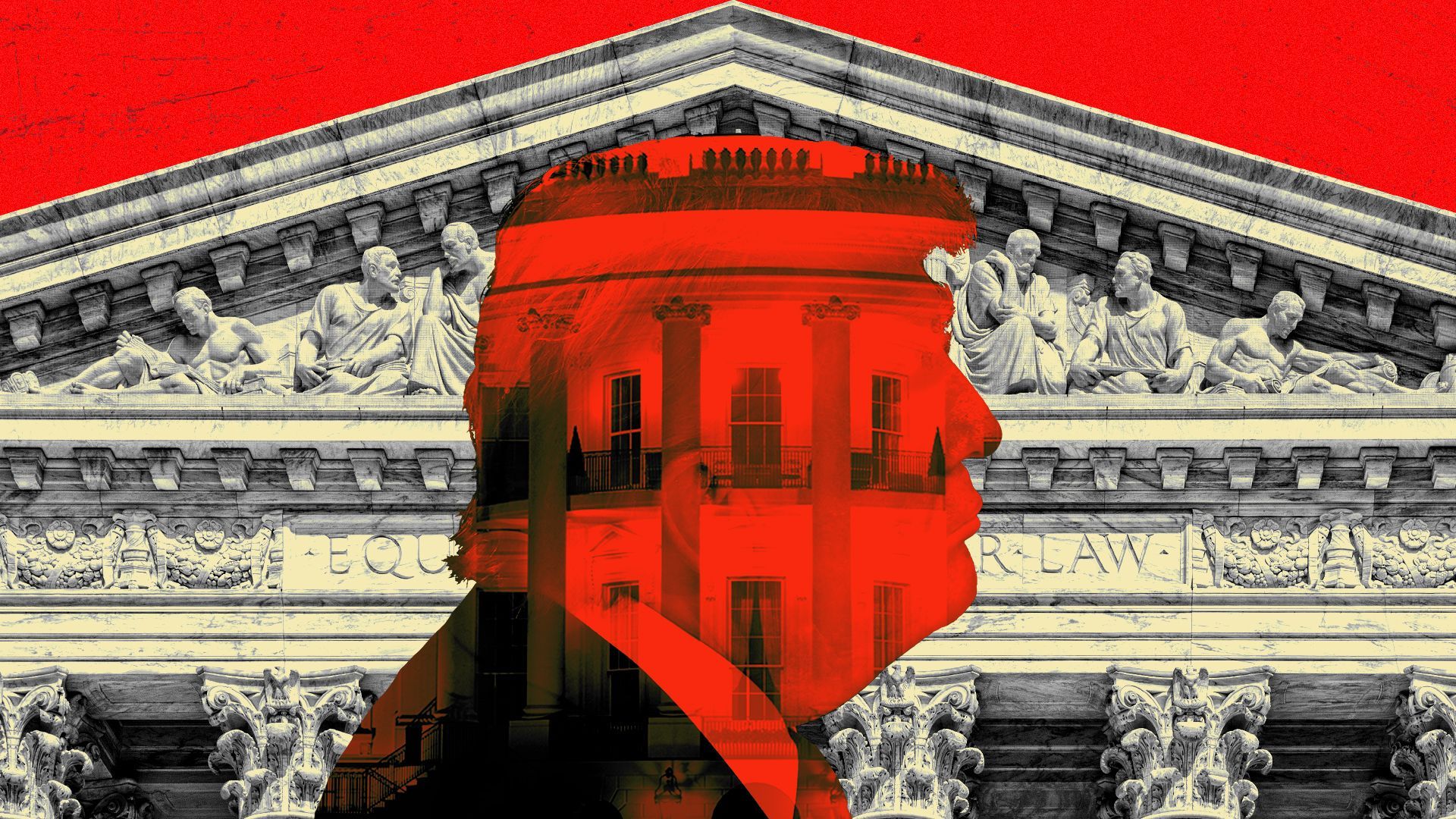
Photo illustration: Sarah Grillo/Axios. Photo: Joe Raedle/Getty Images
President Trump has accelerated a multipronged, methodically planned strategy to push the Supreme Court to bless his power to deport vastly more people with vastly fewer judicial restraints, top officials tell Axios.
- Trump officials see at least five questions, detailed below, that they hope the Supreme Court will answer.
Why it matters: Trump's plan revolves around two cases and obscure laws that have ignited lawsuits and sent shockwaves through the immigration system over successive weekends:
- Invoking the Alien Enemies Act of 1798 to deport accused Venezuelan gang members without immigration hearings. Nearly 140 were flown out of the U.S. on Saturday in a controversial operation that left a federal district judge fuming that his order to turn the plane around had been ignored.
- Using the Immigration and Nationality Act of 1952 to detain pro-Palestinian activist Mahmoud Khalil, who helped lead protests at Columbia University. The administration says the courts have little say over Secretary of State Marco Rubio's determination that Khalil should be deported as a national security risk for protesting against U.S. foreign policy.
Zoom in: Between the two cases, Trump administration officials and their allies see five major questions they'd like to put before the Supreme Court.
- Does a peacetime president have the right to deport noncitizens under the war-time Alien Enemies Act — even if there's no declared war against a foreign adversary?
- Should a single federal judge in a district court have the power to block a president's deportation program nationwide?
- Can that federal judge's order extend to international waters and demand that a plane full of deportees turn around mid-flight?
- Does a green card holder like Khalil have speech rights that protect him from deportation? Or can the secretary of state unilaterally declare his speech "adverse" to U.S. foreign policy interests because the government alleges it aligns with the terror group Hamas?
- Can the secretary of state's power to deport immigrants based on foreign-policy concerns extend to so many student visa holders that some colleges won't be able to admit foreign-exchange students?
Zoom out: "When you broaden that concept," a senior Justice Department official told Axios, "every single noncitizen who actively supports Hamas is subject to a determination by Secretary Rubio that they lose their status — and become exactly like Khalil and are immediately deportable."
- "Our end game is all hands on deck, trying everything," the official said. "Everything we're doing, we're gaming out how the Supreme Court gets to decide."
The DOJ official summarized the Trump administration's legal attack plan this way:
- "We really do want to push the court — ultimately the Supreme Court — to take a stand. ... We're trying to get clarity. And we're not putting all eggs in one basket. It's why we're seeing all efforts to remove people."
- And, the official said, "We have other plans."
One of those other plans could be a doozy: stripping U.S. citizenship from naturalized Americans.
- "What's going to be on the horizon are denaturalization cases," said Mike Davis, a close White House ally and founder of the conservative Article III Project.
- "You're going to have Hamas supporters who have been naturalized within the last 10 years, and they are eligible to lose their status as citizens and get deported," Davis said. "It's worth it."
The other side: Civil libertarians are horrified by what they see as a large-scale assault on free speech and due process by an administration that's bent on granting authoritarian-like powers to Trump.
- "The government's action constitutes a profound threat to free speech on university campuses and beyond," law professors Ahilan Arulanantham and Adam Cox wrote last week in Just Security, a law and policy journal.
- They wrote that freedom of speech on campuses was "already on life support after aggressive measures universities had taken to discipline and discourage pro-Palestine protest activity since shortly after October 7, 2023."
- Khalil has said he's a "political prisoner," and that he was protesting in support of a free Palestine and against the war in Gaza.
Behind the scenes: Trump's effort is spearheaded by deputy chief of staff Stephen Miller, the president's top domestic policy adviser.
- Unlike Trump's first administration, there's close coordination on immigration policy among the White House and the departments of Homeland Security, Justice and State.
Between the lines: Trump's administration is counting on a Supreme Court on which six of the nine members were appointed by Republicans — three by Trump.
- This high court typically has tried to avoid immigration disputes, but Trump's team aims to force its hand.
- "We have the law, and we have the numbers on the court," a Trump adviser said. "We've always known this is where all this ends up."
- Andrew R. Arthur, an attorney with the Center for Immigration Studies, a group that wants to restrict immigration, said: "This is a Supreme Court that over four years of Biden indicated it wanted to get out of political questions with immigration issues, and leave them with the political branches."
Chief Justice John Roberts inserted himself into the political line of fire Tuesday, rebuking Trump and others after they called for the impeachment of District Judge James Boasberg for his rulings aimed at delaying the deportation of the Venezuelans.
- The episode gave some headline-hungry House Republicans another chance to show their fealty to Trump: They promptly proposed a bill to impeach Boasberg. The measure is doomed to fail in the divided House.
