Two Americans in a U.S. Open semifinalmakes for a hot ticket.
The big picture: A lot has already been made this year about the big crowds at this year's annual Grand Slam event in New York.
And tonight there's an added attraction — Frances Tiafoe and Taylor Fritz will face off to become the first American man in the tournament's title match in 18 years.
Follow the money: As of late this morning, there were 442 tickets available on StubHub for the 7pm ET match.
The cheapest one offered was for $224, but only 39 of the more than 400 available were to be had for under $300.
180 tickets were listed at over $1,000. (Someone was offering a ticket in section 54 for $16,195.)
The great American job creation machine began creaking more slowly this summer, and a response from the Federal Reserve is near — though the scale of that response remains in question.
Why it matters: That's the takeaway from a much-anticipated August jobs report out on Friday, which showed job creation slowing down even as the unemployment rate remained relatively low.
Salesforce has agreed to buy Own Co., a New Jersey-based provider of data protection and management solutions, for $1.9 billion in cash.
Why it matters: This is Salesforce's largest acquisition since buying Slack in 2021, and may signal the company's return to large dealmaking after disbanding its M&A committee last year.
The U.S. economy added 142,000 jobs in August, while the unemployment rate edged slightly lower to 4.2% from 4.3%, the Labor Department said on Friday.
Why it matters: A slowing labor market is a pivotal factor that will help the Federal Reserve determine the size of a highly anticipated interest rate cut later this month.
It's not just the U.S. — real estate is becoming increasingly unaffordable across most wealthy countries, as the Financial Times recently reported.
Why it matters: High and rising housing costs mean people have less money to spend on other things, and make it harder for folks to move. At the extreme end, a lack of affordable homes pushes more people into homelessness.
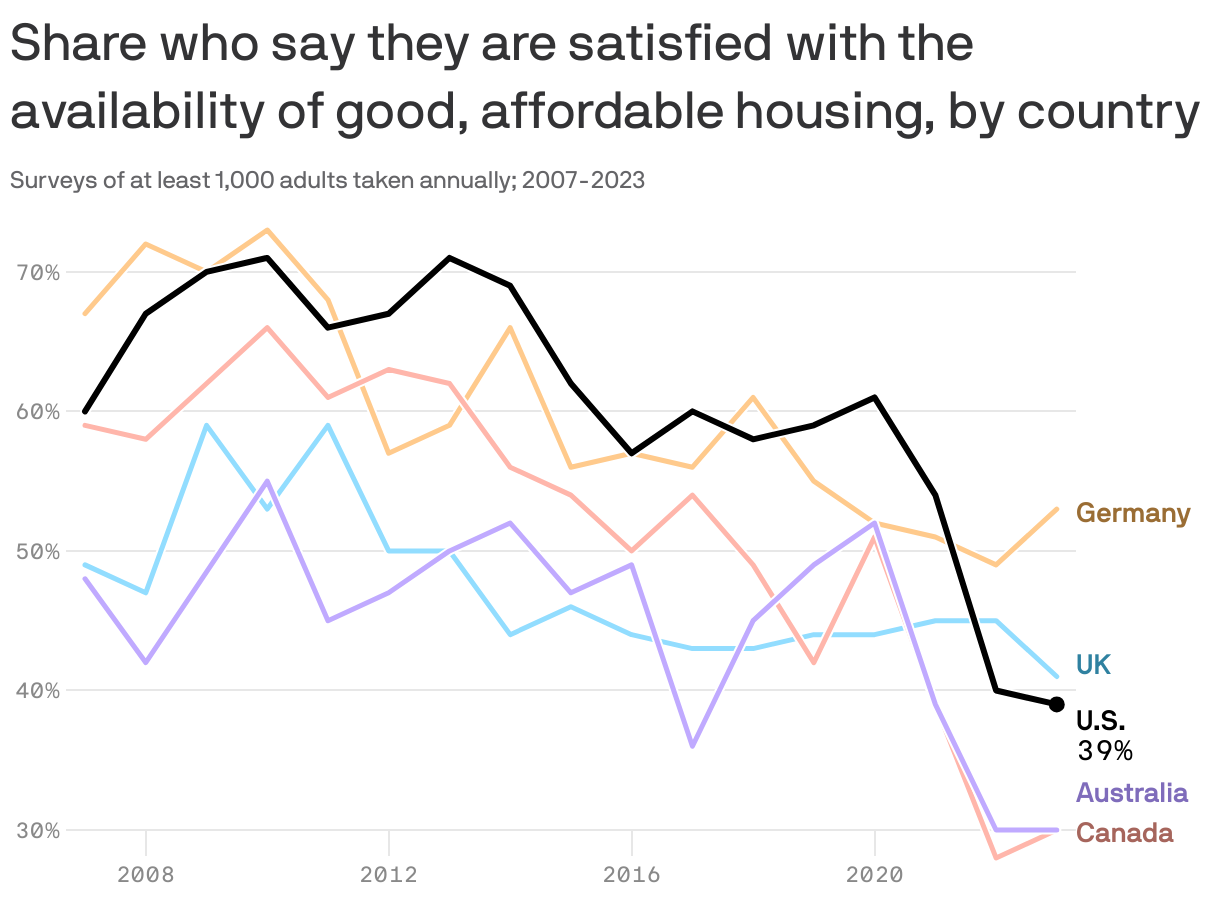
State of play: The share of people in OECD countries who say they're satisfied with the availability of good, affordable housing fell to 45% in 2023 from 51% in 2019, according to the Gallup World Poll, an annual survey.
In these countries people are less satisfied with housing than they are with things like health care or education.
Zoom in: The numbers were particularly bleak in the U.S., where high mortgage rates have put buying a home out of reach for many. Just 39% of respondents said they were satisfied with housing affordability, compared to 59% in 2019.
It's worse in Canada, where just 30% of respondents are satisfied with home affordability.
The big picture: This is a story about higher mortgage rates putting homes out of reach — they pretty much rose across all these countries — and about lack of home construction.
Home building in the U.S. never really bounced back from the financial crisis housing bust, as Conor Dougherty recently wrote in the New York Times.
It's not just a U.S. thing. "Basically we haven't built enough," Willem Adema, a senior economist in the social policy division of the OECD, tells the FT.
The U.S. is investigating whether major airlines have unfairly devalued customers' frequent flier points, part of a broader probe into potentially fraudulent, deceptive or anticompetitive practices.
Why it matters: Rewards points earned on trips or from using an airline's branded credit card are an important form of currency that travelers may redeem for flights, upgrades and other products and services.
Former President Trump said during an economic speech Thursday that if elected, his administration would create an Elon Musk-inspired government efficiency commission that would audit U.S. agencies.
Why it matters: Rarely does the public see how an idea from an influential business leader makes its way into a campaign platform.
Here's what's new on Peacock, Hulu, Netflix, Disney+, Apple TV+ and Max.
What we're watching: A star-studded series about a pivotal event in Atlanta's history, a reality show about Mormon mom influencers and a new drama-filled season of "Selling Sunset."
A new Trump administration would bring a round of trade wars that reduce GDP growth and raise prices, while a Harris victory would bring a more steady-as-she-goes economic policy, two Wall Street forecasting teams say in new reports.
What they're saying: "The November elections bring the possibility of changes to trade, immigration, and fiscal policy in 2025 that could have implications for inflation, labor force growth, GDP growth, and the fiscal deficit," a team of economists at Goldman Sachs, led by Jan Hatzius, write in a new report.
Of course, the economy is buffeted by countless forces beyond the president's policies, so these types of projections are far from ironclad.
Johnson & Johnson broke its promises to investors in Auris Health, a surgical robotics startup it bought five years ago for $3.4 billion. Now it must shell out another $1 billion, based on a ruling yesterday from Delaware Chancery Court.
Why it matters: This appears to be the largest legal reward ever granted in an investor earnout dispute, and could change the way that such provisions are written.
Turo, a company that does for cars what Airbnb does for homes, needs to be able to tell a growth story if it's going to get its long-delayed IPO off the ground. To that end, it's partnering with Uber, Axios is first to report.
Why it matters: Turo's pandemic-fueled growth of 2020 to 2021 has slowed, which is one reason it still hasn't gone public.
Verizon has agreed to buy Frontier Communications for $20 billion, the company announced on Thursday.
Why it matters: This is the latest in a series of massive telecom mergers, and strengthens Verizon's fiber businesses to help it better compete with rivals like AT&T.
What if the best companies, judged on a moral level, were also, broadly speaking, the best companies judged by the stock market? The chart above suggests that might actually be the case.
Why it matters: The data suggests that ethical investing can deliver impressive risk-adjusted returns — especially if it takes the form of a long/short strategy that shorts the lowest-ranked companies.
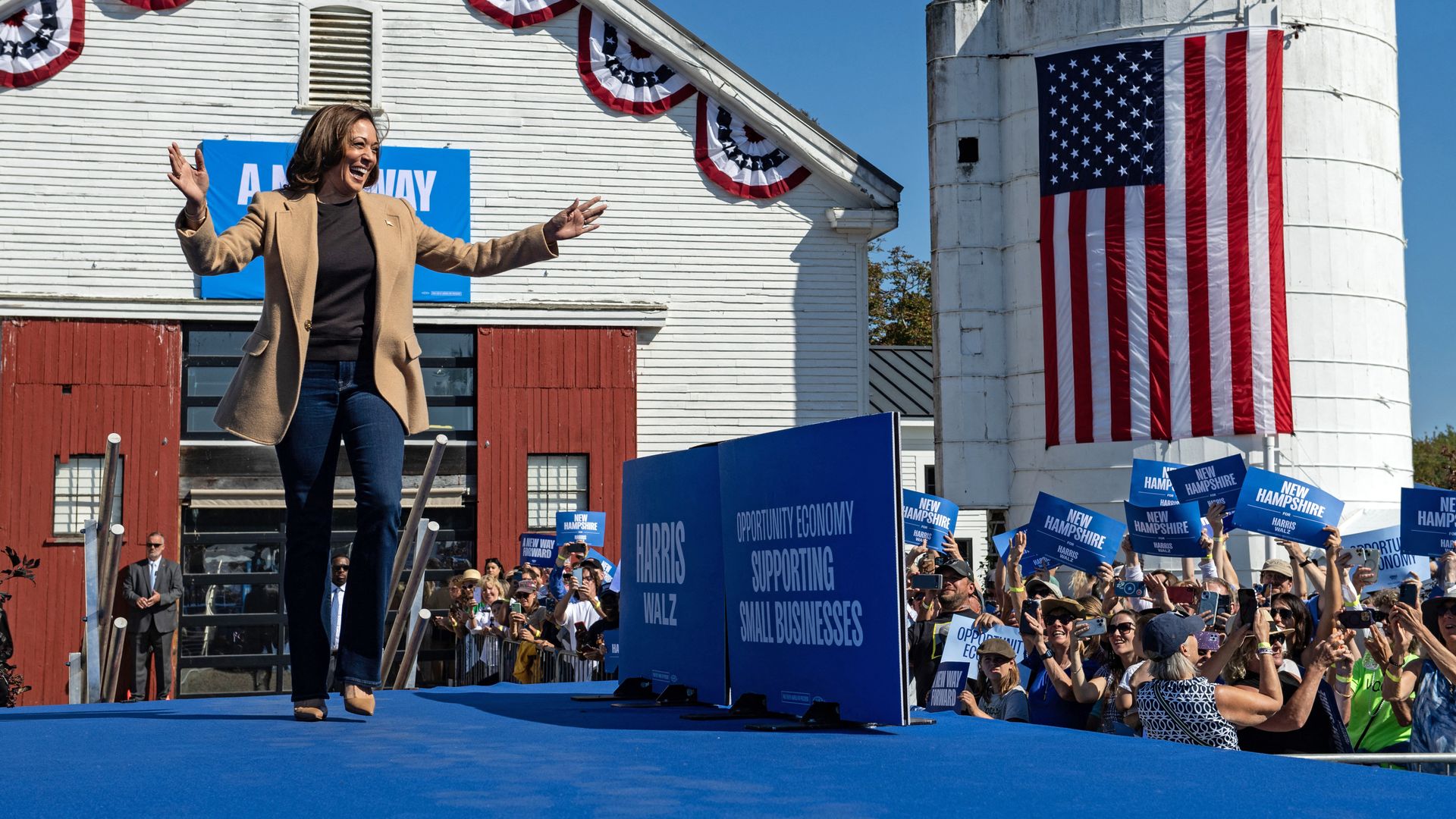
Vice President Kamala Harris chose a rather obscure part of the federal tax code — the top rate for capital gains — to make her first big move toward the center of the 2024 political conversation.
Why it matters: Harris' call for Americans making $1 million a year to pay a 28% capital gains rate marked a symbolic departure from President Biden, who prefers a higher 39.6% tax.