Wall Street economists forecast Trumponomics vs. Kamalanomics

Add Axios as your preferred source to
see more of our stories on Google.
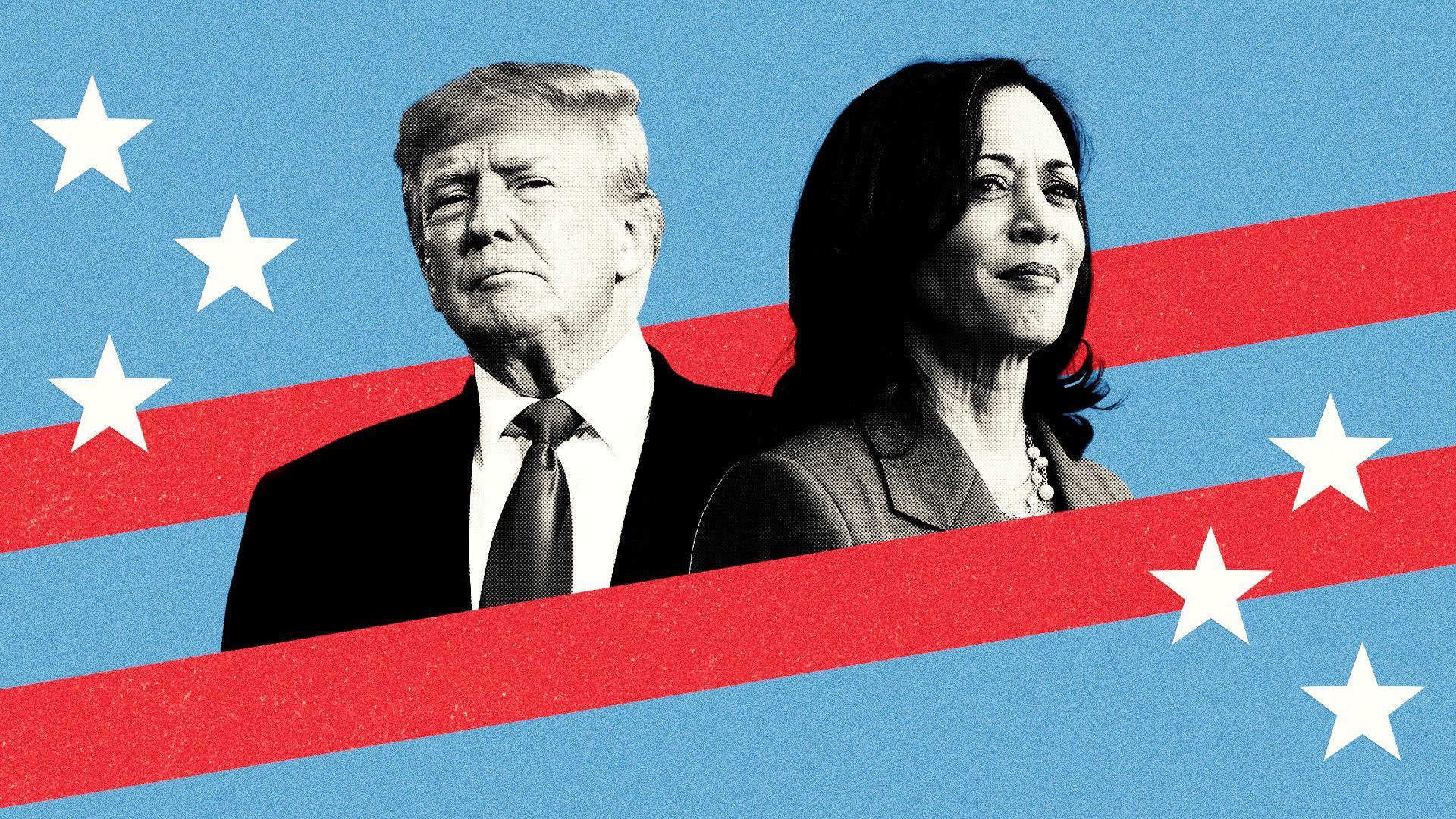
Photo illustration: Tiffany Herring/Axios; Photos: Brandon Bell/Getty Images; Anna Moneymaker/Getty Images
A new Trump administration would bring a round of trade wars that reduce GDP growth and raise prices, while a Harris victory would bring a more steady-as-she-goes economic policy, two Wall Street forecasting teams say in new reports.
What they're saying: "The November elections bring the possibility of changes to trade, immigration, and fiscal policy in 2025 that could have implications for inflation, labor force growth, GDP growth, and the fiscal deficit," a team of economists at Goldman Sachs, led by Jan Hatzius, write in a new report.
- Of course, the economy is buffeted by countless forces beyond the president's policies, so these types of projections are far from ironclad.
By the numbers: Goldman says a former President Trump win — with a divided government or Republican control of both houses of Congress — would result in a 0.5 percentage point drag on GDP in the second half of 2025 before fading in 2026.
- That assumes higher tariffs and tighter immigration policies proposed by Trump on the campaign trail, which would offset any positive impact from government stimulus like lower corporate taxes.
Of note: Such predictions did not age well during Trump's first term when the economy experienced steady growth, historically low unemployment and benign inflation, even amid trade wars.
- Trump advisers argue that his tax and deregulatory policies will unleash economic growth far beyond that seen in mainstream forecasts like those from Goldman.
- "The Goldman Sachs economic team is highly partisan," Kevin Hassett, a Trump economic adviser, told reporters Thursday morning.
- "I don't know why Goldman hasn't tried to hire a more balanced economic team," he added — saying that previous predictions for how the economy would perform under Trump were wrong.
If Vice President Kamala Harris wins and the Democrats control the House and Senate, Goldman predicts a "very slight boost" to GDP between 2025 and 2026.
- Policies like the expanded middle-income tax credit would offset lower investment from higher corporate tax rates.
- With a divided government, any policy changes would be small and have a neutral economic impact.
The big picture: Goldman says the measure of inflation closely watched by the Fed would increase by as much as 0.4 points if tariffs go up on Chinese imports and autos.
- If Trump enacts a universal tariff on imports, Goldman says, that impact would triple.
Economists at Nomura take a similar view in a report this week examining the impact of a potential "Trump 2.0" presidency on global economic growth.
- Whereas during Trump's first term, companies "absorbed inflationary shocks from tariffs," the proposed across-the-board tariffs would reduce the capacity for a similar scenario to play out, Nomura chief economist David Seif wrote.
The intrigue: Seif and his team estimated that higher tariffs would increase inflation by 0.75 percentage points in 2025.
- In 2019, a trade war caused the Fed to cut interest rates as it sought to keep the expansion going. But that was an era of persistently low inflation, unlike now.
- Nomura expects that this time around, higher tariffs might cause the Fed to cut rates just twice next year — half as many cuts as it expects without these policies.
