Fed's Powell at Jackson Hole: "The time has come" for rate cuts


Add Axios as your preferred source to
see more of our stories on Google.
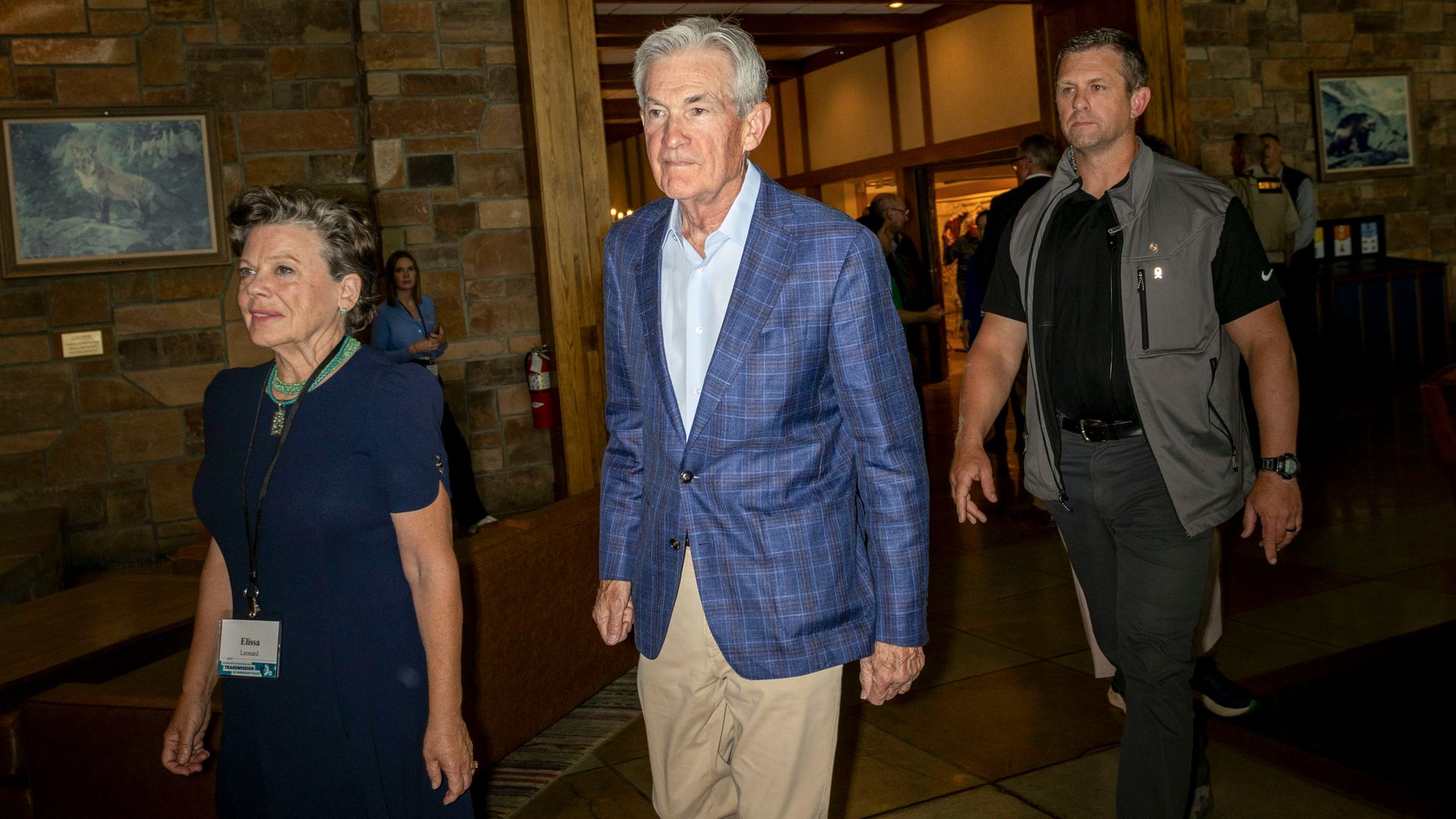
Federal Reserve chair Jerome Powell (center) in Jackson Hole, Wyoming. Photo: Natalie Behring/Bloomberg via Getty Images
Federal Reserve chair Jerome Powell said Friday that the central bank is poised to cut interest rates, adding that policymakers do not want to see the job market cool any further.
Why it matters: In a much-anticipated speech in Jackson Hole, Wyoming, Powell said the Fed's fight to reduce inflation has largely succeeded and it now is attuned to risks of a faltering job market — setting up a rate cut in mid-September.
What they're saying: "The time has come for policy to adjust," Powell said at the Kansas City Fed's annual economic symposium in the Grand Tetons.
- "The direction of travel is clear, and the timing and pace of rate cuts will depend on incoming data, the evolving outlook, and the balance of risks," Powell added.
- That implies that the Fed would respond to any further labor market weakening with super-sized, half-point rate cuts, not the quarter-point rate adjustments that are its more common practice.
- It sets up a rate cut at a meeting that concludes Sept. 18, right in the thick of a presidential election.
State of play: The unemployment has now risen to 4.3%, up nearly a percentage point from recent lows, raising alarm bells about a weakening economy.
- Inflation, meanwhile, has fallen to levels not far from the Fed's 2% target.
After holding rates at nearly 5.5% for more than a year, the Fed is now poised to adjust.
- "Overall, the economy continues to grow at a solid pace," Powell said. "But the inflation and labor market data show an evolving situation. The upside risks to inflation have diminished. And the downside risks to employment have increased."
- "We do not seek or welcome further cooling in labor market conditions," he said, in a notable contrast with his tone over much of the last two years, when he described a cooling in the job market as needed in order to bring the economy into better balance.
Between the lines: "We will do everything we can to support a strong labor market as we make further progress toward price stability," Powell said, suggesting the recent worsening of the job market — the unemployment rate has risen from 3.7% in January to 4.3% in July — has the Fed's attention.
- "The current level of our policy rate gives us ample room to respond to any risks we may face, including the risk of unwelcome further weakening in labor market conditions."
Flashback: Powell's speech also offers a review of why inflation soared so much in 2021 and 2022. At the beginning of the inflationary episode in early 2021, he'll note, the inflation was highly concentrated in a few areas facing short supplies.
- "My colleagues and I judged at the outset that these pandemic-related factors would not be persistent and, thus, that the sudden rise in inflation was likely to pass through fairly quickly without the need for a monetary policy response — in short, that the inflation would be transitory."
- "The good ship Transitory was a crowded one, with most mainstream analysts and advanced-economy central bankers on board," he said, ad-libbing to the crowd of economists that "I think I see some former shipmates out there today."
- But by the fall of 2021, he said, "It became clear that the high inflation was not transitory, and that it would require a strong policy response if inflation expectations were to remain well anchored."
Go deeper: The economy-wide bullwhip effect
