What you need to know about the Fed's big Jackson Hole gathering

Add Axios as your preferred source to
see more of our stories on Google.
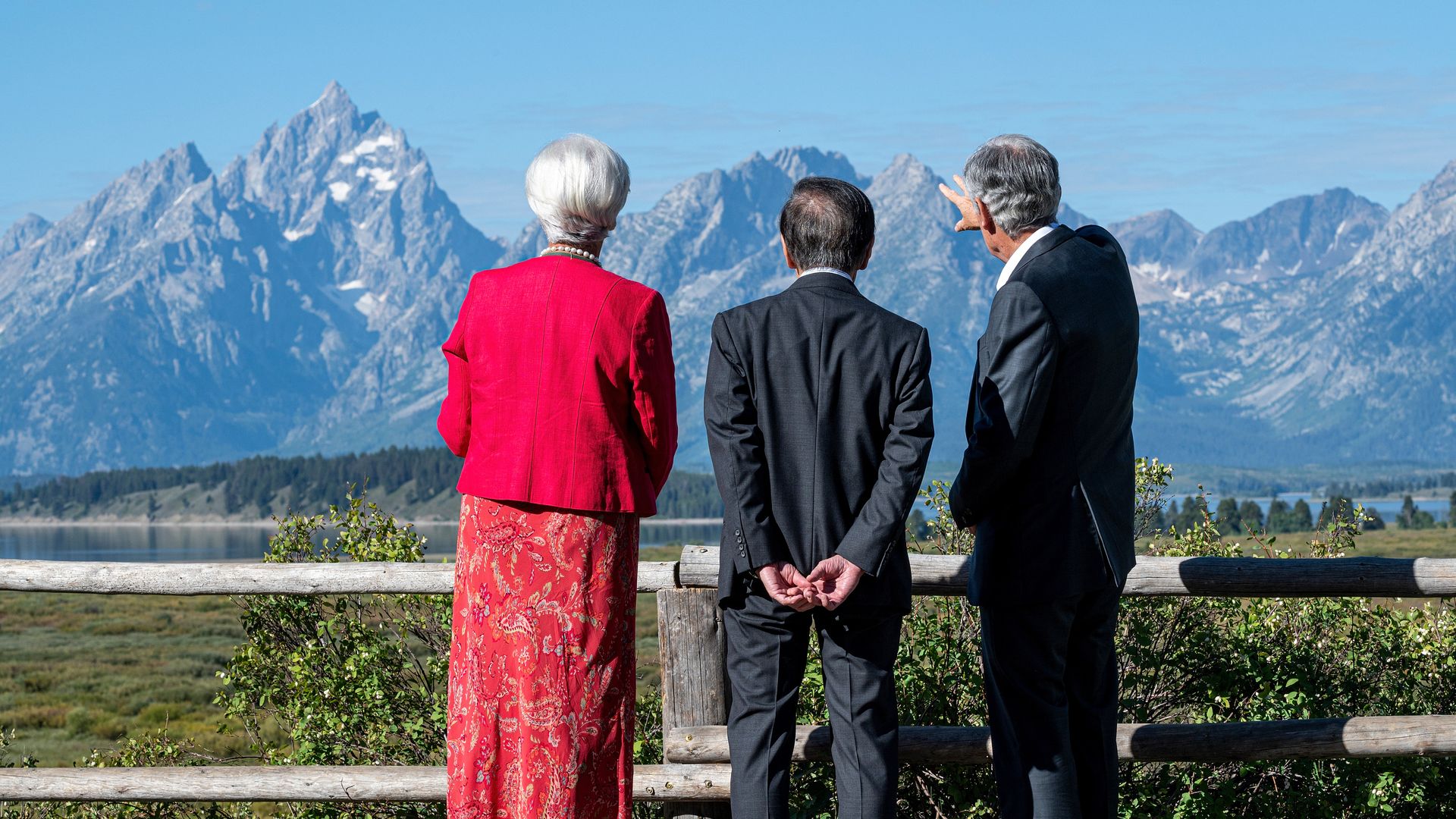
European Central Bank president Christine Lagarde, Bank of Japan governor Kazuo Ueda, and Federal Reserve chair Jerome Powell at the 2023 Jackson Hole symposium. Photo: David Paul Morris/Bloomberg via Getty Images
Financial markets headlines right now are dominated by talk of Jackson Hole.
Why it matters: Jackson Hole is shorthand for an annual gathering of central bankers in Wyoming that inevitably makes big-time economic news. To set the scene, here are the basics you need to know about the event and what makes it worthy of so much attention.
What is this thing? The Federal Reserve Bank of Kansas City has hosted its annual economic symposium in a lodge in Grand Teton National Park since 1982. It's a gathering of central bankers from around the world, academics, other influential economic thinkers, policymakers and journalists.
- The meat of the event consists of a series of papers on important economic ideas related to the year's topic. This year, it is "Reassessing the Effectiveness and Transmission of Monetary Policy."
- Fed chair Jerome Powell will speak first thing Friday morning (8am local time, 10am ET).
- Bank of England governor Andrew Bailey is also on tap, scheduled to speak later Friday.
What will Powell say? Traditionally, the Fed chair uses the Jackson Hole speech to deliver a particularly important and long-range message. In the past, Powell has seen this venue as a chance to lay out an intellectual framework for policy rather than tactical signaling of his next policy moves.
- For example, his 2018 "Guided by the Stars" speech was perhaps his most memorable as chair. It outlined how he thinks about important but unmeasurable variables like the natural rate of interest (R-star) and natural rate of unemployment (U-star).
- But right now, with the central bank poised to begin cutting rates next month, this year's speech will be scrutinized for more immediate policy implications. The pre-announced topic of Powell's speech is simply the "Economic Outlook," which doesn't exactly narrow things down.
- In particular, traders will be looking for hints of whether the Fed is likely ease policy gradually and cautiously, or is sufficiently worried about the state of the job market that rapid rate cuts are a real possibility.
Why Jackson Hole? In the early 1980s, the Kansas City Fed leaders learned that the best way to ensure Fed chairman Paul Volcker would accept an invitation was to locate the event somewhere with good fly fishing in late August. Jackson Hole it was.
- Four decades later, the symposium has become entrenched as the premier event on the Fed's annual calendar, in no small part through network effects. Influential policymakers and thinkers want to be there because they know other influential policymakers and thinkers will be there.
- It also helps that the setting is gorgeous, the weather is usually great, and the Kansas City Fed has done an excellent job over the years of curating the topics, papers and guest lists.
What's the scene like? The event does not take place in some luxury resort. It's at a lodge in a national park that remains open to the public, and features a big grizzly bear taxidermy in the lobby. The rooms are decidedly rustic.
- It's not uncommon to see powerful economic policymakers from Europe or Asia wandering the hotel lobby, amid American tourists who pulled up on motorcycles or in RVs.
- Some attendees fully embrace the Western vibe, wearing cowboy boots, hats, and the like. Others stick to more traditional business casual attire.
- Behind closed doors at the symposium itself, things are considerably more intimate than at many economic conferences. The guest list, constrained by the size of the ballroom where the gathering takes place, is a bit over 100.
- After a long day of economy talk and maybe an afternoon hike, attendees usually go to a Friday dinner with Western-themed entertainment, such as a live show by a horse whisperer.
Who's there? The list of attendees this year has not yet been released, but in the past, the lineup has included:
- Most Fed governors and reserve bank presidents, as well as the governor or a top deputy from dozens of other global central banks.
- Top economists from international organizations and the current U.S. administration.
- Leading academic and private sector economists.
What will make news? The biggest headlines are likely to come from Powell's speech, but the papers presented and the discussions they spur can create their own fireworks.
- The Kansas City Fed publishes the papers on its website.
- The presentations and discussions are not broadcast (except for Powell's speech this year), but the proceedings in the room are on-the-record, and economics journalists (including yours truly) are on hand to report what they hear.
What are some historical highlights? Here are a few:
- In 1990, central bankers from former Soviet bloc countries attended — a vivid signal of global economic unity amid the end of the Cold War.
- In 1994, Fed vice chair Alan Blinder gave a talk about the importance of the Fed keeping unemployment low, which gave some economic commentators apoplexy and created the appearance of a rift between him and chair Alan Greenspan. (If that sentence sounds bizarre to you, it should).
- The 2005 symposium became a celebration of Greenspan as he approached retirement, a high water mark for the Great Moderation, the era of solid growth and low inflation over which he presided.
- In 2007, chair Ben Bernanke started a pivot toward emergency footing in the early days of what would become the Global Financial Crisis.
- In 2010, Bernanke began the push toward a new round of quantitative easing, which became a Fed policy signature over the years that followed.
- In 2014, European Central Bank president Mario Draghi indicated that he was worried about inflation falling persistently too low, laying the groundwork for Europe's version of QE.
- In 2022, Powell delivered a succinct, blunt message that the Fed was willing to tolerate deterioration in the economy in order to defeat inflation that had reached multi-decade highs.
So why is this gathering special? There is something unique about the beauty of the setting and the repetition of seeing many of the same people, in the same place, year after year. The smallness of the conference contributes to its intimacy.
- Most importantly, there is a sense that it is where important moments in modern economic history have taken place. It's cool to be in the room when history happens.
Note: An earlier version of this article was published in 2022; this is an updated version of that piece.
