The paradox of interest rate policy

Add Axios as your preferred source to
see more of our stories on Google.
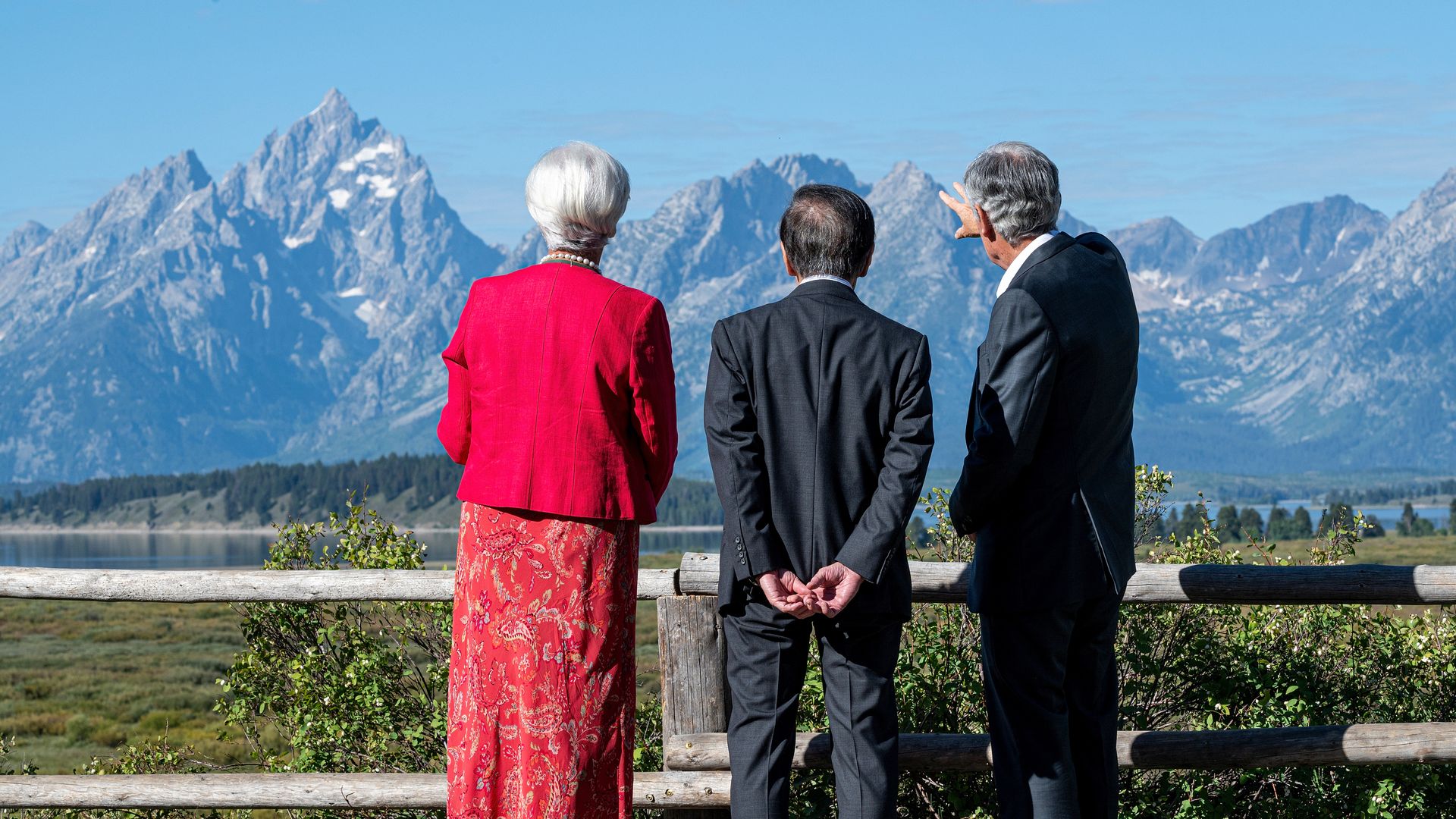
European Central Bank president Christine Lagarde, Bank of Japan governor Kazuo Ueda and Federal Reserve chair Jerome Powell at the Jackson Hole conference in Moran, Wyoming, last year. Photo: David Paul Morris/Bloomberg via Getty Images
As central bankers from around the world gather in the Grand Tetons, they plan to discuss a massively important yet surprisingly unsettled question: How do the policies they make really affect the economy?
The big picture: Central banks shoulder the main burden of stimulating the economy during a recession and fighting inflation when conditions become overheated. But the ways that their interest rate policies achieve those goals are less clear than you might think.
- There is a paradox. As governments have relied more heavily on interest rate policy to manage the economy's ups and downs, companies and individuals have insulated themselves from the impact of rate swings, potentially making those policies less effective.
Zoom out: In theory, raising interest rates the way the Fed did in 2022 and 2023 slows the economy by causing demand to fall in interest-sensitive sectors like housing and autos, companies to pull back due to higher cost of capital, and a retreat in asset prices that lowers wealth and therefore consumer demand.
- Rate cuts, by contrast, are meant to stimulate the economy through those mechanisms in reverse.
- In practice, those effects have not been nearly as clear-cut as the textbooks would suggest, both in the Fed's recent tightening campaign to stamp out inflation and its stimulus efforts in the 2010s.
State of play: In the U.S., most homeowners have a fixed-rate mortgage. That means that when the Fed raises rates, it doesn't affect day-to-day housing costs for the bulk of the population. (It's a different story in countries like Australia, where mortgages are mostly floating rates.)
- When rates were low in 2021, many companies similarly locked in long-term debt, helping mitigate the effect of the Fed's 2022-2023 rate-hiking campaign on corporate balance sheets.
- There's no doubt that rate-hiking caused a steep drop in asset prices in 2022 — but markets have proven strikingly resilient since then, with the S&P 500 now 18% above its high before rate hikes began.
Flashback: Not long ago, economists widely predicted that the Fed's aggressive rate-raising — more than 5 percentage points before it was done — would likely cause a recession.
- In his speech in Jackson Hole two years ago, Powell essentially announced that the Fed would tolerate serious economic pain as a necessary cost of bringing down inflation.
- The job market has cooled quite a bit from its high boil of two years ago, but the jobless rate is still only 4.3%, and GDP growth and other measures of output have remained robust throughout.
Between the lines: Separately, there's a case to be made that rates policy works as much through communications strategy as the mechanical effects of pricier money. Open-mouth policy may be more powerful than open-markets policy.
- Maybe, just maybe, the Fed's communication of its resolve in 2022 — including the aforementioned Powell speech — has made consumers more cautious in their spending and wage demands, and CEOs more restrained in capital spending and price-setting than would have been the case otherwise.
- But that's an awfully fuzzy, hard-to-prove notion — not the kind of rigorous, testable hypothesis favored by the Ph.D. types who populate central banks.
The bottom line: We're excited to see where consensus settles over the next couple of days as the officials who set these policies debate how they work.
