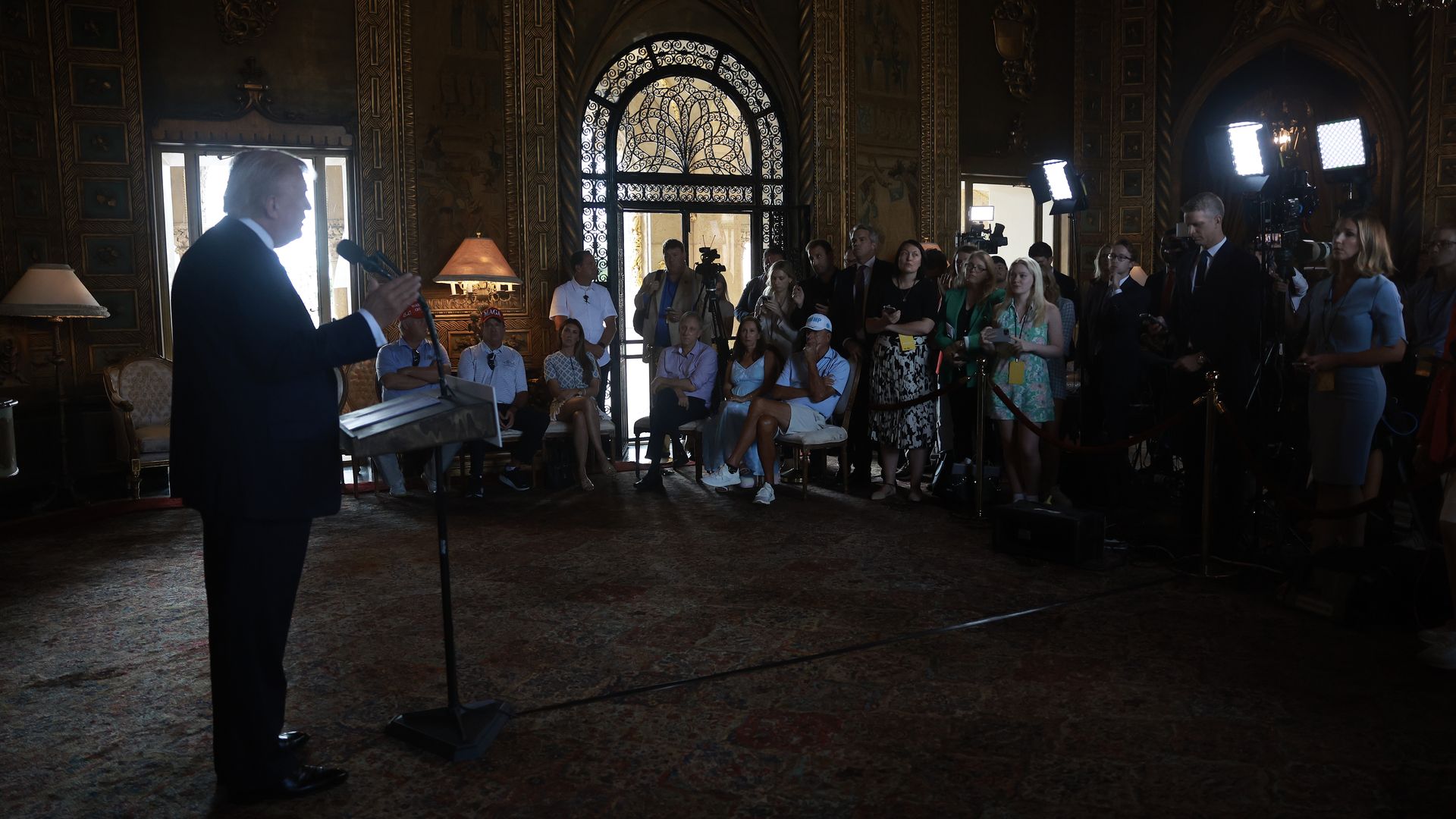
If he wins in November,former President Trump would likely attempt to take a more hands-on role steering the Federal Reserve's policy moves than has been seen in decades.
Why it matters: Trump could attempt to install Fed appointees who are personally loyal to him — and willing to take direction from the White House — in ways that would surely reverberate through the U.S. economy and markets.
However, there are some limits — both political and economic — on his ability to follow through on those instincts.
A little before Donald Trumpspoke at Bitcoin 2024 in Nashville last month, with thousands of people sitting in the room waiting to see the former president, longtime Bitcoin developer Matt Corallo took the stage and told everyone that Bitcoin mining isn't meaningfully decentralized.
Why it matters: Decentralization is key to Bitcoin's trustless nature, the idea that it's very hard to censor or control, which is key to its value to many people around the world.
Between the lines: Corallo was describing a known problem with the system and imploring the audience to start demanding that Bitcoin's miners — its security system — start tinkering with a solution.
Delta said July's global IT outage cost it $550 million in a regulatory filing on Thursday and also shot back at CrowdStrike's response to an initial letter threatening legal action against CrowdStrike and Microsoft.
Why it matters: The three-way blame game involving Delta, CrowdStrike and Microsoft continues to escalate as each company tries to clear the air about its role in one of the largest tech glitches in recent history.
Why it matters: The strongest argument for blockchain technology has always been truly neutral money. In other words: a way to transact value that no one can step in and prevent. ("Censorship resistance" in industry-speak.)
Here's what's new on Netflix, Peacock, Paramount+, Max, Apple TV+, Hulu, BET+ and Prime Video.
What we're watching: The final season of "The Umbrella Academy," a new sitcom starring Stephen Curry and a new competition show to award the best state fair pastry maker.
Why it matters: The strongest argument for blockchain technology has always been truly neutral money. In other words: a way to transact value that no one can step in and prevent. ("Censorship resistance" in industry-speak.)
Driving the news: A study published yesterday by staff at the Federal Reserve Bank of New York documented in detail a growing unwillingness by participants in Ethereum's settlement chain to process transactions made through the Tornado Cash privacy application.
Indeed, going more deeply, they observed that reluctance increased following a ruling by U.S. courts that upheld the sanctions.
Ripple, the company that created the cryptocurrency XRP (and still owns mountains of it), has received judgment in the case the SEC brought against it, and the market is interpreting it as a win.
It's just a little shy of two years since FTX suddenly collapsed the morning after U.S. midterm elections, and a judge has approved a deal to distribute what remains of its assets to creditors.
Why it matters: In 2022, as the air was coming out of the tires of the cryptocurrency hot rod, FTX somehow became the world's darling for several months, before the whole thing turned out to be a giant fraud.
The latest: U.S. District Judge Peter Castel yesterday approved a deal for $8.7 billion in restitution to those who sustained losses from FTX and its sister company, Alameda Research, and $4 billion in disgorgement of profits.
Michael Saylor, the chair of MicroStrategy, owns over a billion dollars worth of bitcoin (BTC).
Why it matters: His company is already one of the largest holders of BTC in the world that anyone knows of for sure, but it turns out he's even more exposed to the world's oldest cryptocurrency.
The latest: He was on Bloomberg talking about the dip this week, and he repeated something he'd said in 2020 when he disclosed that he had 17,732 BTC (a billion dollars worth).
He also noted that he never sells and he continues to buy, but he didn't update the number.
Binance controls more BTC than MicroStrategy, but most of that is likely to belong to its users, rather than the company.
The Bank of Japan blinked.After its surprise interest rate hike last week sent tremors through global markets, a top BOJ official on Wednesday gave the central bank equivalent of a "never mind," helping restore calm.
Why it matters: It shows that, no matter how much policymakers might wish to brush aside the ups and downs of financial markets, when conditions get rough they can't help but use their powers to calm things down.
Delta and CrowdStrike have entered a public war of words following last month's IT outage that led to more than 5,000 flight cancellations and an estimated $500 million in losses for the airline.
Why it matters: The blame game rarely improves corporate reputation — and Delta's recent messaging strategy could backfire.
For insurers like UnitedHealth Group and Cigna, the road to ever-larger profits increasingly leads through anything but health insurance.
Why it matters: A host of earnings reports in recent weeks reinforce how much pharmacy, physician networks and other non-core products are driving the bottom lines of health behemoths with big insurance units — a situation that is grabbing the attention of regulators and Congress.
As more EVs hit the road, one often overlooked danger is the potential fire risk from parking all those energy-packed batteries together in an enclosed space, like a garage.
Why it matters: EV fires last longer, are harder to put out and have a tendency to reignite — a major concern for underground parking garages, maintenance facilities and bus depots.