Three companies — leaders in their respective industries — are mired in a public spat over the fallout of July's global IT outage.
Why it matters: The she-said, he-said stories spilling out from Delta Air Lines, cybersecurity giant CrowdStrike and Microsoft have escalated into a blame game full of legal threats — just one repercussion of a world increasingly full of a few key tech dependencies.
It is always earnings season, as I like to say. Here are a few of the most notable from today:
Maersk, the shipping giant, expects to see the full impact of higher ocean delivery rates this quarter as Chinese exports continue to drive container volumes.
CVS Health plans to cut $2 billion in costs over several years. It also cut its earnings guidance for the fourth time in nine months, blaming its Medicare business.
Novo Nordisk is being forced into discounting obesity drugs via rebates to pharmacy benefit managers as it wins access to more insurers, hurting its Q2 revenue.
Warner Bros. Discovery reported a $107 million loss for its combined streaming business and premium pay-TV business and a $9.1 billion write-down to align the book value of its linear TV unit with an uncertain advertising environment and sports rights renewals with the NBA set to move on.
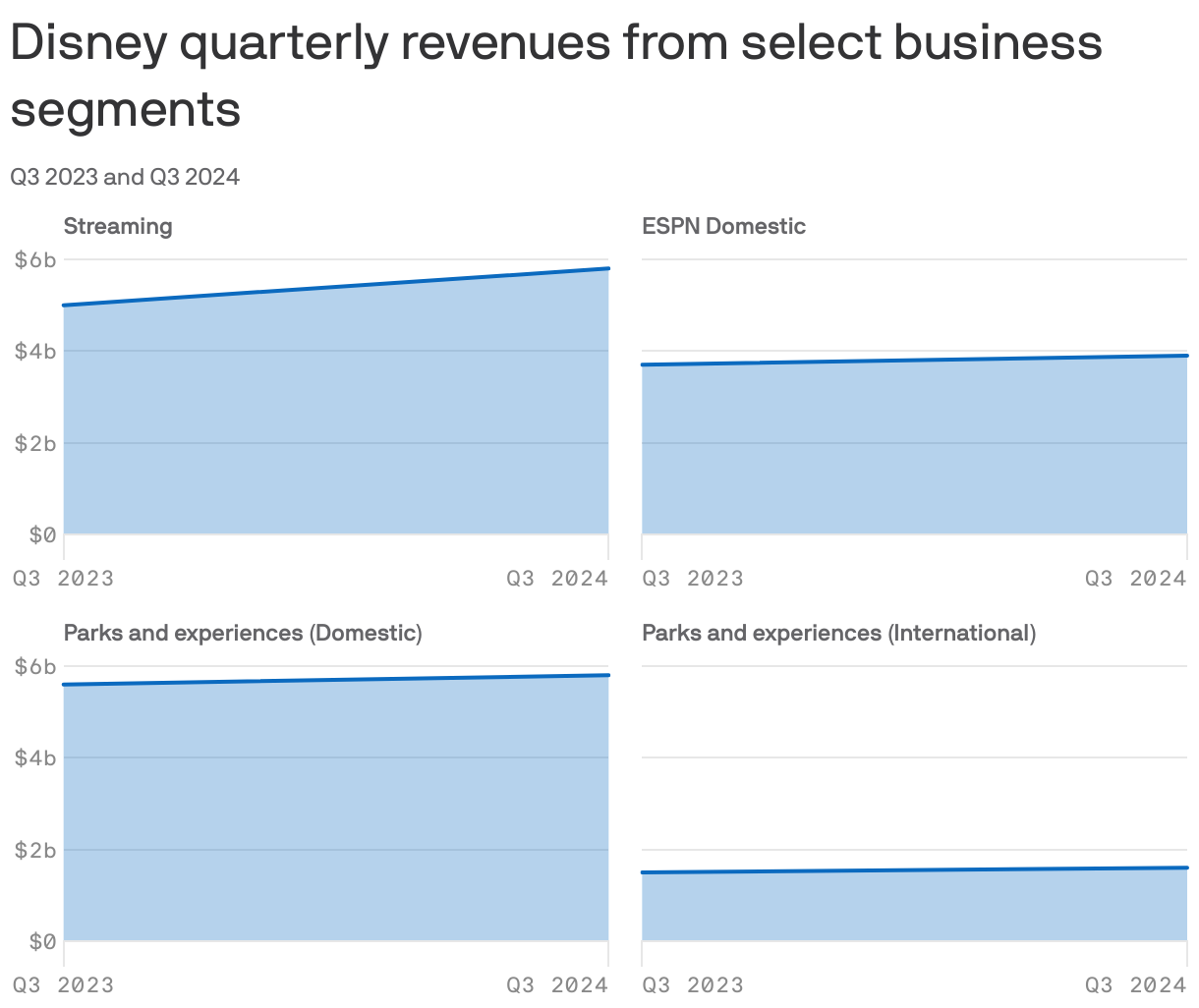
Disney's streaming services reached profitability last quarter, which was earlier than expected.
The big picture: The media and entertainment giant has ESPN+ to thank, as sports have become the only true reliable source of mass audience engagement.
The milestone is also significant as the larger industry shifts away from obsessively counting new subscribers.
Zoom in: The House of Mouse this morning reported that it made $47 million in operating income in its Q3 from its direct-to-consumer and ESPN+ platforms combined.
I'll have one less thing to look forward to on my United flights.
The airline will soon cease publication of its in-flight magazine Hemispheres.
Zoom out: The decision, reported by Modern Retail, ends a 32-year product that's won hundreds of writing awards.
United told Modern Retail that the digital version of Hemispheres can reach a bigger audience and "offer more personalized content."
Between the lines: There's a digital ad play here.
Like Walmart, Marriott and Macy's, United has launched a media network — the first of any airline. Dubbed Kinective Media, the platform will enable United to sell targeted ads through its app and seatback screens.
The two astronauts whose weeklong mission aboard the International Space Station is now stretching into its second month could be left in orbit until winter.
Why it matters: NASA astronauts Barry "Butch" Wilmore and Sunita "Suni" Williams have been in limbo after docking with the ISS on June 6 as part of the Boeing Starliner's first crewed test flight.
In the closing hours of this session of Congress, Sen. Cynthia Lummis (R-Wyo.) has released language for her bill that would require the United States government to buy a million bitcoin.
Why it matters: At this moment, the bill, S. 4912, seems unlikely to win passage, but it's more likely a bid to expand the so-called Overton window of how the U.S. government might think about cryptocurrency.
The Overton window is the notion that certain things can be conceptualized as politically feasible, if unlikely, while things outside the window are just impossible.
The window moves, and sometimes an attention-getting piece of legislation can be part of the moving.
It's the first birthday of PayPal USD (PYUSD), the stablecoin from the payments giant.
Why it matters: The fact that the company has stuck to its guns on the product, despite lacking wild uptake, continues to give some credibility to blockchains as a medium for financial technology.
How it works: PYUSD is a vanilla stablecoin like USDC or USDT.
Managed by stablecoin services company Paxos, each PYUSD token is backed by assets worth $1 held at a financial institution.
Delta passengers filed a lawsuit against the airline forrefunds following the chaotic CrowdStrike worldwide outage that led to thousands of flight cancellations.
Why it matters: The July outage hit businesses worldwide and was estimated to be the largest IT outage in history. Itleft Delta in a head-to-head battle with CrowdStrike, which is already facing a class action lawsuit over alleged negligence.
A group of eight academicsdetermines when the United States has entered a recession. The indicators they rely upon to make that call point to an economy that is slowing, but which is not particularly close to outright contraction.
Why it matters: Recession talk reached a high boil in recent days, after a weak July jobs report and a bout of stock market volatility. But the broad range of indicators used to measure economic cycles looks decidedly less gloomy.
McDonald's is betting on nostalgia to drive sales with its next rendition of the adult Happy Meals — the "collector's meal."
Why it matters: The limited-time meal — which launches Aug. 13 and comes with a collectible glass — is the fast-food giant's latest attempt to bring consumers back.