Trump would face constraints in remaking the Federal Reserve if elected

Add Axios as your preferred source to
see more of our stories on Google.
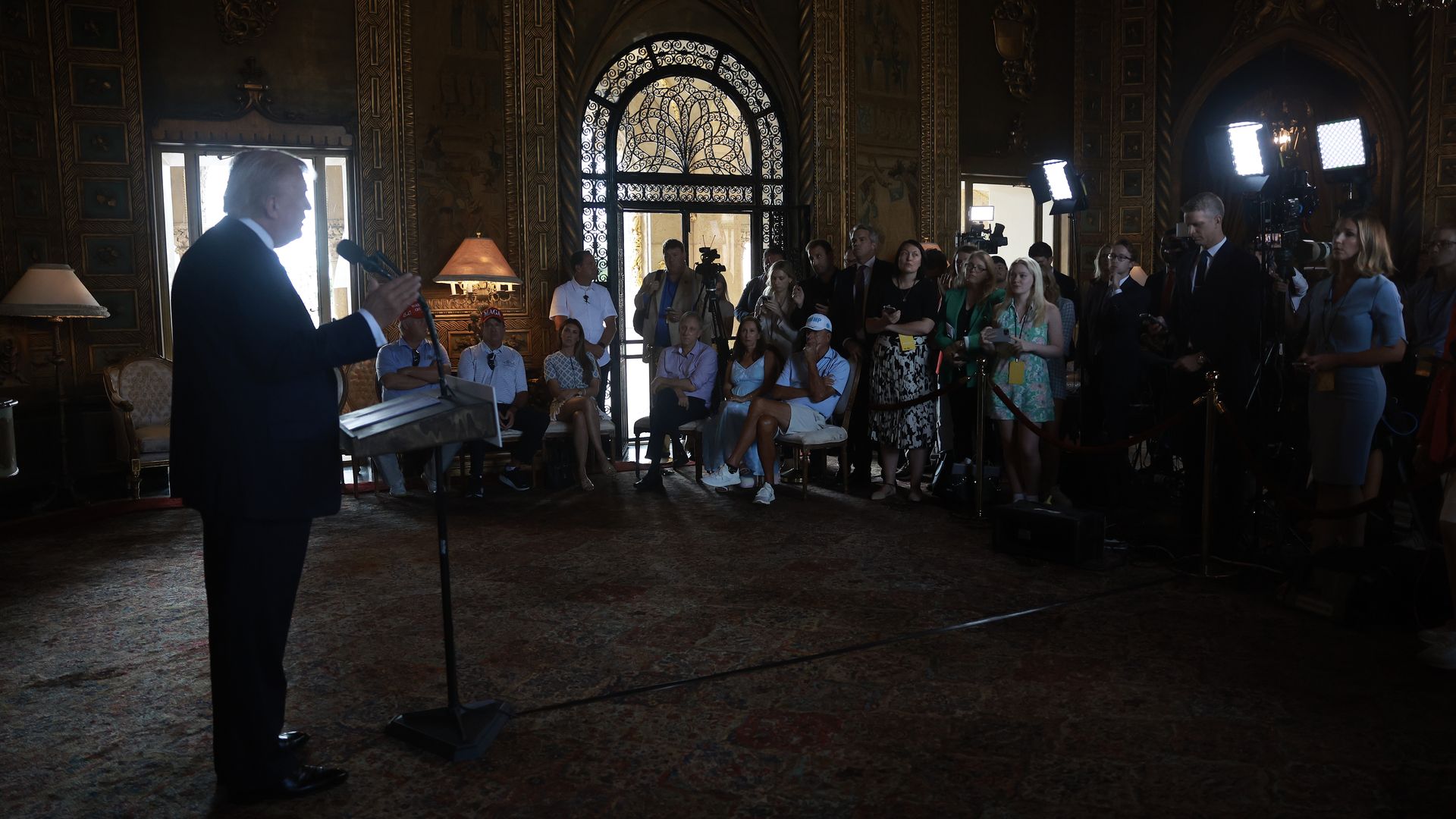
Former President Trump in a news conference Thursday. Photo: Joe Raedle/Getty Images
If he wins in November, former President Trump would likely attempt to take a more hands-on role steering the Federal Reserve's policy moves than has been seen in decades.
Why it matters: Trump could attempt to install Fed appointees who are personally loyal to him — and willing to take direction from the White House — in ways that would surely reverberate through the U.S. economy and markets.
- However, there are some limits — both political and economic — on his ability to follow through on those instincts.
What they're saying: "The Federal Reserve is a very interesting thing and it's sort of gotten it wrong a lot," Trump said at a news conference Thursday.
- "And you know that's very largely a — it's a gut feeling. I believe it's really a gut feeling. And I used to have it out with [Fed chair Jerome Powell]. I had it out with him a couple times very strongly. I fought him very hard," Trump said.
- "I feel the president should have at least say in there, yeah. I feel that strongly. I think that, in my case, I made a lot of money. I was very successful. And I think I have a better instinct than, in many cases, people that would be on the Federal Reserve or the chairman."
State of play: As we've previously reported, Trump would have few options to remake the Fed in his image in the first 16 months of a new term. There are no governor vacancies until January 2026, and Powell's term as chair extends until May 2026.
- But after that, Trump could look to appoint Fed leaders who have agreed to abandon modern norms around keeping the White House at arm's length.
- Since at least the 1990s, the conventional wisdom among presidents and their close advisers has been that jawboning the Fed is counterproductive.
Between the lines: It's crystal clear that Trump wants more obedient central bankers. He would face two major constraints: the bond market and the Senate.
- If Trump successfully installs Fed leadership that will cut interest rates on his orders, it could cause bond markets to lose confidence in the central bank's credibility on inflation, paradoxically causing longer-term interest rates to rise.
- And there is strong support in the Senate for the principle of central bank independence. Even assuming a Republican majority, appointees seen as excessively deferential to the White House may have a hard time winning confirmation.
Zoom out: The paradox of Trump's pursuit of a complaisant Fed chair is that he would need to find an appointee who listens to Trump on policy, but whom markets and the Senate view as firmly independent.
If Trump wins and seeks to assert greater power over the Fed's decisions, it won't be without historical precedent. Several presidents did exactly that, though their approaches — and success levels — varied.
Flashback: Richard Nixon's administration pressured Fed chair Arthur Burns to loosen the money supply in many subtle and not-so-subtle ways, hoping to rev up the economy before the 1972 election.
- "I respect his independence," Nixon said at Burns' swearing-in ceremony in 1970, adding ominously, "however, I hope that independently he will conclude that my views are the ones that should be followed."
- Later, Nixon's dirty-tricks squad spread the accusation that Burns was seeking a large pay raise amid high inflation, meant to pressure Burns to acquiesce to the president's preferred monetary easing.
- Burns largely acquiesced to Nixon's desire for monetary stimulus heading into the 1972 election — a decision that many economic historians believe contributed to inflation becoming unmoored as the decade progressed (though there is some revisionist thought that this is unfair to Burns).
Only somewhat more subtle was the Reagan administration. In 1984, Fed chair Paul Volcker was summoned to the White House.
"As I arrived, the president, sitting there with Chief of Staff Jim Baker, seemed a bit uncomfortable," Volcker wrote in his memoir. "He didn't say a word. Instead, Baker delivered a message: 'The president is ordering you not to raise interest rates before the election.'"
- "I was stunned," Volcker wrote. "Not only was the president clearly overstepping his authority by giving an order to the Fed, but also it was disconcerting because I wasn't planning tighter monetary policy at the time."
- "What to say? What to do?," Volcker wrote. "I walked out without saying a word."
- Volcker added that he had already been planning to ease policy following the collapse of the Continental Illinois bank.
