How Trump could (and couldn't) reshape the Fed

Add Axios as your preferred source to
see more of our stories on Google.
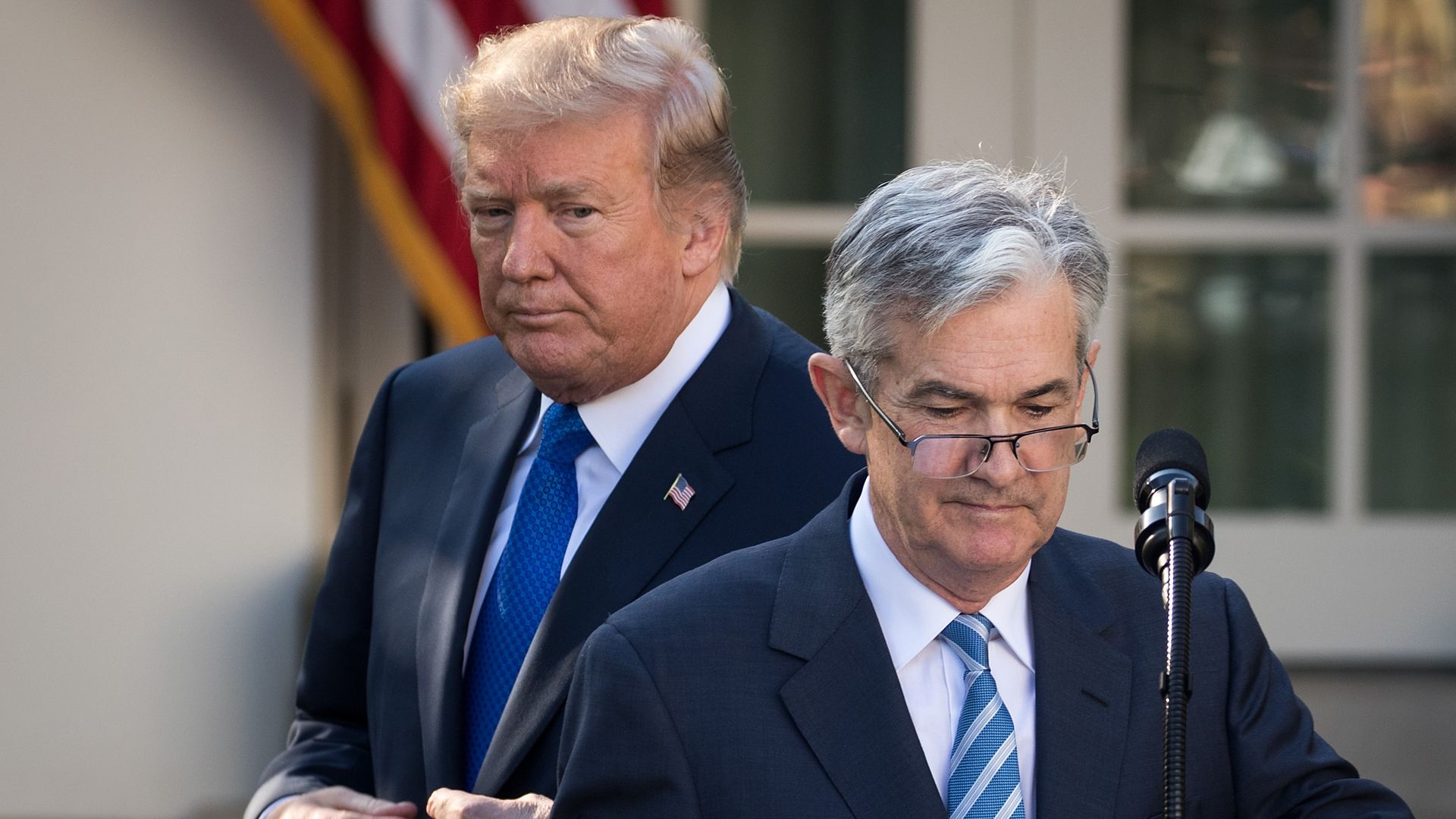
Trump announces the appointment of Jerome Powell as Fed chair in 2017. Photo: Drew Angerer/Getty Images
If former President Trump wins in November, he will have the opportunity to reshape leadership of America's central bank.
- But he will face a choice: whether to follow standard historical practice and do so patiently or to attempt to do so quickly, which would likely lead to legal uncertainty and rattled markets.
The big picture: Trump offered frequent, harsh criticism of chair Jerome Powell and the Fed when he was last in office, and some of his allies have advocated dramatic steps to rein in Fed independence.
- If Trump wishes to install appointees who will be loyal to him and less attached to the Fed's tradition of political independence, his ability to act will be constrained by legal complexities and ambiguities in the Federal Reserve Act.
State of play: The seven members of the Fed's board of governors are appointed by the president, but they have staggered 14-year terms.
- No governor slots are scheduled to come open until Adriana Kugler's term ends on Jan. 31, 2026 — more than a year after the inauguration.
- In a quirk of the system, the chair and vice chairs of the Fed are governors as well — and their terms as governors don't line up with their terms as leadership.
- Powell's term as chair does not end until May 2026 — meaning for the first 16 months of a new Trump term, the president would have a Fed leader who he has publicly pilloried. Powell's term as a governor extends until 2028, though standard practice would be for him to relinquish that position when his time as chair concludes.
Similarly, vice chair Philip Jefferson's term extends to September 2027, and vice chair for supervision Michael Barr's term is up in July 2026.
- But their terms as governors extend to 2036 and 2032, respectively. Theoretically, either could gum up the works — denying the president a governor slot — by holding onto those positions rather than resign, though that would not be the historical norm.
The intrigue: The Federal Reserve Act specifies that governors can be removed by the president "for cause," which legal scholars take to mean malfeasance or dereliction of duty, not policy differences.
- It is ambiguous in the statute whether a president can fire a governor from their role as chair or vice chair before that term ends.
- "Other presidents have concluded that they lacked that authority, and there is good reason to think they were right," University of Pennsylvania legal scholar Peter Conti-Brown wrote in 2019. "But we just don't know: it's legally uncertain."
Powell is wealthy and can afford hefty legal bills. He believes deeply in the importance of Fed independence, and it's reasonable to expect he would fight any attempt to fire him in court.
- Moreover, the Federal Open Market Committee — the Fed body that sets monetary policy and also includes presidents of regional reserve banks — elects its own chair and vice chair at the start of each year.
- By tradition, the Board of Governors chair is also chair of the FOMC. But theoretically, the FOMC could defy the president by electing governor Powell as its chair in defense of the Fed's independence.
Any of these scenarios would amount to a crisis situation. Ambiguity around who is in charge of the most important central bank in the world would surely shake stock and bond markets — hardly something a president wants to see.
- It also looks likely that the Fed will be in rate-cutting mode next year, just what Trump would presumably want.
- Powell, for his part, emphasizes that he sees strong bipartisan support for an independent central bank.
What they're saying: "A long time ago, people learned that a central bank that's independent of political considerations does a better job getting inflation under control, and that is now accepted wisdom in all advanced economies around the world," Powell said this week at the Economic Club of Washington, D.C.
- "It's also a principle that has very, very strong and broad support where it really matters, which is in Congress," he said.
Trump, in an interview with Bloomberg published this week, didn't seem particularly eager to try to force the issue — though he made no ironclad promises around whether he would test the boundaries of Fed independence.
- Asked whether he would allow Powell to serve out his term, Trump said, "Yes, I would. There's a lot of false information on that."
- "I've had my own disputes with him. But ... I would let him serve it out especially if I thought he was doing the right thing."
- Trump, notably, does not think that cutting rates before the election, as the Fed appears likely to do, would be the right thing. "Maybe they will do it prior to the election, prior to November 5, even though it's something that they know they shouldn't be doing," he said.
Go deeper: Read Conti-Brown's full 2019 piece for more detail on the legal questions involved if a president wished to fire a Fed chair.
