Inflation has become the new diva that companies must cater to — carefully.
Why it matters: People are getting pickier about what they buy in an environment where everything has gotten more expensive. And businesses will only profit if they size and time their price hikes precisely.
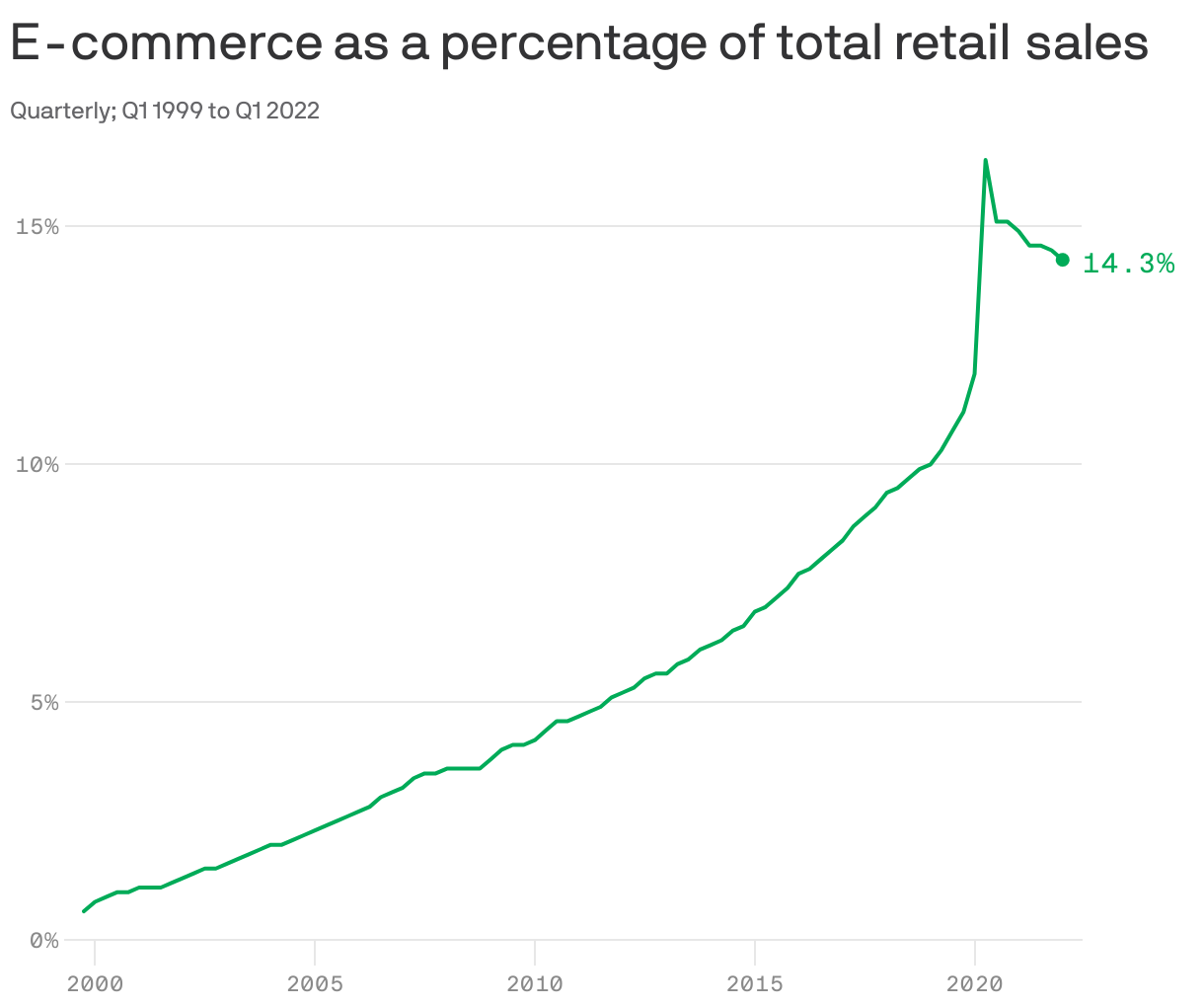
Data: U.S. Census Bureau; Chart: Erin Davis/Axios Visuals
Shopify said Tuesday that a slowdown in the pace of e-commerce sales growth caught it by surprise, prompting the online retail platform to announce layoffs.
Why it matters: A tapering off in e-commerce sales growth suggests the economy is rebalancing as the pandemic's grip eases.
Google parent Alphabet narrowly missed revenue and earnings expectations in earnings reported Tuesday.
What's happening: Shares were up 2% in after-hours trading Tuesday. Investors had braced for the worst after weak earnings reports from Snapchat and Twitter suggested a slowing ad market.
General Motors is lining up deals to shore up its long-term supply of battery materials, even as short-term supply issues continue to undermine current production.
Driving the news: The automaker on Tuesday announced two deals to secure access to battery materials that are crucial to the company's future EVs, including the recently revealed Chevrolet Blazer EV and the Cadillac Lyriq:
The vast majority of young adults in the U.S. live within a stone's throw of where they grew up, per new Census Bureau/Harvard University research, Alex Fitzpatrick reports.
Why it matters: It's yet another data point suggesting many young Americans are staying relatively close to home rather than striking out on their own, in part due to economic forces.
The jackpot for Tuesday's Mega Millions drawing has grown to an estimated $830 million, the lottery game's third largest prize.
The big picture: Strong sales of the $2 tickets ahead of Tuesday's drawing have pushed the jackpot up $20 million from $810 million Monday, which is up an estimated $170 million from Friday's drawing, according to Mega Millions.
The International Monetary Fund on Tuesday said global economic growth will slow considerably this year and issued a fresh warning that a number of risks threaten to push the global economy to the brink of a recession.
Why it matters: However grim the economic picture was earlier this year, the outlook now is decidedly worse for the global economy. In new projections, the fund now expects the world will face a dreaded stagflationary mix: considerably slower global growth, with higher inflation rates, for a sustained period.
Fintech, financial services and blockchain will be "inseparable" and "indistinguishable," according to Kraken Ventures partner Akshi Federici, laying out a vision of the future during during her talk at the Ethereum Community Conference or EthCC in Paris last week.
Why it matters: All major aspects of financial services could use the blockchain, including capital markets, asset management, payments, retail and institutional banking and insurance, she said.
It's hard to recall a White House deploying as much effort to pre-spin economic data as the Biden team has with Thursday's gross domestic product report.
There's a real possibility it will show a second straight quarter of contraction. It's likely to prompt an even more exhausting — and confusing — discourse about the economy's health.
Analysts have begun cutting projections for advertising growth this year, sending shockwaves through the media and tech industries.
Why it matters: Macroeconomic factors, such as supply chain issues and inflation, are causing a deceleration in ad growth at a level most companies hadn't anticipated when forecasting for the second quarter.
Newsweek, the decades-old magazine company, is looking to build a digital subscription business that focuses on lifestyle and hard news content, executives told Axios.
Why it matters: The hope is that subscriptions will not only be lucrative, but also help steer the publication's reputation toward one of quality independent journalism amid a messy legal battle with its former parent company.
China-based officials tried to build a network of confidants inside the Federal Reserve, in some cases attempting to offer employees of the central bank lucrative contracts in exchange for confidential information about interest rate policy changes and the U.S. economy, a congressional investigation found.
Why it matters: The report, which has received strong pushback from the Fed, calls out a failure to counter a decade-long attempt by Chinese officials to infiltrate the world's most powerful central bank. The findings, however, stop short of saying whether sensitive economic information had been compromised.
Alternative meat startup MyForest Foods unveiled Monday what it calls the world's largest aerial mycelium farm, a high-tech facility meant to crank up production of its mushroom-based imitation bacon — one of many products making it easier for meat lovers to give up the real thing.
Why it matters: Animal farming is a major greenhouse gas emitter, and wide-scale adoption of alternative meats could help curb climate change — assuming they're produced cleanly.
The details: MyForest Foods' new facility, called the Swersey Silos, is located in Green Island, N.Y., a short drive up the Hudson River from Albany.
The Swersey Silos are expected to annually produce nearly three million pounds of mycelium — the root-like fungal structure from which mushrooms grow — for making the company's MyBacon pork alternative. A company rep said that would be enough for about one million pounds of MyBacon per year.
Axios got to tour the 78,000 square-foot vertical farming facility, where mycelium will be grown in substrate on racks reaching 16 feet tall. With seven rooms, it'll have 1.75 acres of growing space — about the same as a smallish conventional mushroom farm. Each batch is grown for 12 days and harvested in a single day.
MyBacon samples offered at Monday's event were delicious, if not exactly like the real deal. (For those interested in cooking some at home, the chef recommended medium-to-high temperatures, adding that "you can't flip often enough.")
What they're saying: "We basically build these cyborg buildings that replicate the environment you find in a forest," MyForest Foods co-founder and CEO Eben Bayer tells Axios. "And we sort of trick the mushroom to form these, basically, sheets of mushroom flesh. So rather than forming a mushroom, we get a 50-foot-long, four-foot-wide, two inches thick slab of mushroom meat."
"The organism does a self-assembly of something that's like a piece of animal flesh, and we just harvest it, like harvesting an animal," he adds, referencing the fungal mycelium.
"They've got this umami flavor, which sort of mimics flesh. And all we do is slice it off, slice it into bacon strips, salt it, smoke it, put a little coconut fat on it."
The big picture: MyForest Foods was spun off from Ecovative, a company Bayer co-founded to explore business opportunities in mycelium-based clothing, packaging, and more.
Ecovative was one of the earliest commercial mycelium ventures, a category that has since grown to include a number of other startups, such as the San Francisco-based MycoWorks, Colorado-based Meati, and Israel's Mush Foods.
Yes, but: Despite lots of marketing and industry partnerships with big brands like McDonald's and Starbucks, consumer interest in alt-meats may be waning.
What's next: MyBacon, which was first available at an Albany grocery co-op, is now coming to two Massachusetts stores as the company scales up production and the broader alt-meat wars rage on.
Sanctions have been effective at crippling the Russian economy. That's the conclusion of a new 118-page paper from Yale's Jeffrey Sonnenfeld and 18 c0-authors.
Why it matters: The big question about Russia sanctions is whether they have teeth, if they exclude Russian oil and gas. While official Russian statistics suggest the economy is using its oil and gas revenues to withstand the effects of sanctions, Sonnenfeld's paper says that the official Russian statistics are lies.
A new generation is dramatically reshaping the internet — rejecting and rebuking the social networks they grew up with, which barely resemble themselves anymore.
Why it matters: The social hierarchies created by decades of public "like" counts, and the noise level generated by clickbait posts and engagement lures, have worn on Gen Z. And constant pivots by social media giants have eroded younger users' trust.
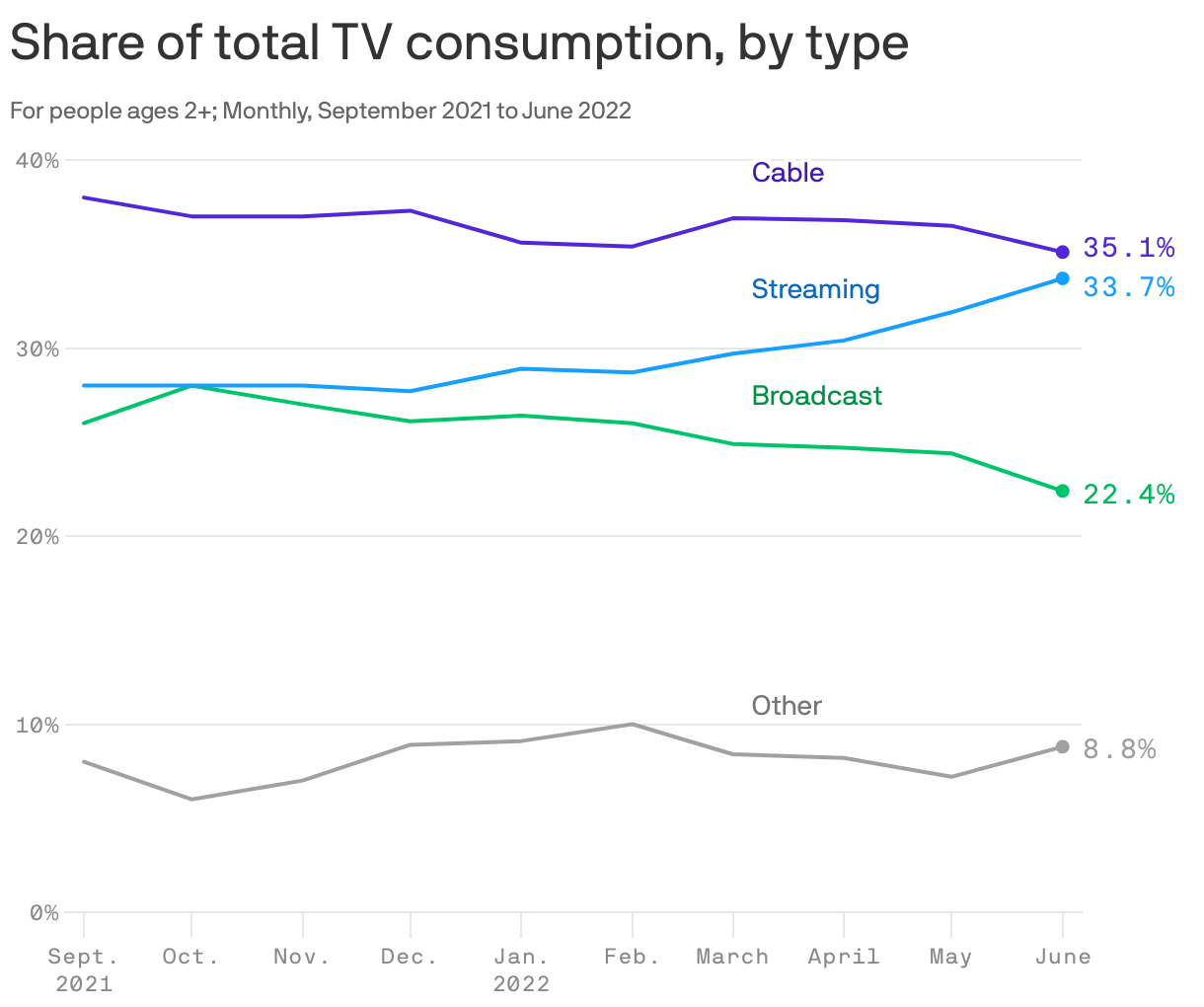
Streaming made up one-third of television consumption among people in the U.S. last month, per Nielsen, the highest percentage since the media measurement firm began its monthly report in June 2021.
Why it matters: Cable and broadcast saw their lowest-ever share of the television audience, although they still collectively make up the vast majority of TV viewing in the U.S., for now.
President Biden has a new headache: He can't avoid the debate over whether the U.S. is in a recession, but if he dwells on it, he may hasten the very slowdown he's desperate to avoid.
Why it matters: In economics, psychology matters. If the country and consumers believe we're in a recession — even if we technically aren't — the economy will eventually slow down, turning Biden's inflation problem into a potential stagflation nightmare.