Meta, the parent company to Facebook, Instagram and Whatsapp, reported its first ever year-over-year quarterly revenue decline since going public in 2012.
Why it matters: The results raise the question whether Meta's strongest growth period is behind it. Earlier this year, the Facebook app lost roughly 1 million daily active users — its first ever year-over-year user drop.
Sony Pictures Television announced Wednesday that Ken Jennings and Mayim Bialik will be the full-time hosts of "Jeopardy!" moving forward.
Why it matters: This ends the search for a permanent replacement for the late Alex Trebek, who hosted the show from 1984 until his death in 2020. Jennings and Bialik previously split hosting duties after Trebek's passing.
The federal government's budget deficit will soar in coming decades, after a brief reprieve this year from climbing deficits, according to a Congressional Budget Office (CBO) report on Wednesday.
Why it matters: The nonpartisan agency warns that the nation's fiscal position is set to become more challenging in the years ahead as deficits balloon and interest costs spike.
The Federal Reserve continued its campaign of aggressive interest rate increases Wednesday, hiking its rate target another 0.75 percentage point, while acknowledging for the first time that "recent indicators of spending and production have softened."
Why it matters: The Fed's tightening of monetary policy, the most rapid in decades, is intended to bring down inflation. It has also sent financial markets reeling and increased the risk the United States will fall into a recession.
Why it matters: Trident Mortgage Company, a division of Berkshire HomeServices of America, agreed to resolve allegations that it engaged in a pattern or practice of lending discrimination by “redlining” in what the Justice Department said was its second largest redlining settlement and its first against a non-bank lender.
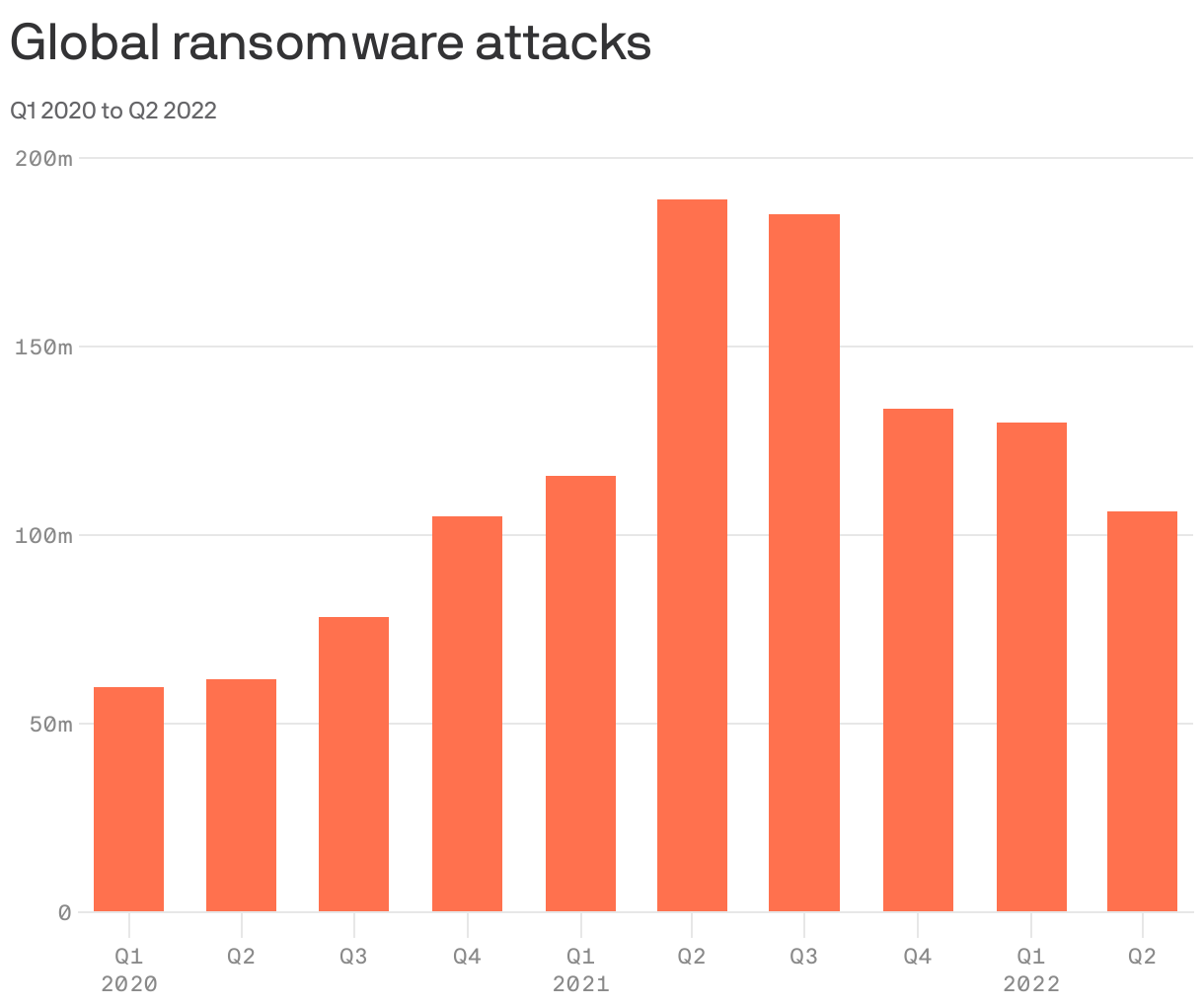
One silver lining of a crypto winter: the threat of digital assets being held for ransom has abated.
Driving the news: Ransomware attacks declined 23% from January to June, according to U.S. cybersecurity firm SonicWall's 2022 mid-year cyber threat report.
Ethereum, the world's second-biggest blockchain, is switching to a new security model that at least one legal expert claims could raise an issue with profound repercussions for the cryptocurrency market.
Why it matters: If ether (ETH), the coin that runs Ethereum, is found to be a "security" by the Securities and Exchange Commission, it's hard to imagine how the blockchain even functions in the United States.
Vox Media is laying off 39 people, less than 2% of its total staff of more than 2000, in an effort to get ahead of economic uncertainty, according to a source familiar with the cuts and a memo obtained by Axios.
Why it matters: Vox Media is the latest in a long string of firms taking measures to prepare for a potential economic downturn.
Shares in Spotify spiked nearly 7% Wednesday morning after the streaming audio giant said it beat Wall Street's expectations on revenue, earnings and user growth.
Why it matters: Several media and tech firms attributed slowed growth last quarter to macroeconomic headwinds. CEO Daniel Ek told Axios he remains "paranoid" about a potential recession but said, "so far, we're not seeing much of it at all."
Disney on Wednesday confirmed to Axios that it would allow political issue ads — in addition to candidate ads — on Hulu's streaming service, effective immediately, bringing Hulu's ad policies to parity with Disney's cable networks.
Why it matters: The change comes amid a controversy over Hulu's decision to reject political issue ads around guns and abortions from Democratic groups.
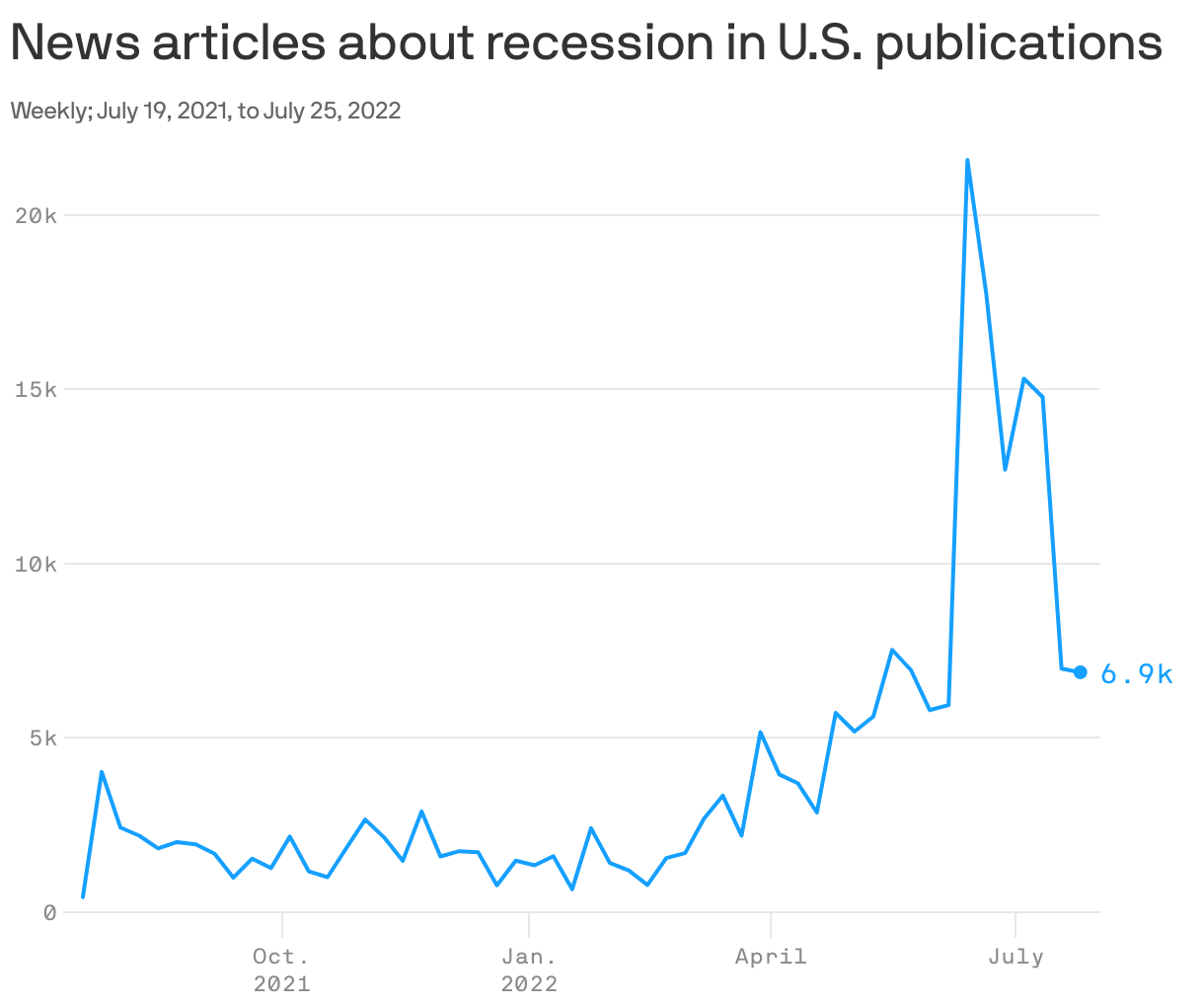
Note: Within the headline or first paragraph of articles algorithmically determined to be about the economy. Data: Signal AI; Chart: Erin Davis/Axios Visuals
Many things cause Americans to think we're in a recession, including rising gas prices and falling stocks. One key component is simply the amount of recession chatter in the media.
A bill that would limit banks' ability to charge overdraft fees is gaining ground in the House. The Overdraft Protection Act, introduced last year — scheduled for a markup, the final step before legislation is advanced to the House floor this week — despite strong opposition from the industry.
Why it matters: These fees, often $35 for spending or withdrawing more money than you have in your account, are a big profit center for banks — one bank CEO even named his boat Overdraft a few years ago — but a political football often kicked by legislators and consumer advocates.
The electric Ford F-150 Lightning pickup truck made an unexpected guest appearance at my recent backyard birthday party.
Why it matters: It turns out the Lightning's two-way charging system has other uses beyond powering job sites or campsites. My musician friends used the truck to haul their band gear to the party and then plugged their amps and sound system into its multiple power outlets.
In an innovative pushback against paper and plastic waste, eco-companies are starting to pump out cups, spoons and straws that you can eat after you use them — no need to recycle.
Why it matters: While the "edible" angle is a bit of a cheeky marketing hook, there's a serious trend here: A campaign to replace items considered biodegradable or recyclable with ones that are "home compostable" — toss them in your backyard pile, and they'll break down quickly and naturally.
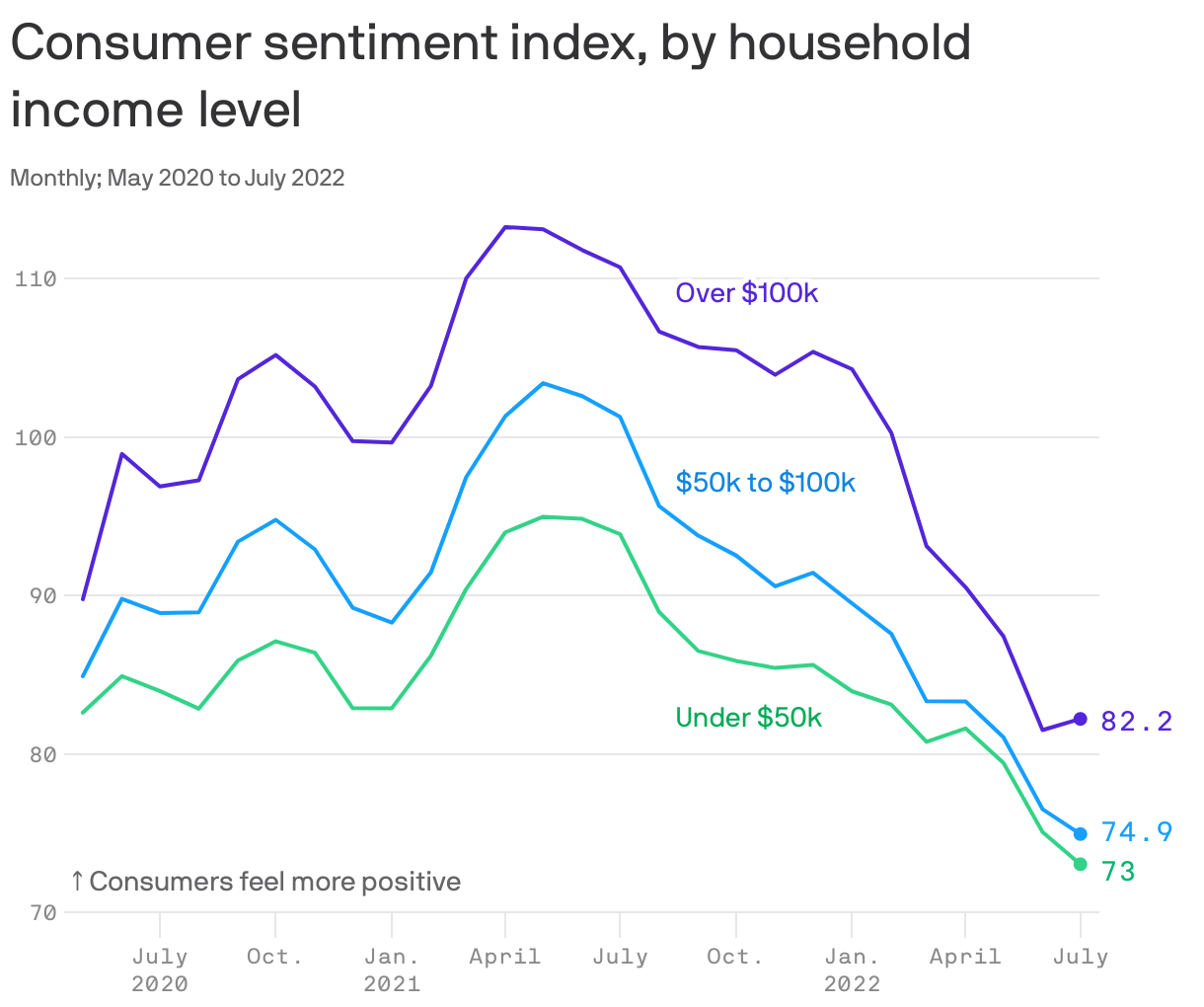
You've heard of income inequality and wealth inequality. Well, there's also mood inequality.
The big picture: For the lowest earning households, consumer sentiment worsened in July, according to data out Wednesday morning from the Morning Consult/Axios Inequality Index. However, sentiment improved for those with more money, the survey showed.
Why it matters: Cuomo has been off the air since he was indefinitely suspended last November following revelations about his involvement in the management of his brother's sexual harassment scandal. He was later fired by the network.