Frayed supply chains and U.S.-China tensions were on the minds of many tech executives in Davos for the World Economic Forum this week.
Why it matters: Nearly every tech company is dealing with the one-two whammy of a global semiconductor shortage combined with COVID-related disruptions in China and elsewhere.
Wherever the world's attention might be focused right now, it's not Davos, Switzerland.
Driving the news: When a major new trade pact was announced on Monday — encompassing 13 countries including the U.S., Japan, India, South Korea, and Australia — it was at a summit in Tokyo, 6,000 miles from Davos.
The premise of the World Economic Forum is that if you bring powerful people together across borders, they can solve some of the world's thorniest problems.
But if this year's forum is any indication, the biggest geopolitical players can't even gather in the same room anymore.
Good afternoon, and welcome to our deep dive from Davos, Switzerland, where Team Axios — Dave Lawler, Felix Salmon, Ina Fried, and Axios publisher Nicholas Johnston — covered the World Economic Forum's annual meeting of heads of state, CEOs, activists and celebrities.
The tradition of paying a month's rent (or more) into a landlord's escrow account is being challenged by young companies that offer alternatives to the cash security deposit.
Why it matters: There's a lot of money at stake: An estimated $45 billion sits in security deposit accounts. And while the current system has its flaws, the alternatives also have pluses and minuses.
Looks like America's home buying binge is winding down. There's a vibe shift visible in both the official data and in the anecdata from sellers, buyers and brokers.
Why it matters: This is just what Jerome Powell ordered. The slowdown means the Fed's rate hikes are working — cooling demand in an overheated market.
Billionaire wealth — on paper, at least — has tumbled dramatically during Wall Street’s recent turmoil, illustrating important lessons for everyone about the ephemerality of stock gains and losses.
Why it matters: Net worth is something of a public obsession, and a bit of a chimera avidly followed by publications like Bloomberg or Forbes. Yet the stark reality about paper wealth – especially fortunes tied to volatile technology stocks – is that it can be ephemeral, and attempts to put an exact figure on it can be misleading.
Ex-investment banker and author Carol Roth told Axios recently that there's a "high degree of uncertainty for those businesses who depend on in-person foot traffic."
Yes, but: Labor Department data shows a slow but steady decline in remote work, suggesting that more workers are opting for in-person work, even if it's hybrid.
Delta will reduce its flight capacity this summer, cutting approximately 100 daily departures, the airline announced on Friday.
Driving the news: The move will mitigate employee absences due to COVID, the impact of extreme weather events, and other factors out of their control, per the announcement.
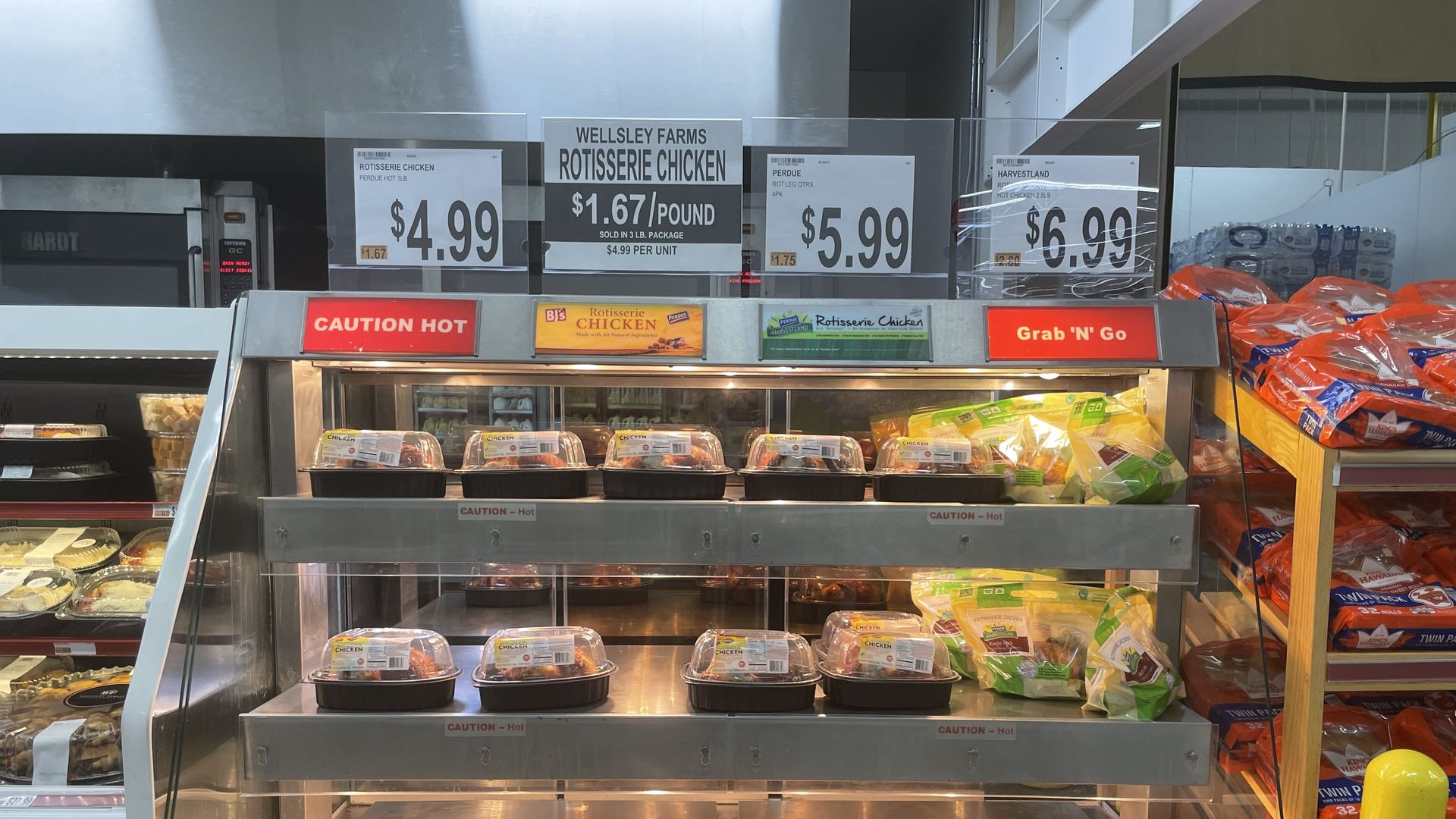
While inflation has taken a bite out of household budgets and food prices continue to skyrocket, the price of beloved wholesale club rotisserie chicken has remained the same.
Why it matters: Even as chicken prices nationwide have increased 16.4% in the last year, Costco, Sam’s Club and BJ’s Wholesale Club have maintained the price of their rotisserie chickens.
Grilling season won’t have quite as much sizzle this year.
What’s happening: With Memorial Day Weekend upon us, sales of outdoor grills have fallen in 2022 as Americans are diverting spending elsewhere, or looking to save.
Grill masters Weber and Traeger reported first-quarter sales declines of 7% and 5%, respectively.
The U.S. Securities and Exchange Commission on Friday confirmed that it is investigating Elon Musk's early April disclosure of an ownership stake in Twitter, which came ahead of his agreement to acquire the company.
Driving the news: At is issue is the question of why Musk seemingly disclosed his 9.2% position in Twitter after he was legally required to do so, and if that disclosure was still faulty.
The no-loss lottery, PoolTogether, launched a sale of NFTs yesterday to raise money for its legal defense in New York state against a class action suit brought by a crypto-critic software engineer.
Why it matters: It aims to test the question of whether or not creators can make something, release it on a blockchain and really claim not to control it anymore.
The largest shareholder in America's largest gunmakersisn't a reclusive billionaire or a 2A rabble-rouser with a heavy Reddit presence. It's BlackRock, the investment giant that talks Wall Street's loudest game on social duty.
Why it matters: With great power comes little accountability.
The Federal Reserve's preferred gauge of inflation remained high in April, though the pace of price spikes showed signs of stabilizing, according to new government data released on Friday.
Why it matters: The personal consumption expenditures price index may be leveling off at a high level as the Fed moves aggressively to tamp down price spikes.
Award-winning actress and LGBTQ advocate Laverne Cox has become the first transgender person to have a Barbie doll modeled after her, Mattel unveiled this week.
Driving the news: "I hope all the kids who are feeling stigmatized when their health care is being jeopardized, ability to play sports, I hope they can see this Barbie and feel a sense of hope and possibility," Cox said on NBC's "Today" show.
Ear piercing startups are popping up in pricey storefronts in New York City and elsewhere, even as big retailers like Target, CVS, Walmart, Ulta Beauty and Five Below also go big on piercing.
Why it matters: Piercing mania shows no sign of slowing down, and retailers are seeking to capitalize on the next big thing in beauty. They're using ear piercing as a draw to attract younger shoppers and as an incentive to purchase jewelry.
The south Asian island nation of Sri Lanka just defaulted on its debt. Its situation is not so different from a host of other lower-income nations — and there’s no reason to think others won’t share the same fate.
Why it matters: In a sovereign debt crisis, the biggest victims aren’t the international creditors — but the regular people whose economy is stuck in a holding pattern while the government haggles over austerity and repayment schedules.
The modern American business era is defined by CEOs celebrated for their wild growth, wild personalities and wild wealth.
Why it matters: Running my second company as CEO, I am increasingly convinced this celebrity, grind-it, growth-at-all-costs model won’t cut it for the next generation.
We need a new twist on cutthroat capitalism — let’s call it aspirational capitalism.











/2022/05/27/1653670657851.gif?w=3840)