Intuit, the maker of TurboTax and QuickBooks, on Monday said that it has agreed to buy email marketing company Mailchimp for $12 billion in cash and stock.
Why it matters: This would be the largest-ever acquisition of a privately-held bootstrapped company, as Mailchimp didn't take any outside funding since its 2001 founding. It's also a huge windfall for the founders of Mailchimp, which opted for profit-sharing instead of stock-based compensation for employees.
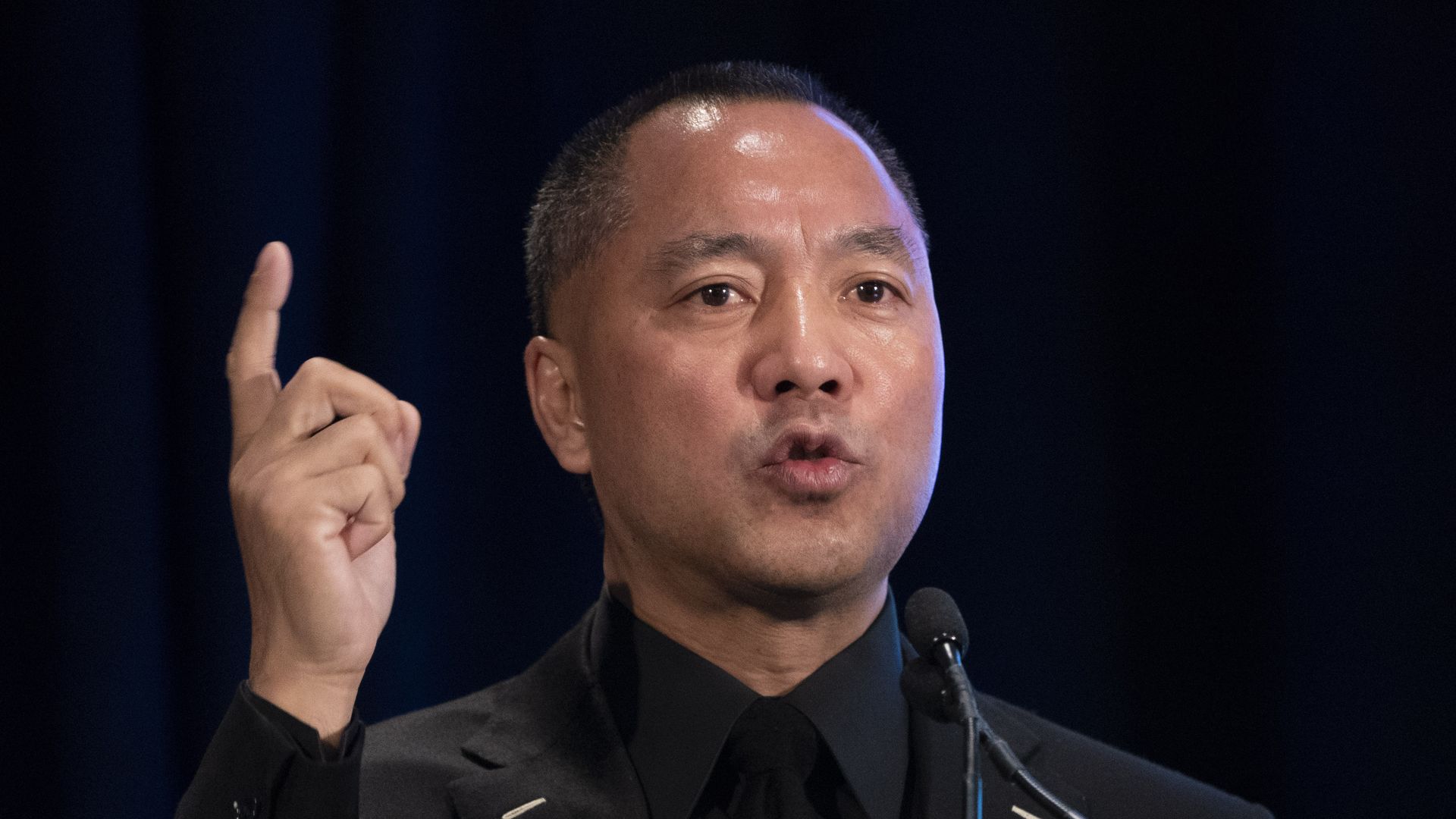
Three media businesses linked to exiled Chinese businessman Guo Wengui have agreed to pay more than $539 million to settle charges brought by the Securities and Exchange Commission. The companies are accused of illegally selling stock and digital assets between April and June 2020.
Why it matters: Guo has been linked to pro-Trump allies and groups, including Steve Bannon and Gettr, the social media network founded by former Trump aide Jason Miller.
Conventional wisdom is that richer people make more informed investment decisions than do less-rich people, even if their wealth was inherited or earned outside the capital markets. It's an unproven underpinning of accredited investor rules, and may play a major role in the fraud trial of Theranos founder Elizabeth Holmes.
Between the lines: Fraud trials mostly are about what the defendant knew and when they knew it. But, in this case, those questions might be flipped on their heads — with the defense rhetorically aiming them at Theranos investors who lost over $800 million.
CVC Capital Partners agreed to buy Glendower Capital, a London-based private equity secondaries firm that manages around €8 billion in capital commitments.
Why it matters: This highlights a major consolidation push in the private equity secondaries market, with at least five announced deals so far in 2021.
The Washington Post is relaunching its 202 newsletter suite with a new email around climate, new authors and an expanded product suite.
Why it matters: The redesigned products are meant to be more digestible and personality-driven, says Rachel Van Dongen, editor of the Washington Post’s 202 newsletters, the editorial franchise that delivers news for D.C. decision-makers.
A group of Vice President Kamala Harris' campaign veterans is launching a strategy firm to help CEOs avoid getting “canceled” and to advise companies how to respond to changing cultural norms before they're faced with a crisis.
Driving the news: C Street Advisory Group, led by CEO Jon Henes, a former national campaign finance chair for Harris’ presidential campaign, will draw on the group's broad political network to help corporate America diversify its workforce.
Producer prices increasedby more than expected in August, a reminder that inflation pressures continue to linger in the economy.
Why it matters: Producer prices reflect what businesses pay for the materials that go into the goods they eventually sell to their customers. While businesses will make an effort to absorb some of those higher costs, they'll pass some of the costs on through consumer price hikes.
Here’s a side effect of the going public boom: a heated race to reserve the hottest unique identifier, the ticker symbol.
Why it matters: The insignias companies are choosing to trade under is a reflection of our time — increasingly they want to go list with snappy symbols that catch the eye of a new generation of traders.
Afghanistan's former central bank governor, Ajmal Ahmady, had a front-row seat to the country's recent economic development. So he knows as well as anyone the financial risks the new government — and the people of Afghanistan — now face.
Driving the news: In a talk with the Atlantic Council on Friday, Ahmady shared his inside perspective on the Afghan financial system and concerns for the future of the economy. Front and center: the lack of hard currency.
Yes, we're all scared of the Delta variant, but the more visceral reasons that people want to keep working from home are striking, a poll found:
75% want to hang out with their pets.
73% want to watch TV while they work.
72% want to nap or exercise during the day.
62% are self-conscious about how they look.
Why it matters: The longer we stay out of the office, the more these personal priorities become ingrained — making return-to-the-office even more of a distant (and distasteful) possibility.
Details: The results come from a Pollfish survey of 1,000 people conducted in July for Digital.com (a procurement website for small businesses).
"Participants had to pass through two screening questions to ensure they started working remotely during the pandemic and wished to stay working remotely," per Digital.com.
When asked why they wanted to continue to WFH, most people gave predictable answers as their top reason — child care or commuting issues, as listed in the chart above.
But most respondents listed other lifestyle factors as part of their consideration.
What they're saying: "The real reason I want to work from home is because I get ownership of my day: I don’t have to dress up for work, worry about my appearance or smile and make small talk when I feel like trash," said Naida Allen, a content writer at Tutor House, according to Digital.com.
“There’s no one breathing down my neck, watching my every move and analyzing whether I’m 'working hard enough.'"
The bottom line: 14% of survey respondents said that "working remotely was so important to them they would not go back to work in-person even if their employers required it, instead giving up their positions to presumably find other remote opportunities."
House Democrats will consider as much as $2.9 trillion in tax hikes for the next 10 years — mostly on the extremely wealthy and corporate America — as they scramble for ways to pay for President Biden's $3.5 trillion infrastructure and social spending plan.
Why it matters: A draft proposal from the Ways and Means Committee, which ricocheted across Washington on Sunday night, previews epic fall fights between Democrats and some of the best-armed lobbies in America.
The global COVID-19 vaccination campaign began nine months ago, and 58% of the world's population has yet to receive at least one dose.
The big picture: Raw material shortages, complex and costly manufacturing, and vaccine makers' choices have made it clear the U.S. and its drug companies likely won't get the poor, unvaccinated parts of the world out of the pandemic — but China might.