Wall Street got a front seat at President Biden's climate summit.
Why it matters: Banks, as financing gateways for other businesses, could help set the tone for the rest of corporate America. They're facing pressure — from world leaders, the United Nations, activists, you name it — to play their biggest role yet in greening the global economy.
Snapchat beat Wall Street expectations on subscriber growth, earnings per share and revenue last quarter, sending its stock up in after-hours trading.
Details: CEO Evan Spiegel said in prepared remarks that the camera company officially has more Android users than iOS users — "a critical milestone that reflects the long-term value of the investment we made to rebuild our Android application."
Just after midnight this past Sunday, 12 of the richest and best-known European soccer clubs announced an agreement to form what they called the Super League. By Wednesday morning, outcry from fans, politicians and other soccer organizations stopped the Super League in its tracks.
Axios Re:Cap is joined by Financial Times sports editor Murad Ahmed to discuss the Super League’s very short roller coaster ride, why it struck such a nerve, and how the financial motivations behind the Super League could reshape soccer even if the Super League is never revived.
Stocks fell Thursday following media reports that President Biden wants to nearly double the capital gains tax paid by wealthy Americans.
Inside the numbers: Biden reportedly is considering a proposal of a 39.6% top rate on long-term capital gains, up from the current 20% rate. He also is expected to maintain an ACA-related investment tax, bringing the total federal rate to as high as 43.4%, as first reported by Bloomberg and confirmed by Axios.
Oxitec, a British startup that plans to release genetically modified mosquitoes into Florida, on Thursday announced that it raised $6.8 million in venture capital from the Wellcome Trust.
Why it matters: This is one of the world's most controversial startups, even though everyone applauds its mission of reducing instances of mosquito-borne diseases like Zika and dengue fever.
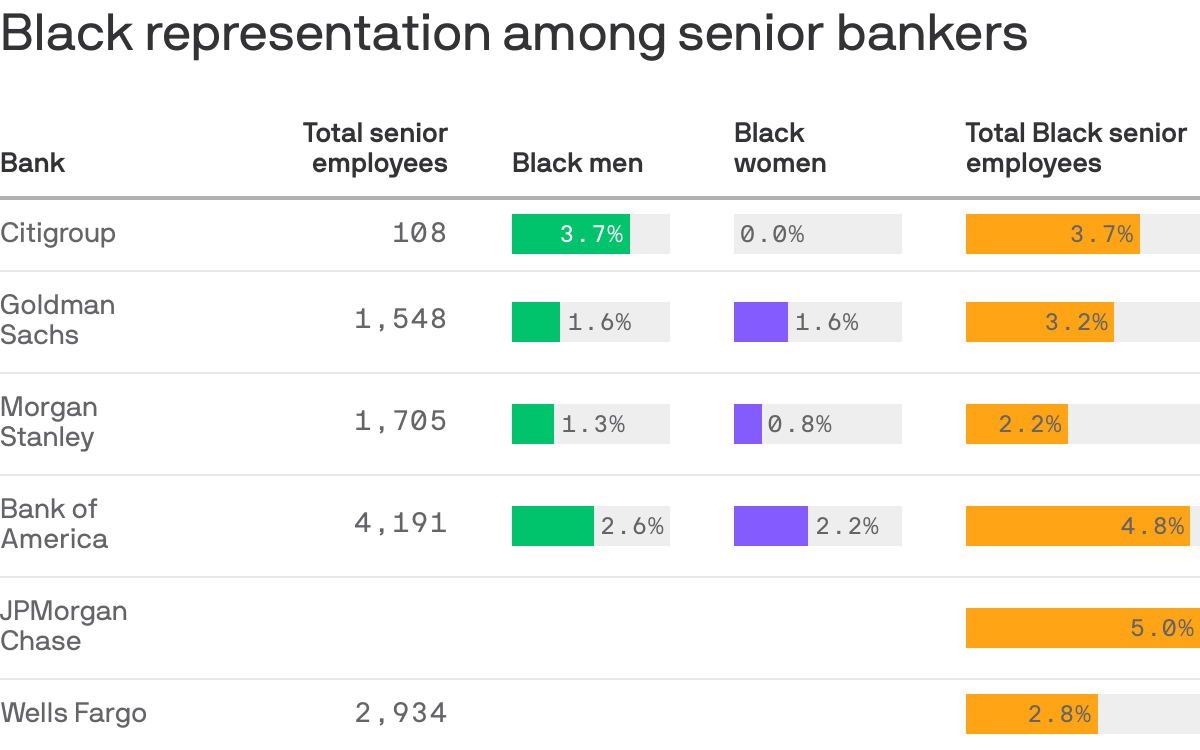
Data: Bank diversity reports/Axios research; Chart: Will Chase/Axios. Note: Full breakdowns couldn't be obtained for JPM and Wells.
White Americans are three times more likely than Black Americans to have a prime credit score. They're also disproportionately likely to end up in senior management at a giant bank.
By the numbers: "In our survey, just 19% of Black respondents and 42% of Latinx respondents indicated a prime credit score, compared with 60% of white respondents," Financial Health Network said in its FinHealth Spend Report 2021.
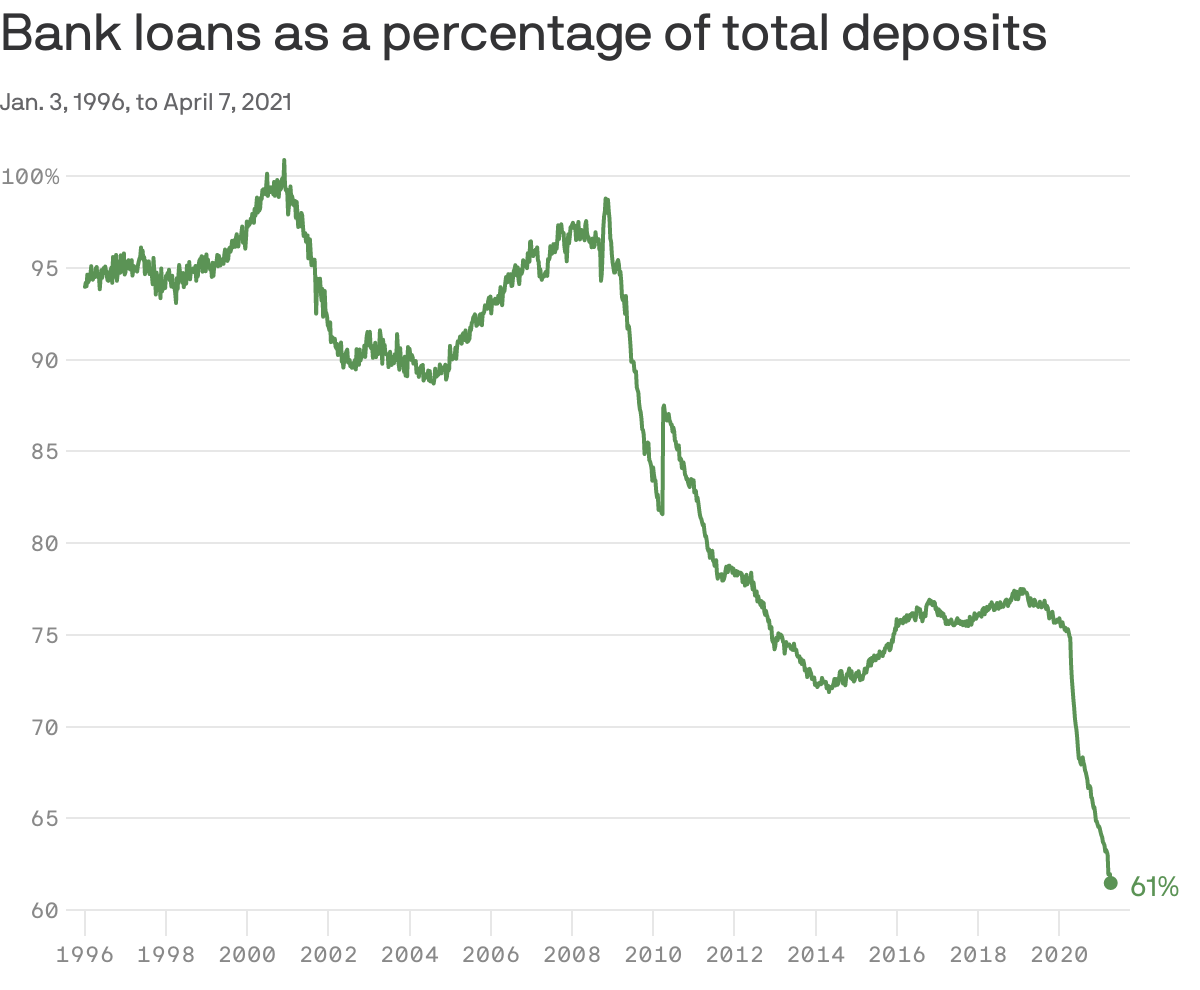
Data: Federal Reserve via FRED; Chart: Axios Visuals
Banks are taking in record deposits — they now have a record $16.8 billion, as of the most recent Fed report — but they're not doing a good job of turning around and lending them out.
By the numbers: Total bank loans and leases are now just 61.5% of the American deposit base. For the biggest banks, as Bloomberg's Shahien Nasiripour reports, that number falls to 53.7%, a new all-time low.
The U.S.-hosted climate summit has now begun, ahead of the bigger U.N. climate change conference in Glasgow in November.
The state of play: One major theme has already emerged: Investing in a zero-carbon future has moved from being a contrarian strategy with virtue-signaling upside, to being the central investing thesis for most giant financial institutions.
The 48-hour rise and fall of the European Super League is the perfect encapsulation of how anti-greed sentiment has changed the rules of capitalism.
Why it matters: The highly-complex structures of capitalism are built from the mostly base motivations of individuals chasing money. That's been condemned and celebrated in equal measure — but has also largely been accepted.
Senate Republicans formally rolled out the framework for their $568 billion counterproposal to President Biden's $2.5 trillion infrastructure plan on Thursday.
Why it matters: The package is far narrower than anything congressional Democrats or the White House would agree to, but it serves as a marker for what Republicans want out of a potential bipartisan deal.
Private equity is carefully watching the D.C. debate on corporate taxes, in which Senate Democrats seem to be settling on a 25% rate.
Zoom in: Marginal rates obviously matter, but for PE it's just an appetizer before the weedier work begins on issues like corporate interest deductibility.
It was expected that with the economy improving and company balance sheets already loaded with cash, U.S. firms would slow down their debt issuance in 2021 after setting records in 2020. But just the opposite has happened.
Why it matters: Companies generally issue bonds for one of two reasons — because they're worried about not having enough cash to cover their expenses or because they want to lever up and make risky bets.
Vaccinations keep climbing, and restaurants are ready to roar back this summer. But eateries from Miami to Martha’s Vineyard to Los Angeles are facing the same problem: not enough workers.
The big picture: Millions of restaurants are hiring all at once and, after a deadly pandemic, the jobs of waiters, cooks, and hosts seem more dangerous than they ever have before. All of this is contributing to a nationwide hospitality worker shortage as the economy opens back up.
The Chinese Communist Party is believed to be responsible for newly found hack attacks on the U.S. government, businesses and American infrastructure, cybersecurity company Mandiant said Wednesday.
Why it matters: This is the third major cybersecurity breach to hit the U.S. in recent months — including two in March blamed on hackers linked to China's government: one targeting 30,000 U.S. victims, including small businesses and local governments, the other hitting Microsoft.