In two cases involving his China trade war this week, President Trump suggested the U.S. should ignore historic separations of power and precedent if it yielded good results, Bloomberg's Shawn Donnan writes.
Trump said the Federal Reserve should keep rates low to help the economy weather the trade war.
Trump suggested he'd help free a Huawei executive that the U.S. is currently trying to extradite from Canada.
Why it matters: "U.S. officials have struggled for decades to convince suspicious foreign counterparts about the separation of powers ... They didn’t persuade all of the people all of the time — but the framing was central to America’s ability to lead by example," Donnan notes.
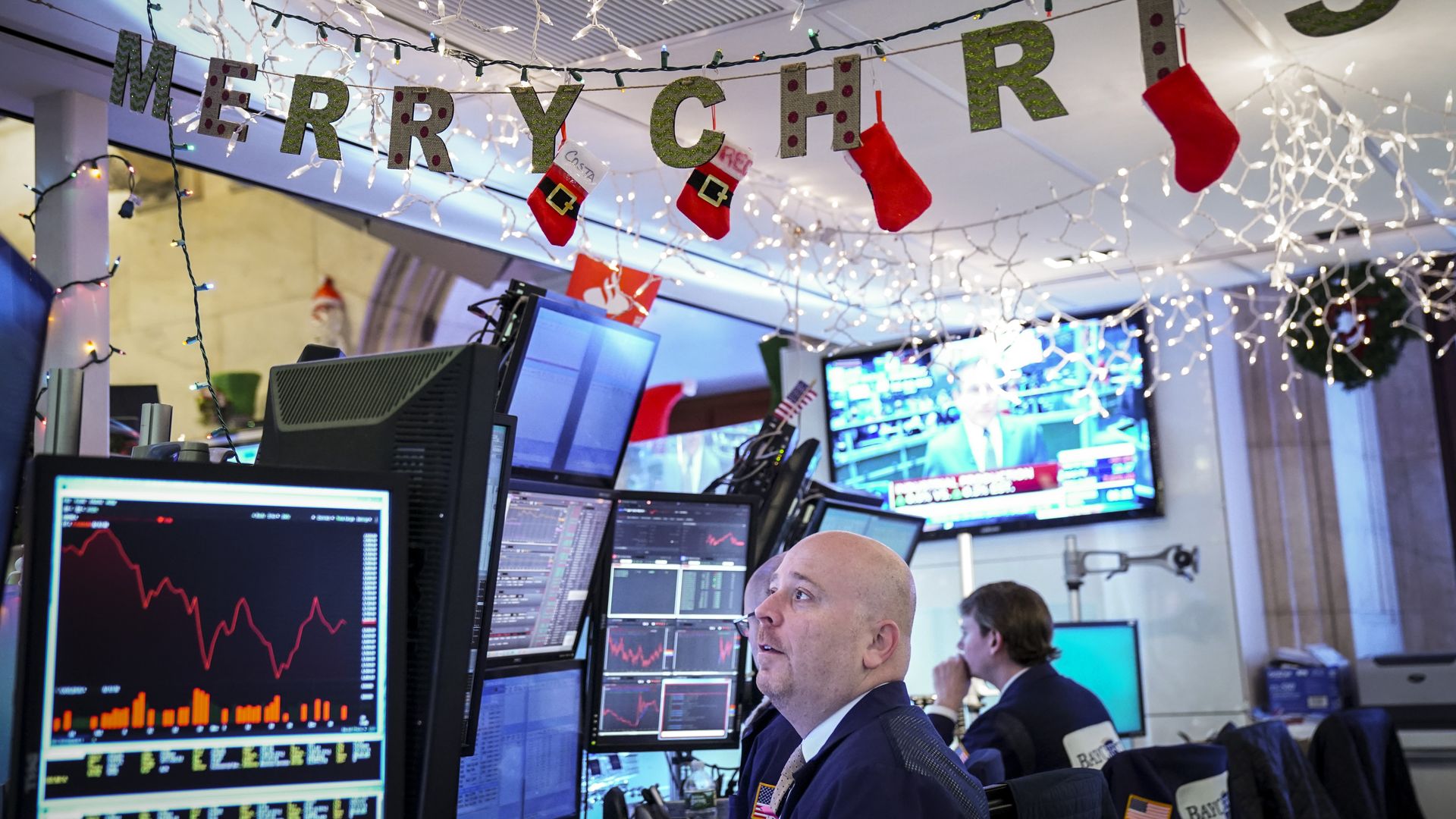
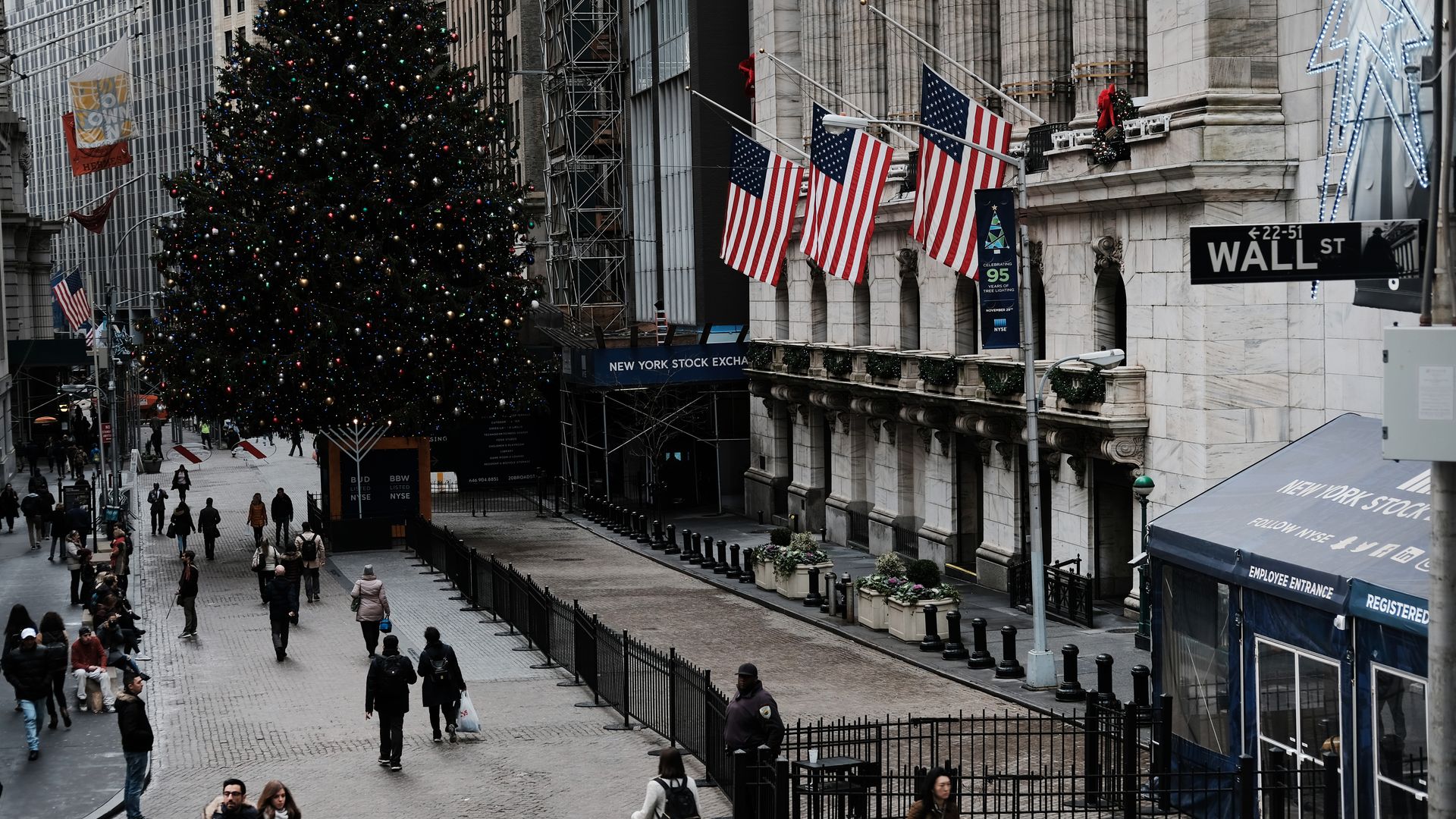
The Dow Jones Industrial Average closed 497 points lower on Friday, or 2.02%, while the S&P 500 fell 1.9% and Nasdaq Composite dropped nearly 2.3%. All three are now in correction territory.
Downward drivers: Johnson & Johnson, the biggest decliner in both the Dow and S&P 500, had its worst day in over 15 years after a Reuters report said the company knew its baby powder "was sometimes tainted with carcinogenic asbestos." Disappointing economic data in China also fueled the sell-off.
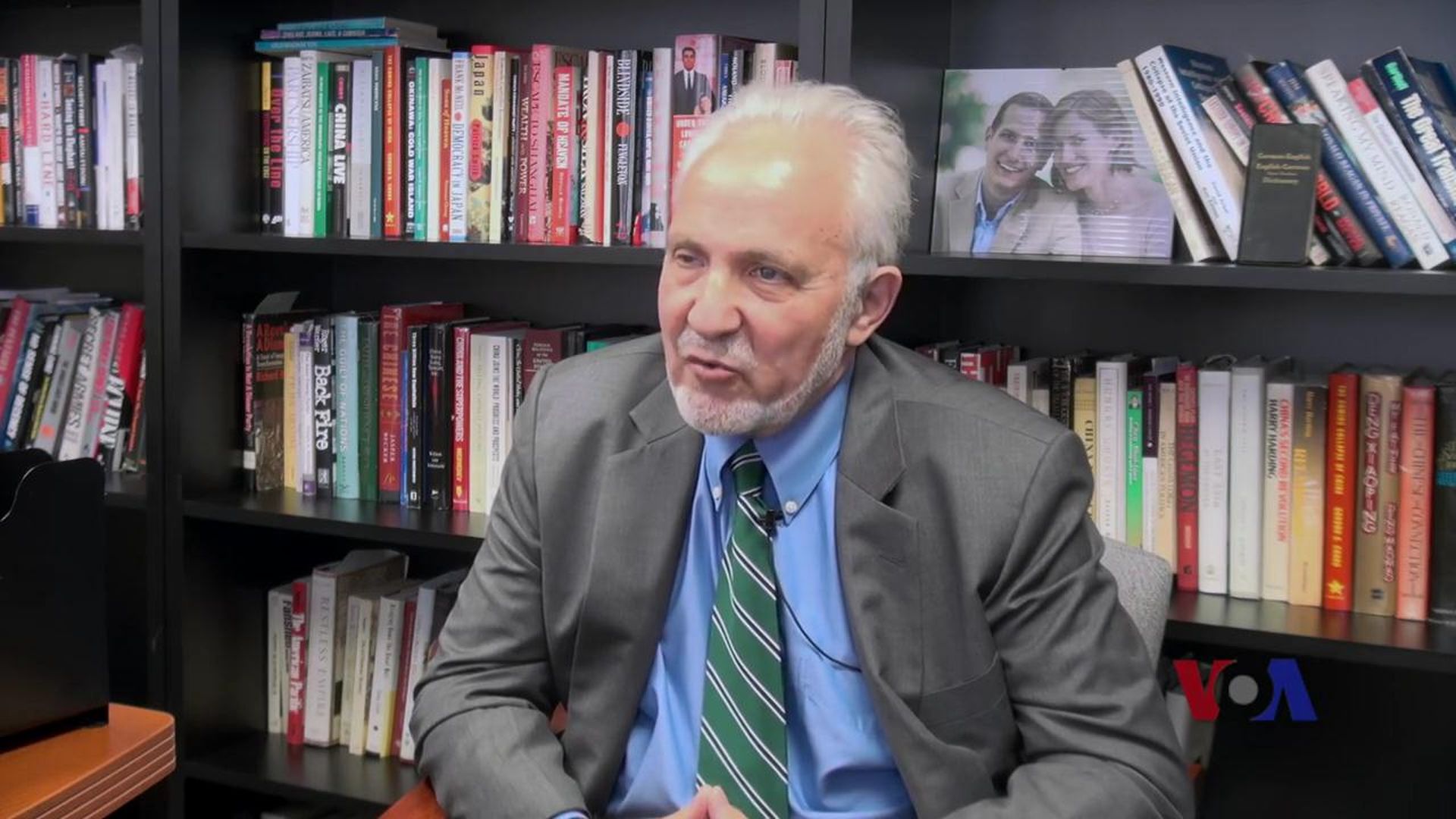
Author James Mann, whose views once stirred controversy about a decade ago when he suggested prosperity might not bring the PRC closer to Western liberal ideals in his book "The China Fantasy," now appears vindicated by the evolution of the relationship between the two superpowers.
What's new: I interviewed Mann this week about the current state of U.S.-China relations, to compare with his older premise (which was one of three possible scenarios) that Western elites misrepresented the benefits of engagement with China. Back then, Mann posed the question...
"What if, twenty-five or thirty years from now, a wealthier, more powerful China continues to be run by a one-party regime that still represses organized political dissent much as it does today? ... What if, in other words, China becomes fully integrated into the world’s economy, yet it remains also entirely undemocratic?"
The parent companies of T-Mobile U.S. and Sprint, Deutsche Telekom and SoftBank respectively, have agreed to "consider curbing" their use of equipment from China's Huawei Technologies in order to receive national security clearance for their planned merger, Reuters reports.
Why it matters: U.S. officials believe Huawei is tied too closely to the Chinese government, and that incorporating its technology into U.S. networks could enable cyber espionage. The company also became a flashpoint in U.S.-China trade tensions following the recent arrest and requested extradition of Huawei's CFO Meng Wanzhou.
Editor's note: This story has been corrected to reflect that parent companies Deutsche Telekom and SoftBank are considering dropping Huawei, not T-Mobile and Sprint.
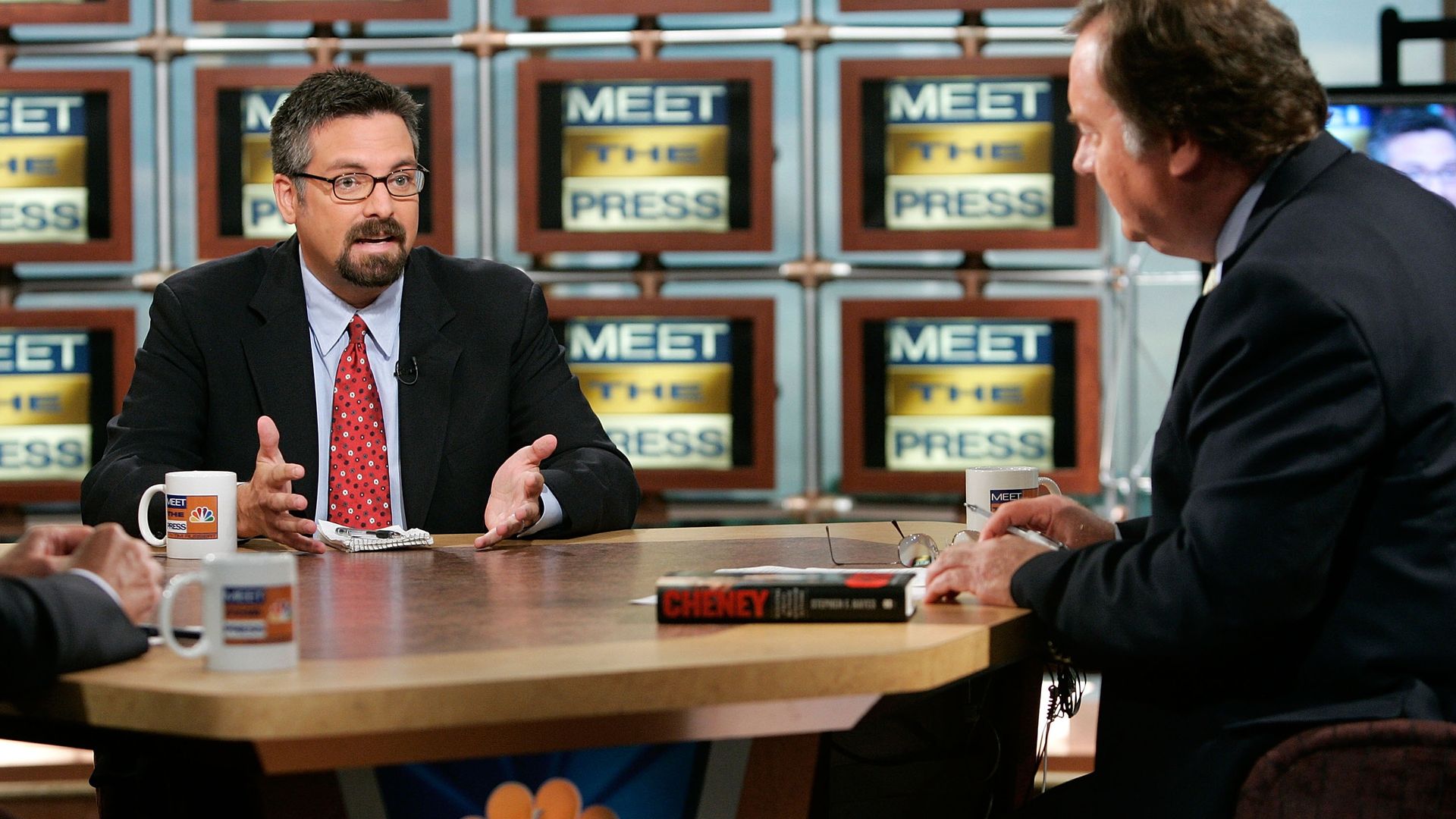
The Weekly Standard, a conservative magazine that hasn't been shy about criticizing President Trump, is officially closing on December 17, Politico's Jason Schartz reports, who obtained a copy of the press release.
Why it matters: The 23-year-old magazine once reflected the opinions and concerns of conservatives on key subject matters including religious liberty, regulation and tax cuts. But the publication has struggled over the past five years, and saw double-digit declines in its subscriber base in all but one year since 2013, according to the press release.
Pharmaceutical company AbbVie, the maker of rheumatoid arthritis drug Humira, said yesterday it has authorized another $5 billion in stock buybacks. AbbVie has now repurchased $15 billion of its own stock since the Republican tax overhaul was signed into law earlier this year.
The big picture: Drug companies are reporting massive profits, due in part to the tax law, and a lot of that money is being used on tools like stock buybacks that benefit Wall Street and executives. Patients, however, continue to voice frustration about their drug costs.
Actress Eliza Dushku received a $9.5 million confidential settlement from CBS after she says she was written off the show "Bull" in retaliation for confronting the show's star, Michael Weatherly, about inappropriate comments he made on set, the New York Times reports.
The big picture: The settlement was uncovered after the CBS Corporation board hired lawyers to go over sexual misconduct allegations made against now-ousted president and CEO Les Moonves. The lawyers' report says, per the Times, that CBS' "misguided" handling of Dushku's complaints was "emblematic of larger problems at CBS."
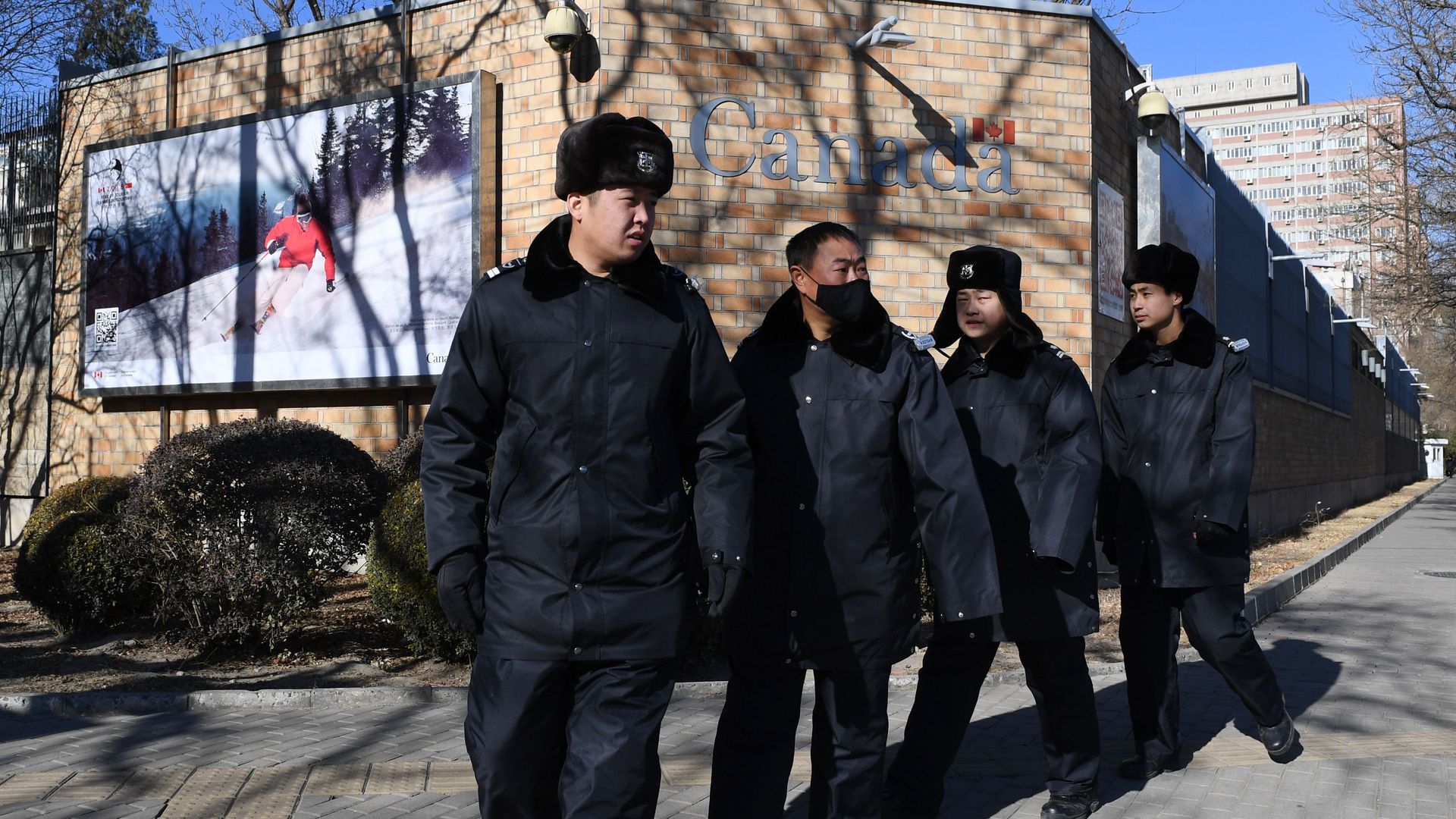
Just as signs emerged that China was softening on trade this week, Beijing seemed to ramp up its retaliation over the arrest of a top Chinese tech executive in Canada.
Between the lines: This confusing week in U.S.-China relations has seen signs of a major climbdown from China, over trade, in parallel with a major escalation. "The Chinese really are trying to keep Huawei and trade separate," says Axios contributor Bill Bishop.
The job search just got a little bit sweeter. 10% of small businesses this past quarter have offered — for the first time — to repay a part of student loans, relax drug policies or hire ex-cons, according to the latest CNBC and SurveyMonkey Small Business Survey. Reeling from the 3.7% unemployment rate, businesses large and small have also raised wages and benefits.
The big picture: To fill a whopping 7.1 million job openings the tightest labor market in a half-century, employers are loosening their requirements and raising traditional benefits to lure workers.
The number of scripted streaming shows overshadowed the number of basic cable and broadcast shows for the first time ever, according to new 2018 projections from FX Network Research.
Why it matters: Online streamers are pouring millions of dollars into original content to lure viewers away from cable and broadcast TV. The number of streaming shows also saw the biggest jump year-to-year, by 27% from last year.Netflix alone had a goal of 700 original series for 2018.
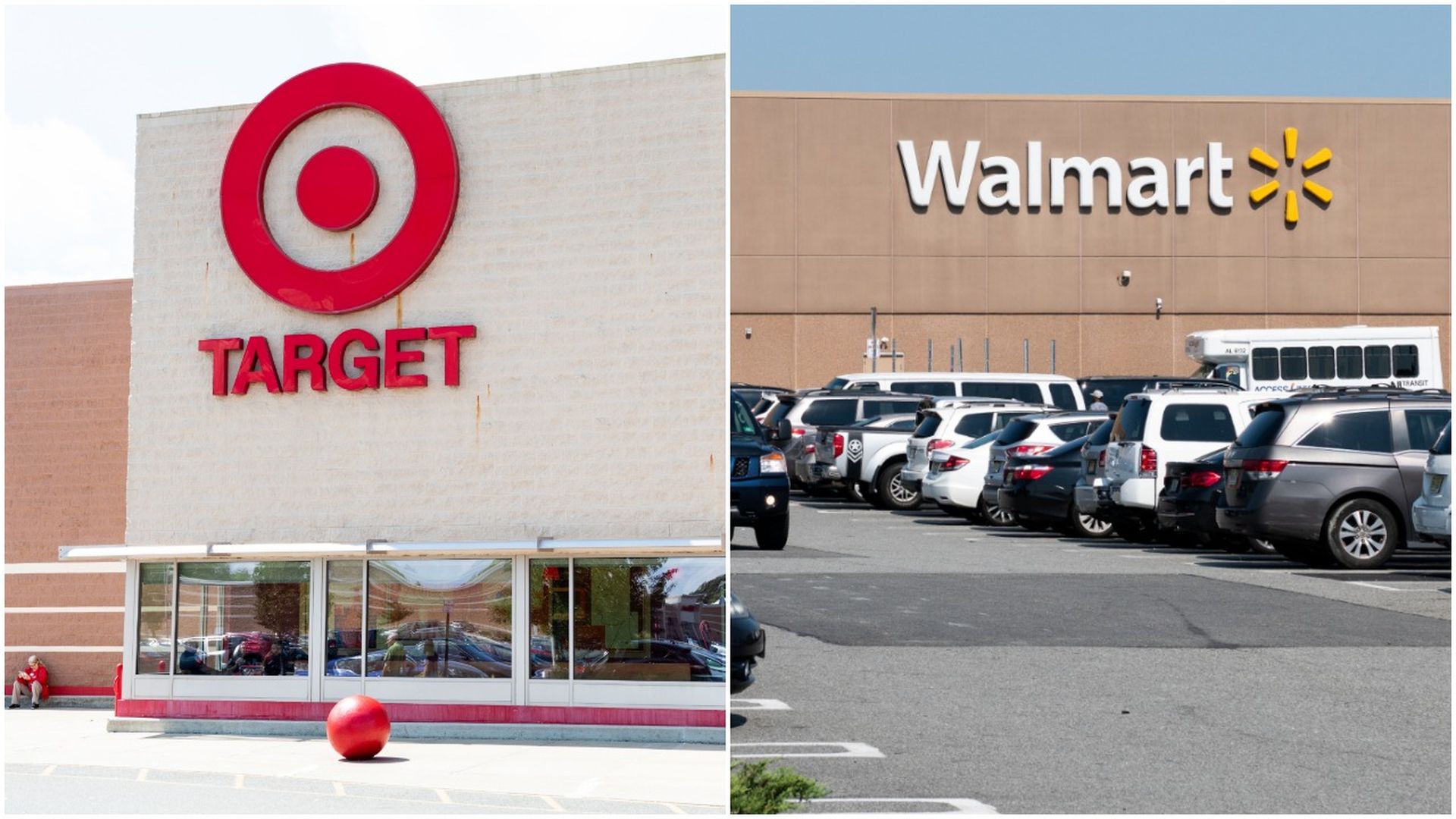
New York Attorney General Barbara Underwood filed suit Thursday against Target, Walmart and LaRose Industries in Albany County Supreme Court due to the alleged sale of lead-contaminated children's toys.
Details: Underwood said in a statement that companies allegedly "committed thousands of violations of multiple state laws by selling Cra-Z-Jewelz" kits with high lead content. Toy parts from the kits were imported by LaRose and distributed and sold at New York Targets and Walmarts between 2015 and 2016, prompting a nationwide recall. Underwood's office is seeking civil penalties for each toy sold as well as a court order to prevent lead-contaminated toys from reaching store shelves.
President Trump, who has deemed himself "a Tariff Man" and made tariffs a centerpiece of his presidential agenda, incorrectly explained how they work during an interview with Fox News' Harris Faulkner.
"We have placed tremendous tariffs on China. When China sends things into America now, they're paying 25% interest on everything they send in."
Reality check: Tariffs are a tax paid by importers — not by exporters. For example, if a Chinese manufacturer charged $10 for a particular product, the American consumer or business purchasing it would have to pay $10 to the seller and an additional $2.50 to the U.S. government (assuming the tariff was 25%). This is not the first time that Trump has incorrectly suggested that revenue from tariffs comes from foreign countries.
The FCC yesterday said it will consider reversing a longstanding ban on mergers between the "Big 4" broadcast television networks. It also plans to revisit rules that prevent the same company from owning two TV stations in the same market and ones that limit a company from owning too many local radio stations in the same market.
Why it matters: 2018 has been a banner year for media consolidation and, if the FCC gets its way, 2019 could follow suit. It also would be the second round of media deregulation under Trump's FCC, the first of which was reinstatement of the "UHF discount" and the elimination of "cross-ownership" rules on newspaper, radio and TV assets in the same market.