The advertising industry is entering a new era of growth fueled by AI agents that can more efficiently buy and sell ads on behalf of human marketers.
Why it matters: The rise of agentic advertising has helped offset economic uncertainty that was initially predicted to slow ad growth in 2025 and 2026.
Major newsrooms are increasingly partnering with prediction market companies, betting that the deals will boost audience engagement and open a new stream of licensing revenue.
Why it matters: The anonymity of some prediction markets, particularly those backed by crypto, could be easily exploited or mishandled by journalists with exclusive or forward-looking information.
The Atlantic on Tuesday soft launched a new friends and family subscription plan called Premium Plus, its chief growth officer Megha Garibaldi told Axios.
Why it matters: It represents The Atlantic's first new paywall tier since it launched digital subscriptions in 2019.
Anthropic is previewing a new tool for non-coders that mostly built itself, engineers at the AI firm say.
Why it matters: The viral popularity of the tool — called Cowork, and designed to help non-coders with everyday work tasks — signals a shift toward software built by AI, with humans guiding the way.
Grocery prices rose at the fastest pace in three years, keeping pressure on household budgets even as overall inflation held steady in December.
Why it matters: The jump in costs highlights the challenge for the White House in the lead-up to midterm elections. Broad inflation relief is little consolation for Americans if they aren't seeing it reflected in grocery bills.
China's government last week confirmed that it will review Meta's $2.5 billion acquisition of Manus AI, whose core team last year relocated from China to Singapore.
Why it matters: This could signal an end to "Singapore-washing," a strategy that's helped a number of Chinese tech companies secure foreign investment and commercial contracts.
WebAI, an Austin, Texas-based sovereign AI platform, raised "high double-digit" millions of dollars at a $2.5 billion pre-money valuation, it tells Axios.
Why it matters: The idea is to run AI directly on devices, bypassing the cloud, for the sake of increased privacy, performance, and energy efficiency.
Inflation held at a four-year low in December, the government said on Tuesday.
Why it matters: The data comes as the White House attempts to address consumers' affordability concerns that have weighed on President Trump's approval rating.
Defense software company Onebrief raised $200 million and snapped up Battle Road Digital, giving its military-planning suite a simulation and wargaming boost.
Why it matters: Onebrief has skyrocketed in just a few short years, riding artificial intelligence and contested logistics waves inside the Pentagon.
Threats to Fed independence, a $200 billion mortgage bond purchase, a possible cap on credit-card interest rates and more didn't stop stocks from hitting records.
Why it matters: The fire hose of policy from Washington hasn't shaken investors, yet, who are happy to keep their eyes on the AI prize.
Axios CEO Jim VandeHei and co-founder Mike Allen write this column on their 20 years as entrepreneurs together:
Twenty years ago this year, Jim quit The Washington Post and Mike bolted TIME magazine to fix a problem that seems baffling today:
Consumers needed more political news, delivered with more speed and more voice. Politico — which launched Jan. 23, 2007 — was the solution.
Why it matters: Little did we know. We soon helped end the daily news cycle, seed and feed a consumer addiction to political news, topple legacy news models, and fragment media consumption in then-unimaginable ways.
A new coalition to protect prediction markets from state-based regulations has recruited two high-profile former members of Congress to join its team, Axios has learned.
Why it matters: By bringing in former Reps. Sean Patrick Maloney (D-N.Y.) and Patrick McHenry (R-N.C.), the Coalition for Prediction Markets (CPM) is signaling they plan to be aggressive about defending their turf.
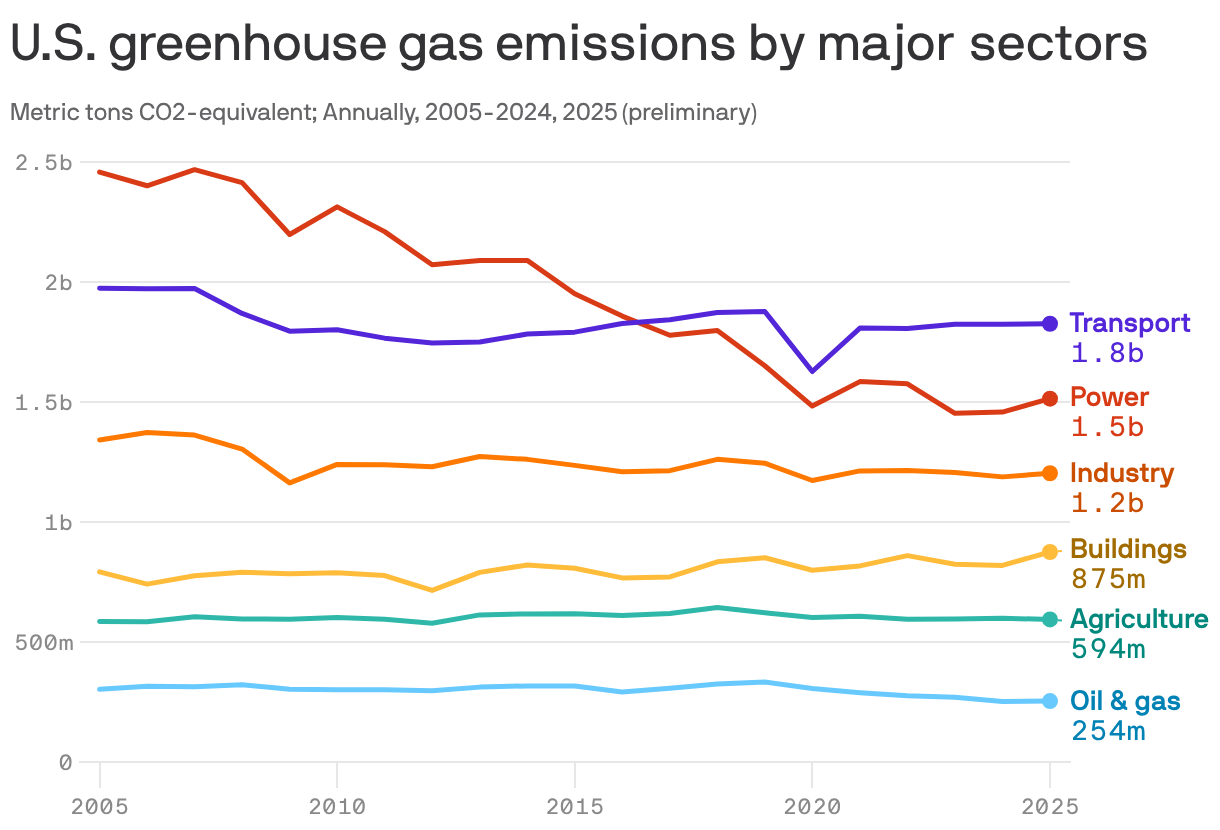
The climate agenda's fall from grace over the past year has been stunning — in speed, scale and scope.
Why it matters: Whether this collapse in climate-changeambition proves permanent or temporary will shape the planet — which is still warming in unprecedented ways — and trillions of dollars in global energy investment.