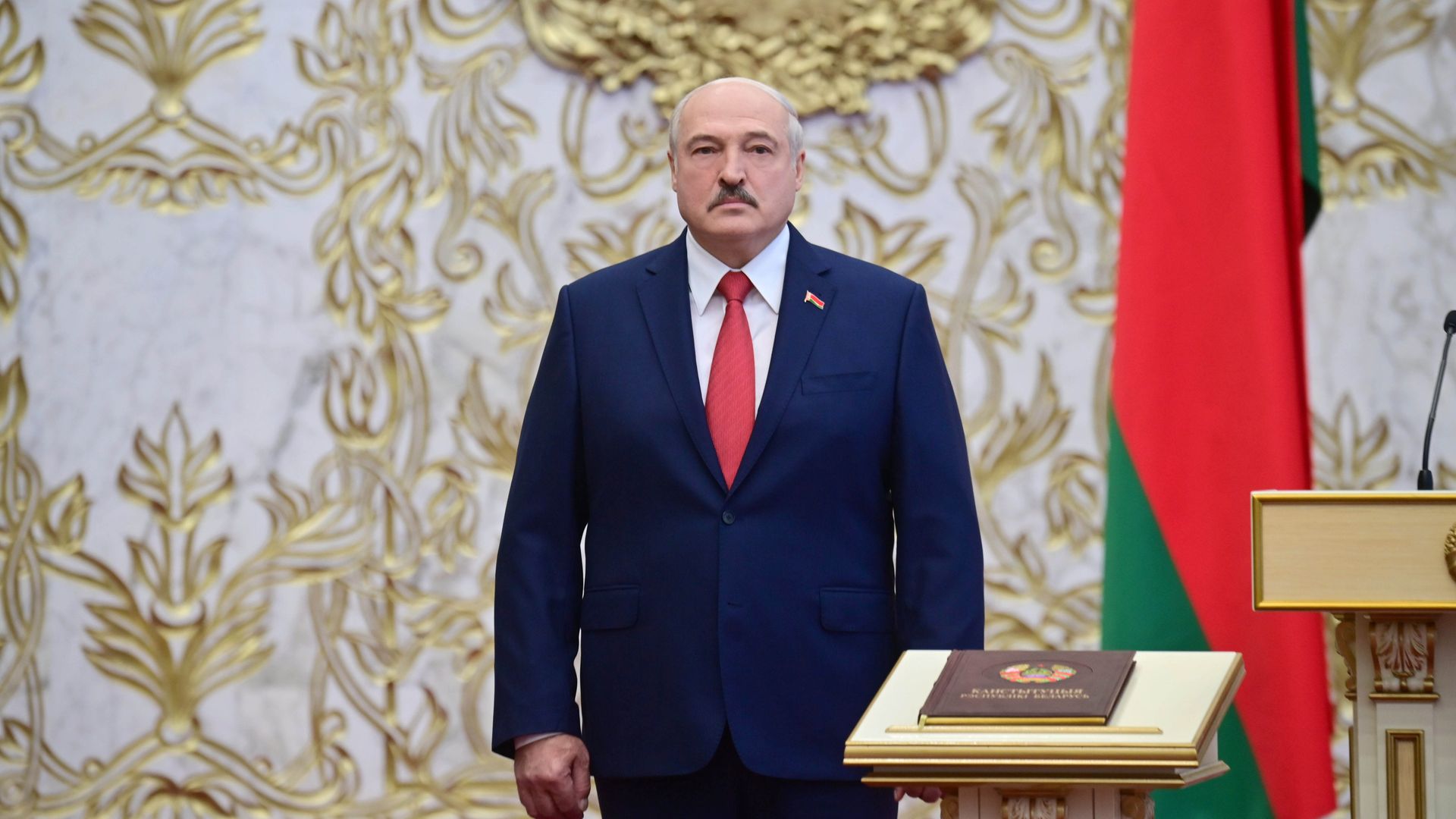
The U.S. no longer recognizes Aleksandr Lukashenko as the legitimate president of Belarus, the State Department said in a statement on Wednesday.
Why it matters: Lukashenko has clung to power with the support of Russia amid seven weeks of protests that have followed a blatantly rigged election. Fresh protests broke out Wednesday evening in Minsk after it emerged that Lukashenko had held a secret inauguration ceremony.
An Iranian cyber operations front organization that’s a target of new U.S. sanctions was itself the victim of an attack that looted its own hacking tools and dumped them on the internet two years ago.
Driving the news: Last week, amid increasing tensions between Washington and Tehran, the Treasury Department announced major new Iran-related sanctions targeting cyber operators working for Iranian intelligence. The sanctions targeted 45 individuals affiliated with Iran’s Ministry of Intelligence and Security (MOIS), Tehran’s main civilian intelligence agency.
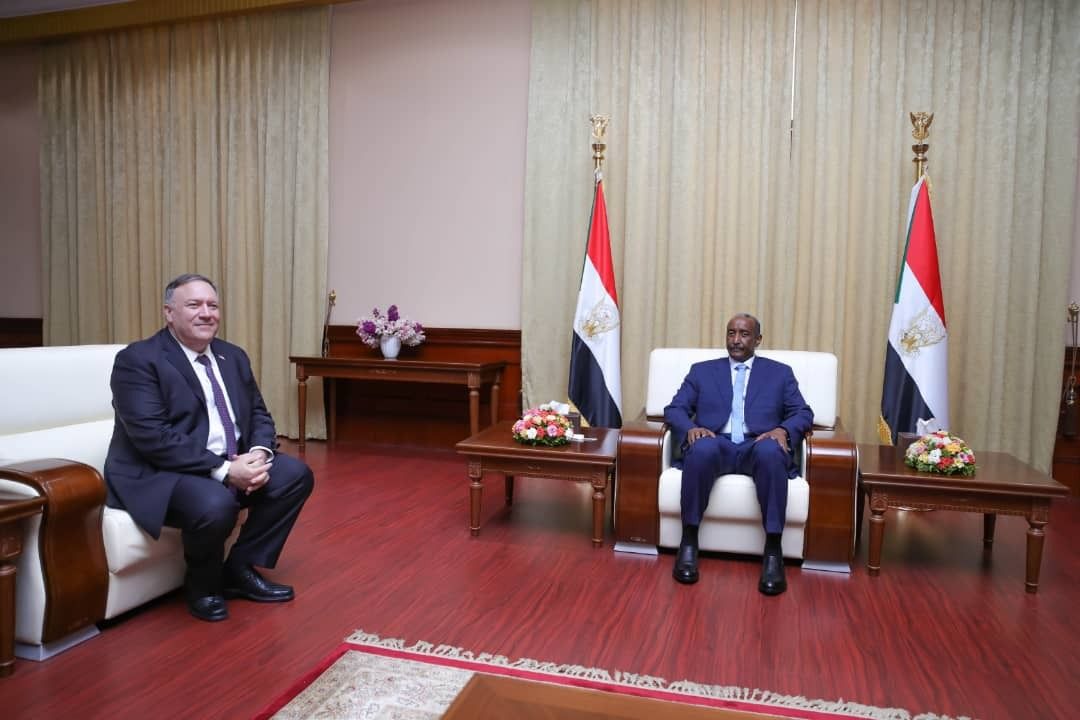
Burhan (R) with Secretary of State Mike Pompeo last month in Khartoum. Photo: Handout/Anadolu Agency via Getty Images
Negotiations in Abu Dhabi between the U.S. and Sudan have ended without a breakthrough on Sudanese recognition of Israel, sources briefed on the talks tell me.
The big picture: Sudan is trying to re-engage with the world economically as it transitions from the dictatorship of Omar al-Bashir, and needs U.S. sanctions relief to do so. The U.S., meanwhile, has pushed Sudan to become the latest Arab country to normalize relations with Israel. The talks in Abu Dhabi, first reported by Axios, were the most substantive to date on that topic.
Major climate news arrived on Tuesday when Chinese President Xi Jinping said China would aim for "carbon neutrality" by 2060 and a CO2 emissions peak before 2030.
Why it matters: China is by far the world's largest greenhouse gas emitter. So its success or failure at reining in planet-warming gases affects everyone's future.
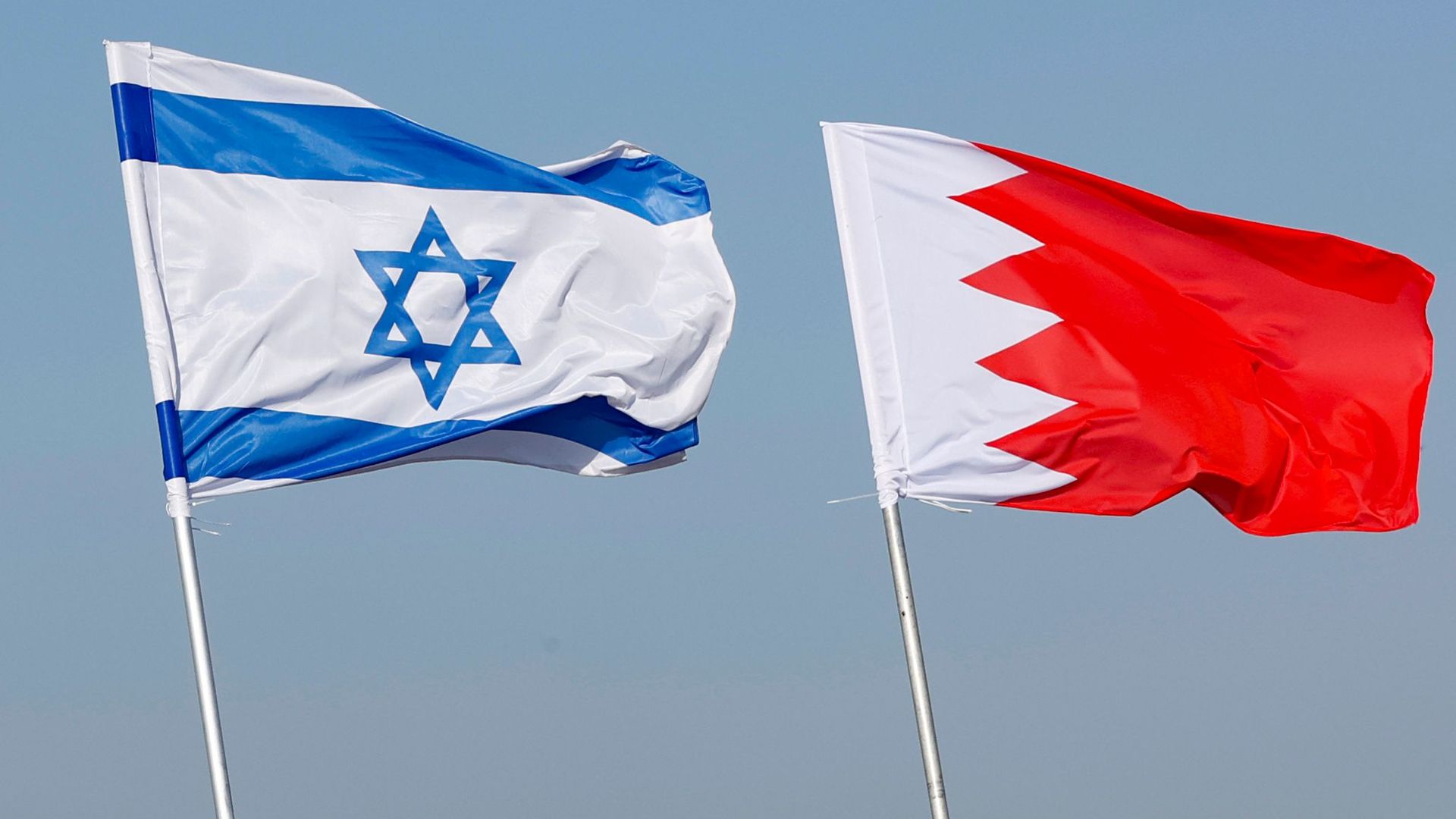
A senior Israeli delegation traveled Wednesday to Bahrain for talks on the drafting of the U.S.-brokered peace treaty between the countries, Israeli officials told me.
The state of play: Both countries need to draft a detailed and comprehensive peace treaty that will have a firm legal status and include side agreements on several fields of bilateral cooperation, according to the officials.
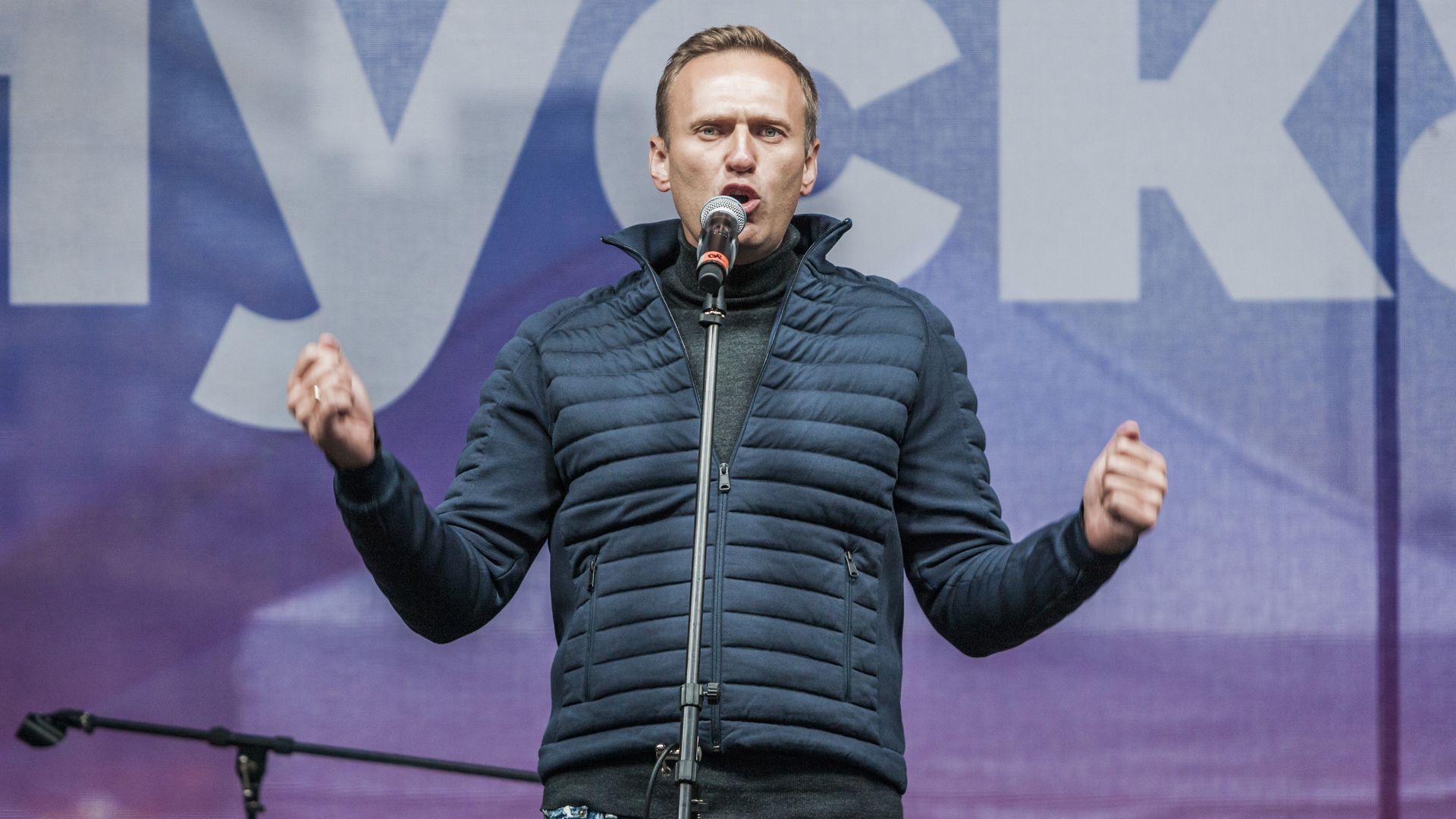
Russian activist Alexei Navalny was released from a German hospital on Wednesday after 32 days of treatment for Novichok poisoning, per the AP.
Why it matters: It is widely suspected that Russian state operatives took part in poisoning Navalny while on a domestic flight. Novichok is a Soviet-era poison often attributed to Russian security services, and Navalny is one of President Vladimir Putin's most outspoken critics.
Navalny was kept in a medically induced coma for two weeks after being poisoned. Doctors say it is too soon to know if he will face any long-term side effects from the nerve agent.
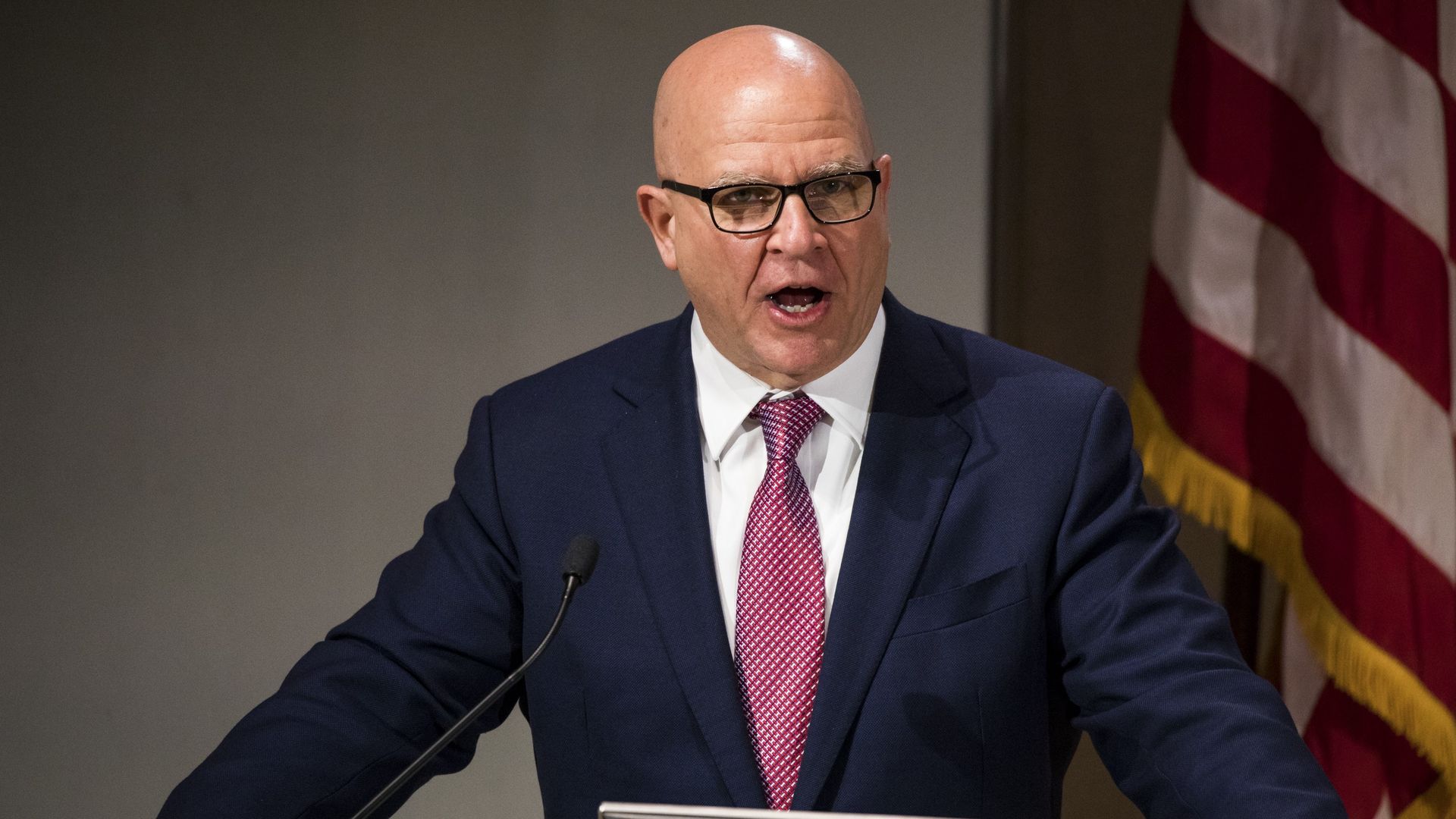
H.R. McMaster told CNN Tuesday evening President Trump and other U.S. leaders are "making it easy" for Russian President Vladimir Putin to peddle conspiracy theories on the U.S. election and Democratic presidential candidate Joe Biden.
What he's saying: "It's just wrong ... it's really important for leaders to be responsible about this because, really, as you know Putin doesn't create these divisions in our society, he doesn't create these doubts, he magnifies them," Trump's former national security adviser told CNN's Jake Tapper.
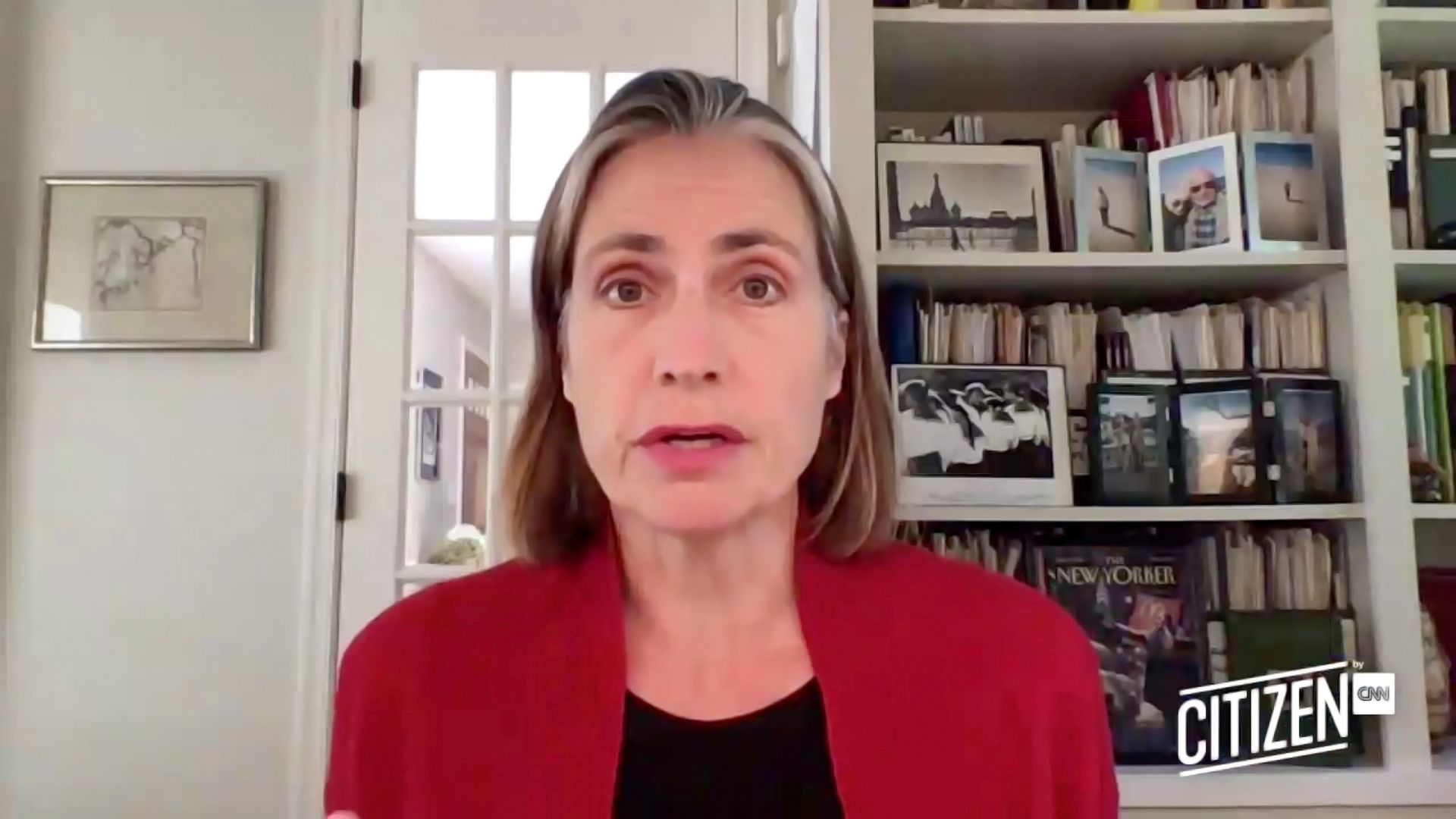
Former top White House Russia adviser Fiona Hill said Tuesday the "bungled handling of COVID," race relations, "political polarization" and the "spectacles that we're presenting" have eroded the United States' world standing.
What she’s saying: "We are increasingly seen as an object of pity, including by our allies, because they are so shocked by what's happening internally, how we're [eating] ourselves alive with our divisions," Hill told CNN's Jim Sciutto at the Citizen by CNN 2020 conference.
The House on Tuesday voted 406-3 in favor of a bill to ban products made with forced labor in China's mass detention camps.
Why it matters: The U.S. has ramped up pressure recently on China to address human rights abuses in the Xinjiang region, where the Chinese government has engaged in a campaign of cultural and demographic genocide against Uighur Muslims and other ethnic minorities.
Democrats and Republicans have sharply differing views on some aspects of foreign policy and national security. But when it comes to China, there is some degree of consensus, according to a new survey by the Chicago Council on Global Affairs.
Details: There is widespread support across party lines for sanctions to combat China's human rights violations, as well as measures to protect Americans from the potential risks of Chinese technology.
China's economic planning and targeted subsidies have increased the competitiveness of Chinese firms in the global economy to the direct detriment of U.S. industry, an academic study has found.
Why it matters: When it comes to American industries and workers, the rise of Chinese industrial policy hasn’t been a win-win — researchers found for every 100 factories opened in China, 12.5 U.S. factories in the same industry closed.
Chinese Communist Party Secretary Xi Jinping announced last week that the party must strengthen its leadership over private companies, and that entrepreneurs must meet the party's needs.
Why it matters: Xi's new announcement will increase fears that Chinese businesses may serve as a Trojan horse for the CCP.
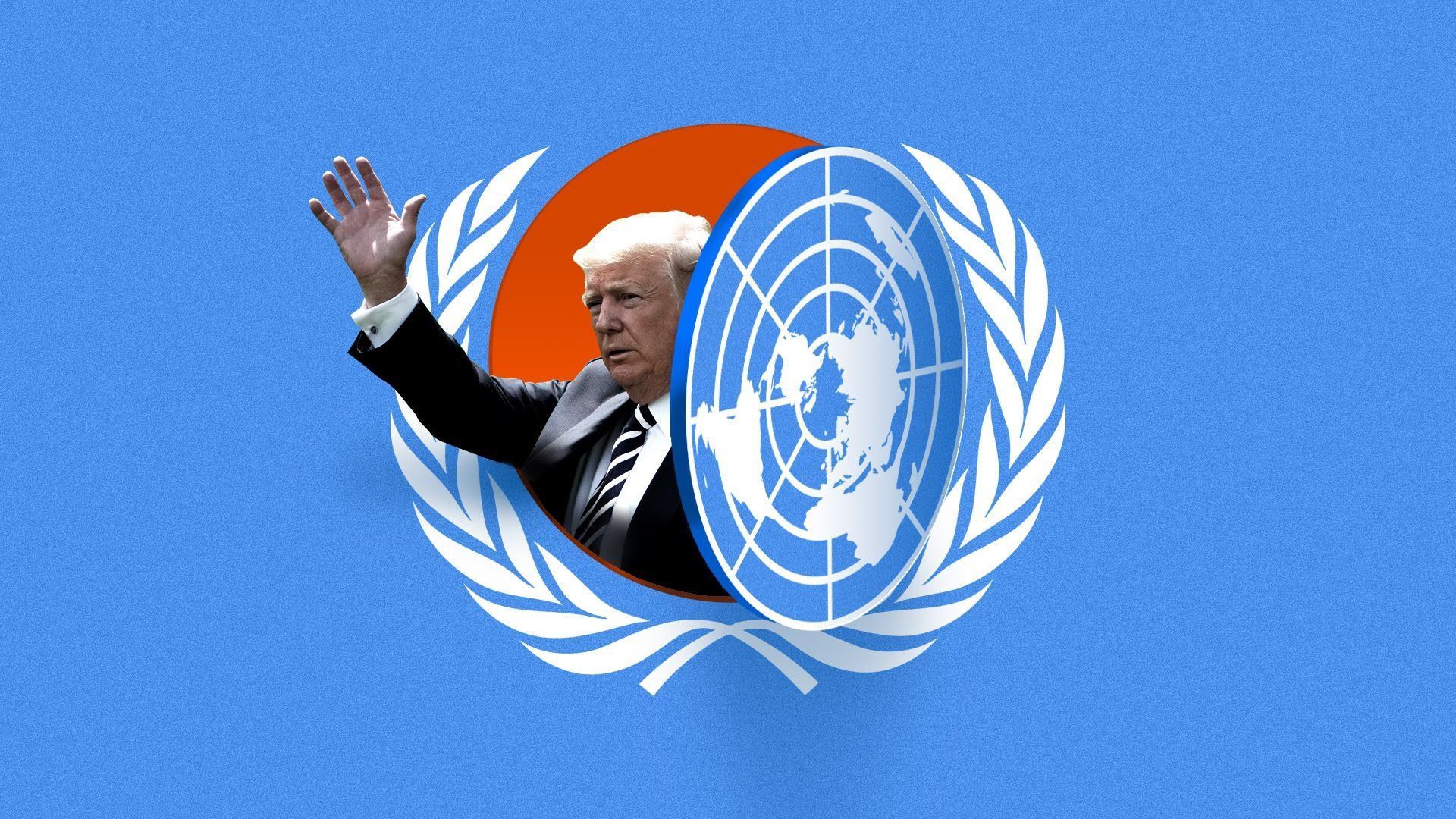
President Trump used a virtual address to the UN General Assembly on Tuesday to defend his response to the coronavirus and call on other countries to “hold accountable the nation which unleashed this plague onto the world: China.”
Setting the scene: Trump ticked through four years of major decisions and accomplishments in what could be his last address to the UN. But first, he launched into a fierce attack on China as Beijing’s representative looked on in the assembly hall.
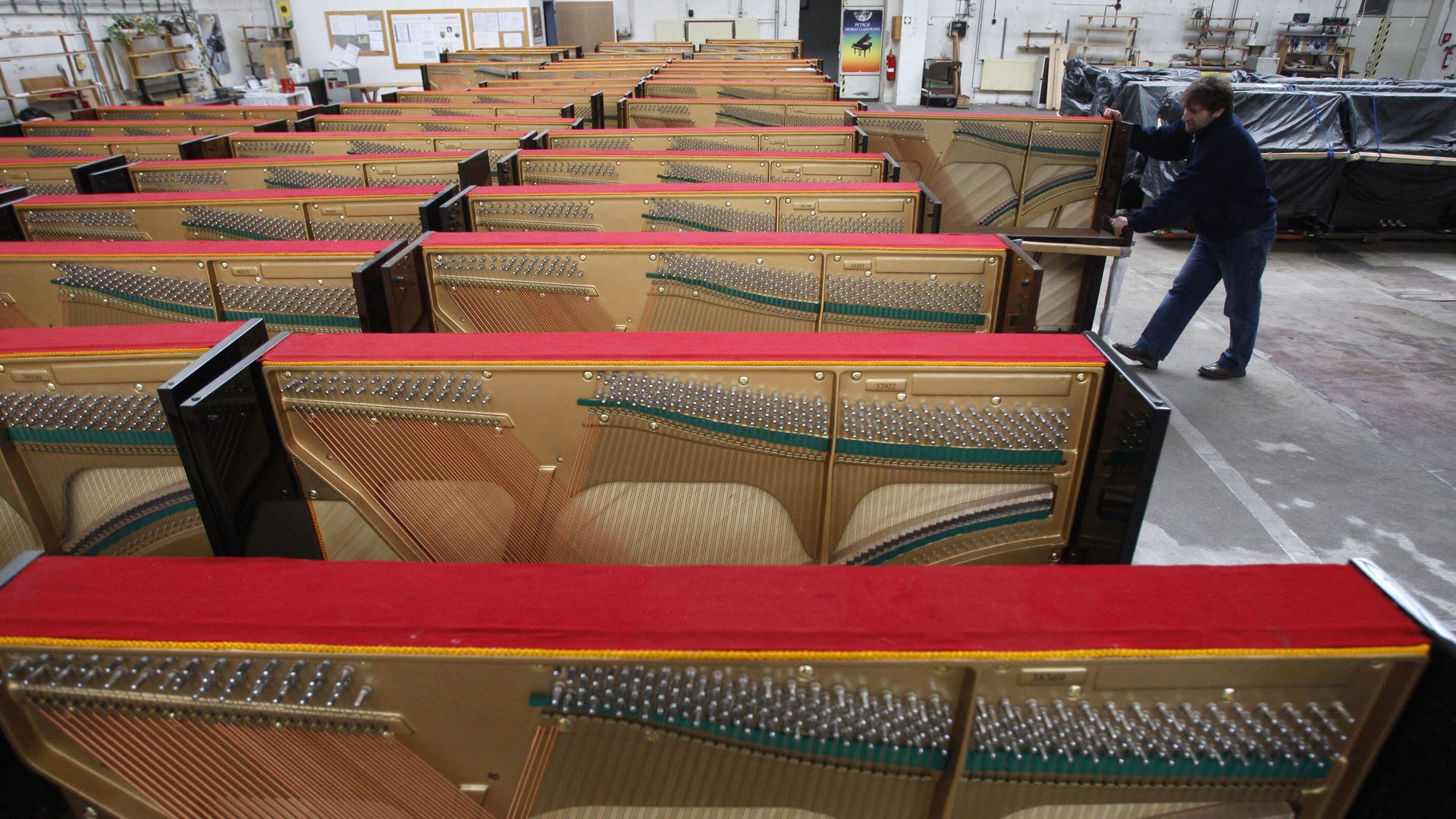
Back in February, I wrote about how the classic Czech piano company Klaviry Petrof, founded in 1864, could face losses after China threatened retaliation on Czech companies after a Czech politician planned to visit Taiwan, which the Chinese government views as part of its territory.
After a second Czech official visited Taiwan in August, China made good on that threat — a Chinese company suspended a $23.8 million order of the Czech-made pianos.
The big picture: WeChat's ban has had a lower profile than TikTok's, but the fate of the app, widely used by Chinese people around the world to stay in touch with family and friends, is at least as consequential.
President Trump and China’s Xi Jinping will address the UN General Assembly just minutes apart on Tuesday morning — with Russia’s Vladimir Putin following soon thereafter.
The big picture: Trump has promised a “strong message on China.” Xi, meanwhile, is expected to laud global cooperation — with the clear implication that it can be led from Beijing.