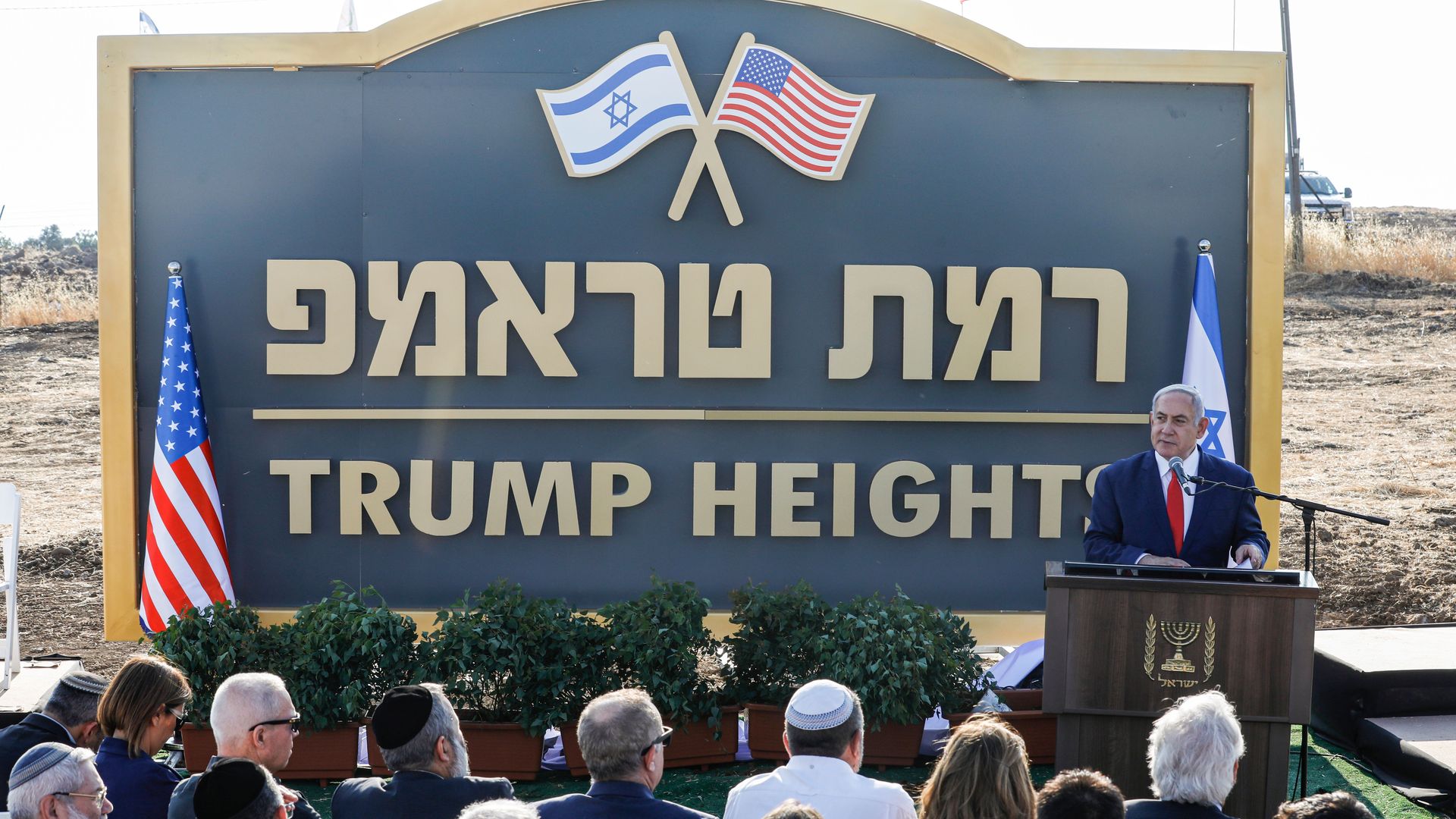
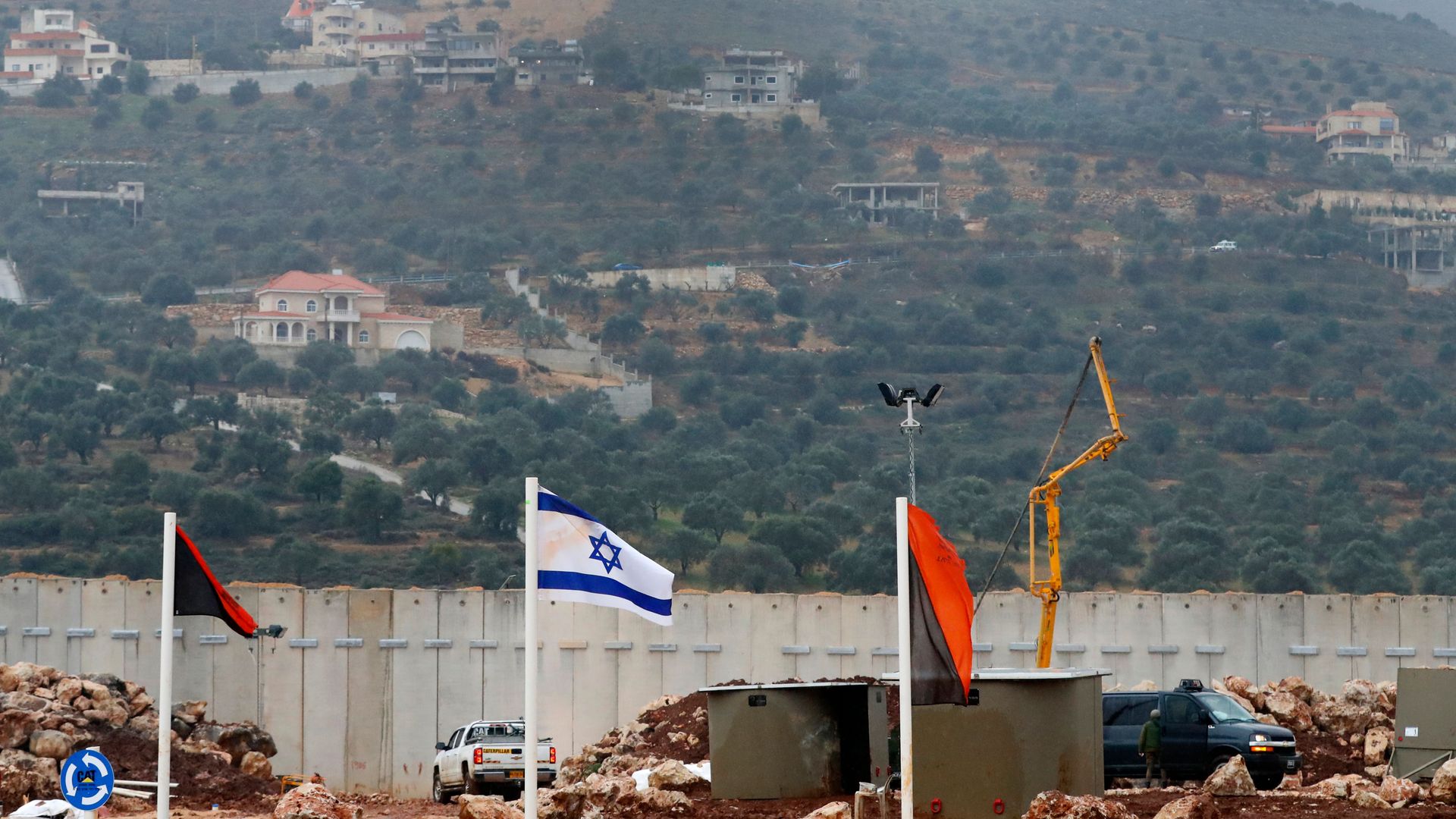
Israel's Prime Minister Benjamin Netanyahu and the U.S. Ambassador to Israel David Friedman hosted a special ceremony Sunday to dedicate a new town in the Golan Heights called "Ramat Trump," or "Trump Heights" in English. The only problem is that for now, this is only a "paper town," meaning it does not yet exist and is not even in planning stages.
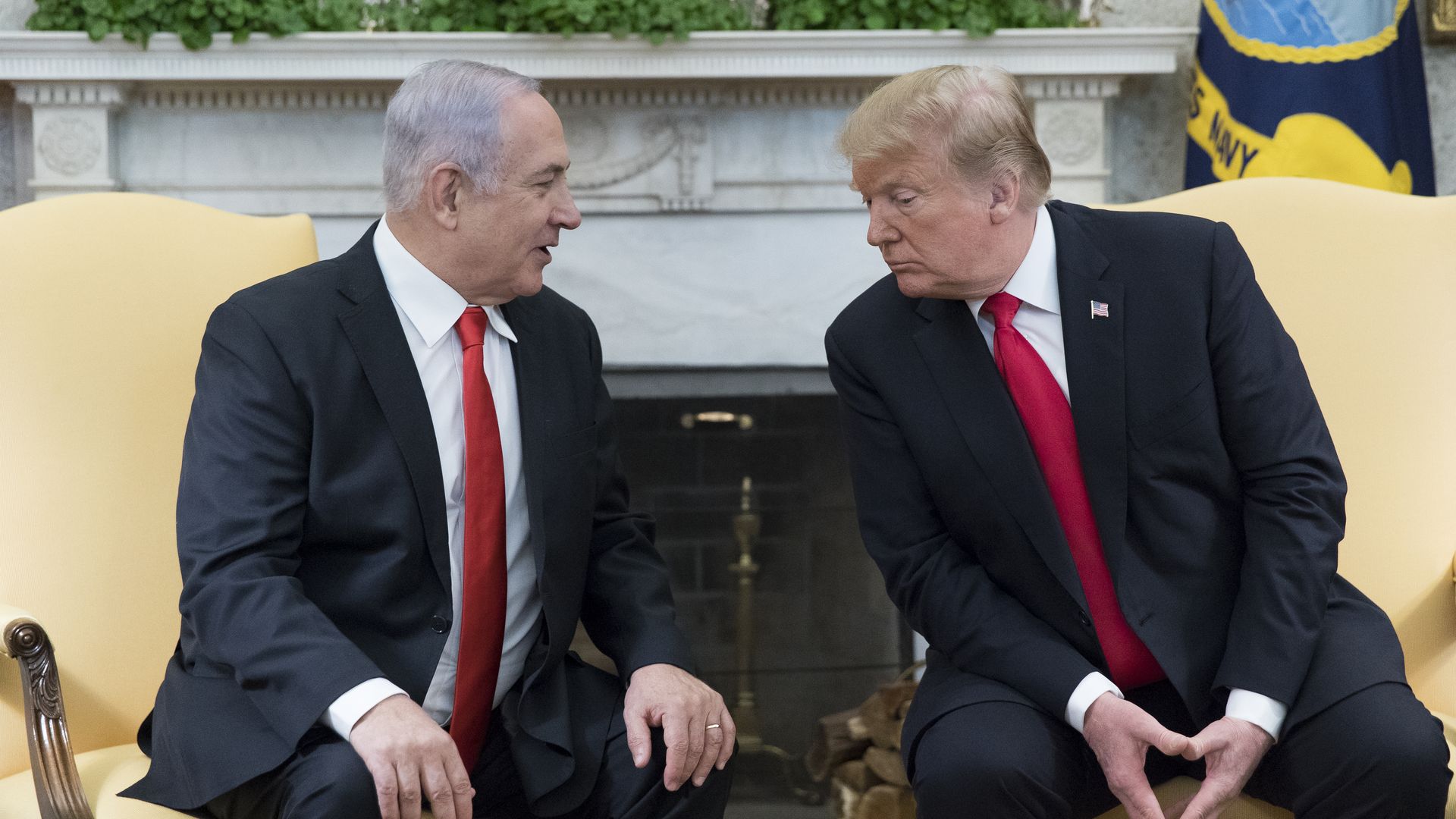
Why it matters: This is a public relations stunt meant for a domestic audience on the eve of the upcoming elections. It's also significant for foreign policy reasons, intended for a target audience of one — President Trump. Trump's recognition of the Golan Heights in March gave a dramatic boost to Netanyahu's election campaign. Netanyahu will need Trump's help again soon with the new September 17 elections looming.
The White House's special envoy for Middle East Jason Greenblatt said Sunday at the Jerusalem Post Conference in New York that the Trump administration is leaning toward holding off on releasing the political part of its Israeli-Palestinian peace plan until November, when a new Israeli government is formed.
Why it matters: President Trump was frustrated by Israeli Prime Minister Benjamin Netanyahu's inability to form a coalition in May, which forced him to call a new election. Greenblatt admitted in his comments that the political developments in Israel torpedoed the White House's timetable for the peace plan.
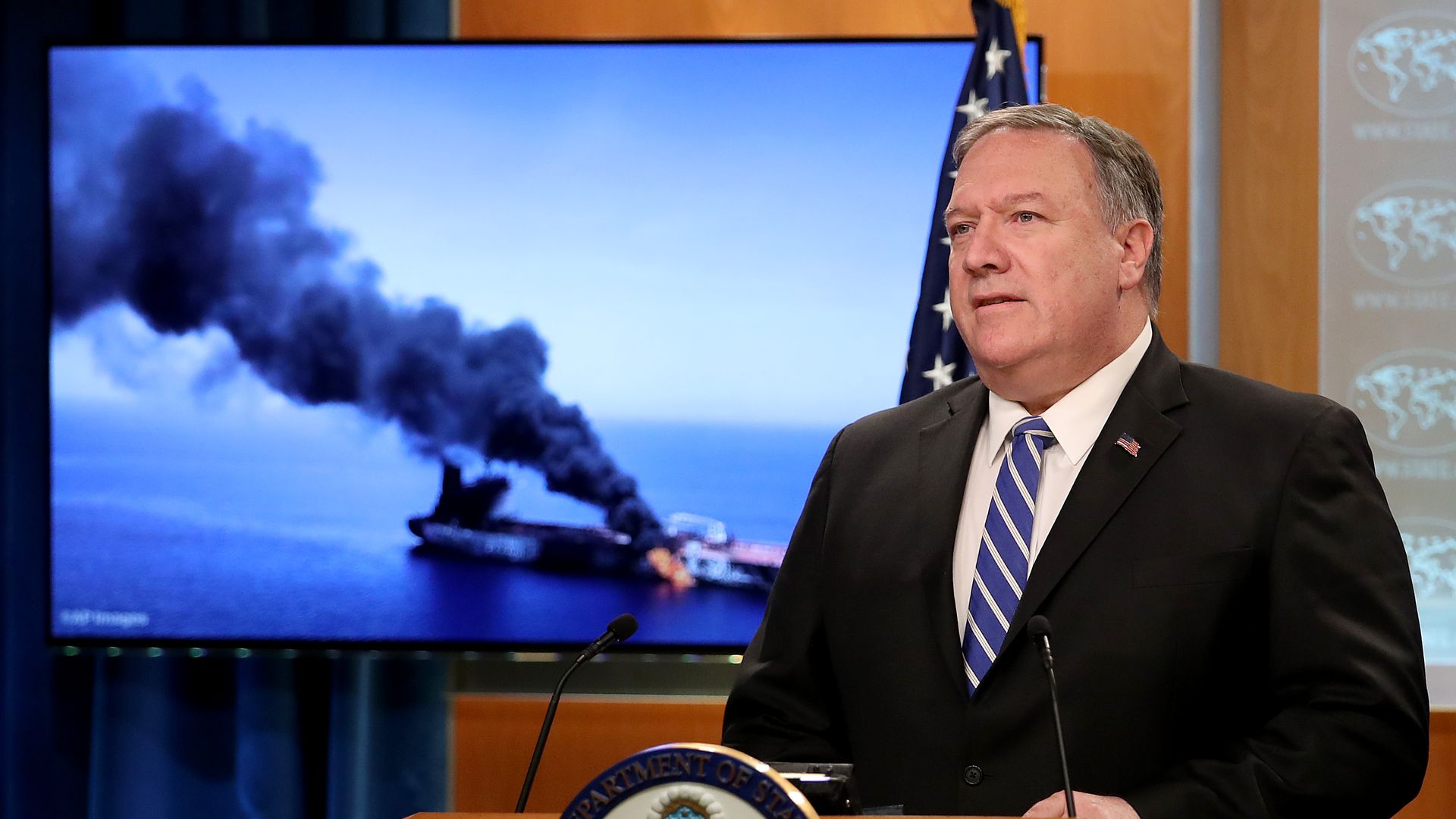
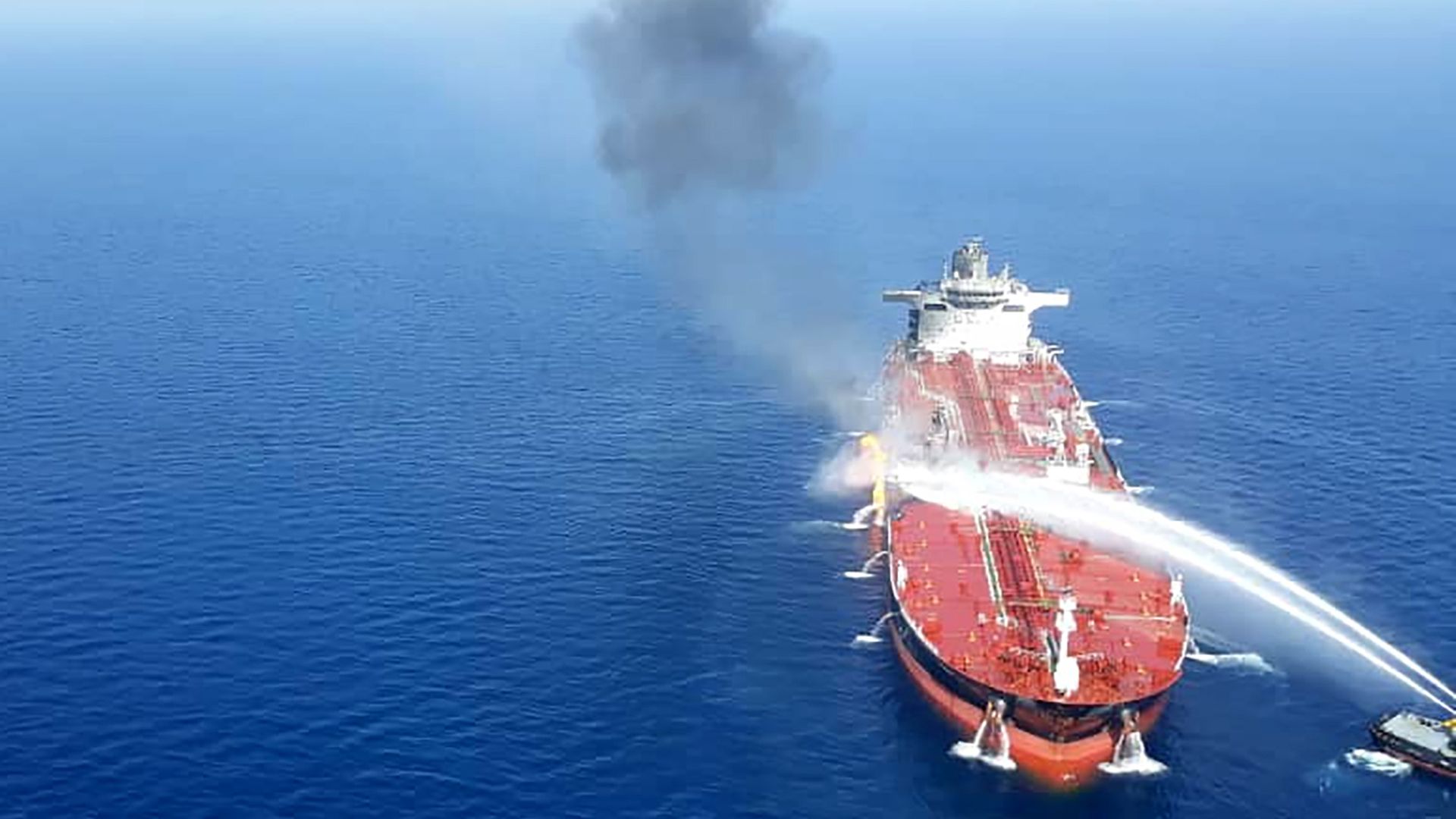
Saudi Arabia has joined the U.S., Israel and the United Kingdom in blaming Iran for attacks on two oil tankers in the Gulf of Oman last week, the Washington Post reports.
Why it matters: Tensions between the U.S. and Iran have ratcheted up once again after the threat of war seemed to have subsided in recent weeks, with Secretary of State Mike Pompeo telling Fox News Sunday: "We’ve taken a handful of actions to increase the opportunity to convince Iran that these actions aren’t in their best interest. And it appears to be Iran that wants to escalate this conflict."
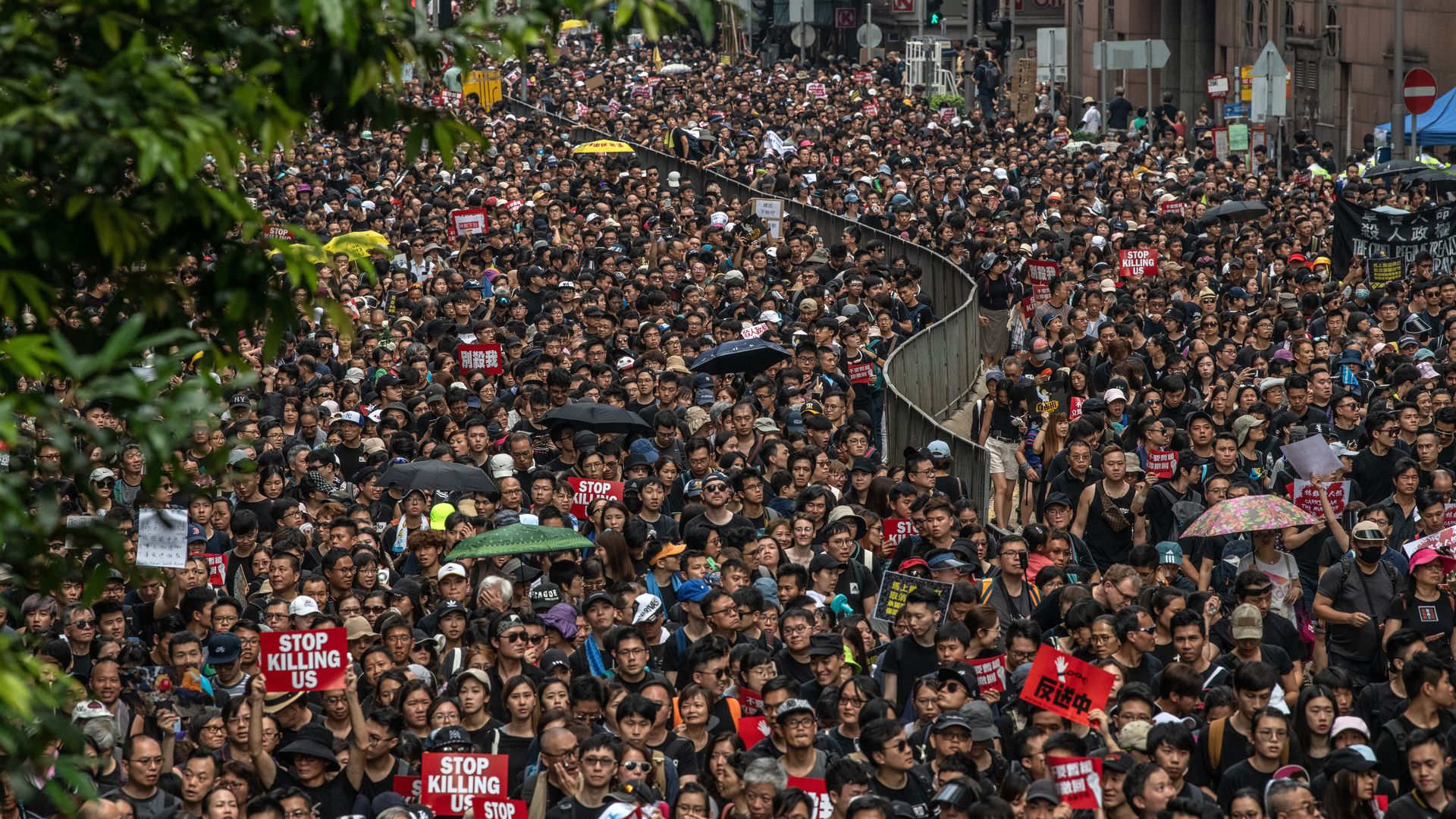
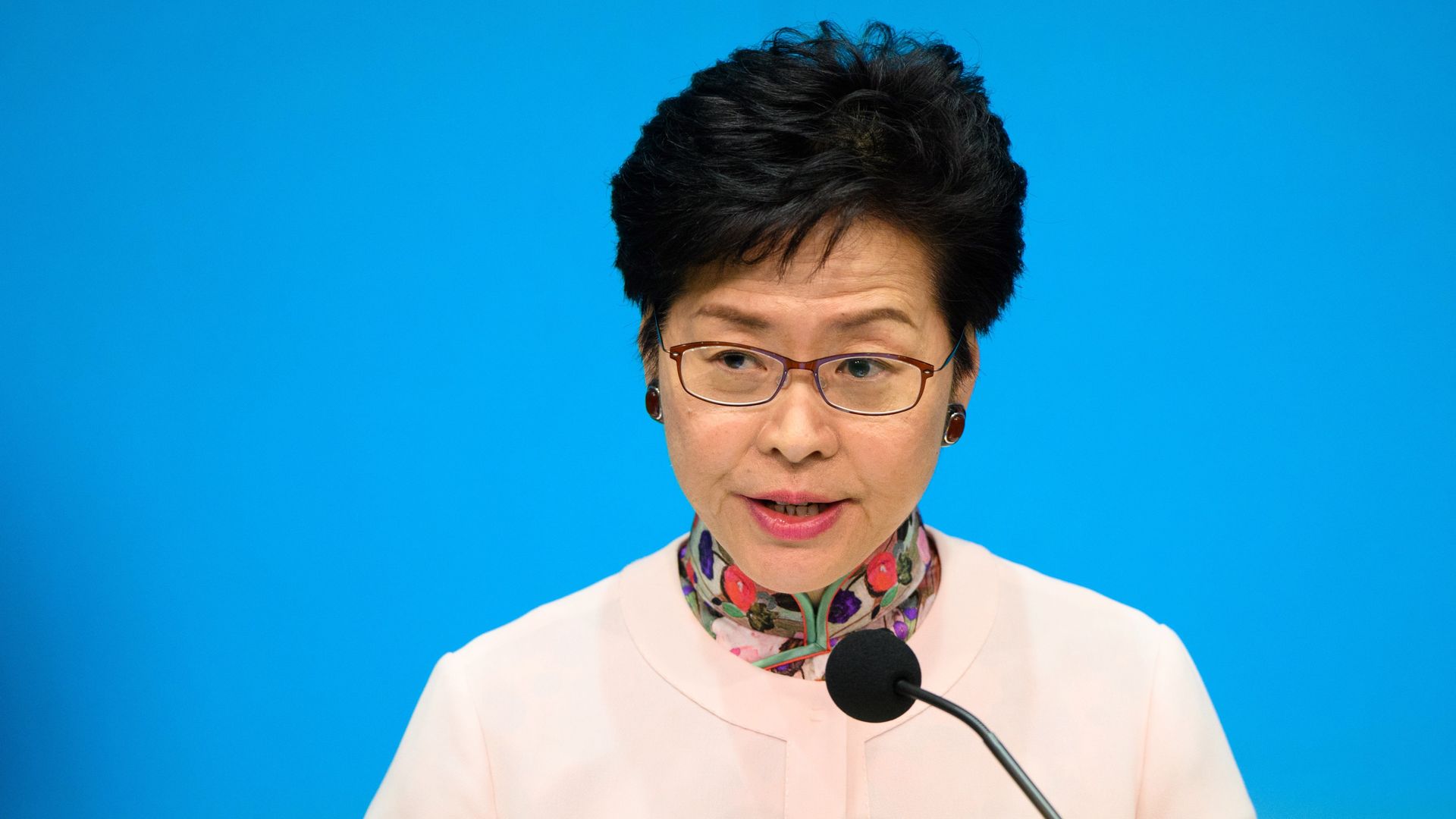
Hong Kong's leader Carrie Lam has apologized for a controversial extradition bill that prompted hundreds of thousands of protesters to take the streets on Sunday and demand for her resignation.
"The Chief Executive acknowledges that her government work has been unsatisfactory, leading to confusion and conflict in society, and leading to disappointment and heartbreak. The Chief Executive would like to apologize to the city’s citizens and is open to receiving criticism [on how to] further improve and provide better services for the broader society.”
Why it matters: Lam indefinitely suspended the bill on Saturday after violent clashes between protestors and police this week, but refused to withdraw it completely. The move did little to quell what has become Hong Kong's worst political crisis in decades.
Israeli officials told me that Iran's Islamic Revolutionary Guard Corps (IRGC) is responsible for the attack against the two oil tankers in the Gulf earlier this week. Israeli officials intimately involved in policy on Iran claimed the IRGC used naval mines and a torpedo to attack the tankers.
Why it matters: Israel is the third country with advanced intelligence gathering capability on Iran to publicly point a finger at the IRGC for the attacks. In the last few days both President Trump and Secretary of State Mike Pompeo blamed the Iranians for the attack. Yesterday, the British Foreign Office announced there is high probability the IRGC is behind the attacks.
Hong Kong's leader Carrie Lam announced on Saturday that a controversial bill to allow extradition to mainland China will be indefinitely suspended, but not withdrawn, per the New York Times.
Why it matters: More than a million Hongkongers have taken to the streets in the past week to protest the extradition bill, which some fear could be used as a political ploy to arrest and try political activists who oppose the Chinese government. Activists are still demanding that Lam withdraw the bill altogether, and are planning another mass protest for Sunday.
The first round of U.S.-mediated talks between Israel and Lebanon over the two countries' long-standing maritime border dispute is expected in July, a senior Israeli official told me.
Why it matters: Israeli-Lebanese talks would be a dramatic diplomatic development and a significant step forward in a long-standing conflict that has stalled natural gas exploration in the eastern Mediterranean. Solving the crisis could unlock potential natural gas reserves for both countries.
Iranian forces reportedly shot down an American MQ-9 Reaper drone in the hours before Thursday's attack on two oil tankers near the Strait of Hormuz, a U.S. official tells CNN.