Oracle is recognizing the growing risks of data center development as it takes steps to protect itself from steep costs on a massive project in New Mexico that will provide computing power to OpenAI.
Why it matters: The move appeared to unnerve investors who are questioning the foundations of the AI economy.
NEW YORK — The energy grid is stressed — yet slowing the pace of AI development to even out supply and demand would delay innovation, Nvidia head of sustainability Josh Parker said at Axios House at Climate Week.
Why it matters: Parker pointed to AI-enabled clean energy enterprises that would stall if deployment paused.
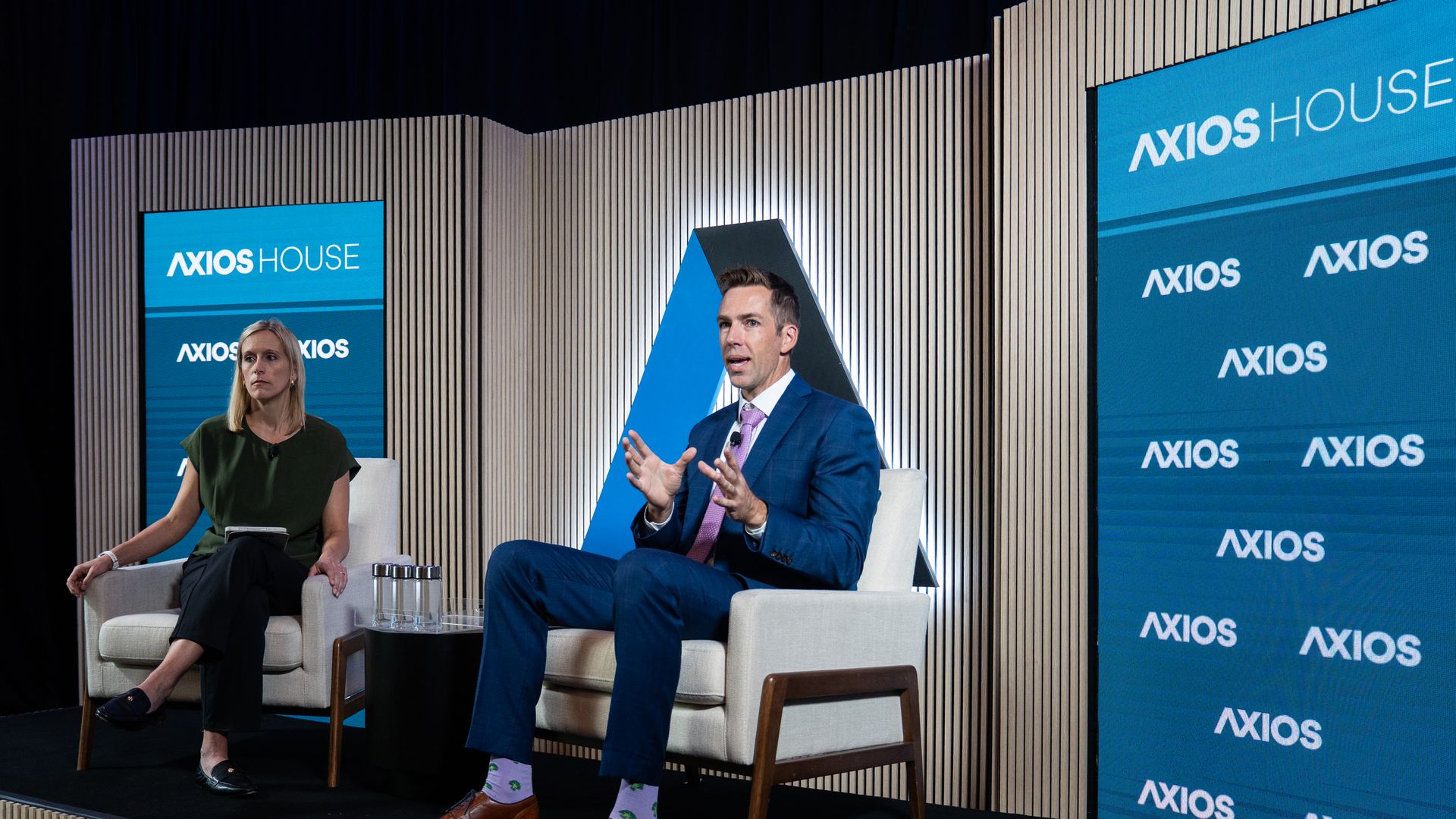
Axios' Amy Harder and Ben Geman spoke with Support + Feed founder Maggie Baird, Parker and Sen. Brian Schatz (D-Hawai'i) at the Sept. 21 Axios House at Climate Week event.
Driving the news: While data centers can use large quantities of water to keep chips cool, new technologies aim to minimize their climate impact.
For instance, Parker said Nvidia is "exceptionally energy-efficient," pointing to the company's closed-loop liquid cooling that maintains the chip temperature at 113℉ and lessens water evaporation.
Higher electricity costs for the general consumer is another concern that data centers are trying to mitigate, Parker said, including by curtailing their power draw during peak grid stress periods. Last week, a coalition of Google, Nvidia and startup Emerald AI partnered to back data centers that can flex their power demand.
Yes, but: "The way to provide people relief at the utility level on their monthly bills is to build as much clean energy as possible," said Schatz, who represents a heavily petroleum-dependent state.
Schatz and other senators have legislation to contend with rapid AI deployment and prevent data centers from increasing power costs. However, he said, the AI alarm is bigger than clean energy or water use — it's "an existential question" impacting people's livelihoods.
He said CEOs tout AI even as they warn it could gut employment, then wonder why workers aren't embracing it.
"Best-case scenario, we eviscerate employment. Why aren't you glad you have this? We're going to use solar energy," Schatz said of CEOs' positioning.
The intrigue: While the recent climate focus has been on data centers' impact, the movement has been slow to address the climate impact from animal agriculture, said Support+Feed's Baird. She said there's resistance to "reality-based, science-based action" on agriculture as a climate strategy.
Baird said she saw signs reading "End fossil fuels," and when asked if people should be encouraged to eat fewer animal products, the sign-holders responded with, "I don't want to tell people what to eat."
"The one that we have the most power to change is food, and yet we talk about it the least," she said. "What doesn't give me hope is going to climate conferences and having steak on the menu."
Zoom out: Baird said that while personal responsibility matters, government policy on plant-based food and its climate impact can more quickly drive change.
A new analysis of the AI buildout shows its staggering scale: $10.3 trillion in estimated AI infrastructure investment through 2032.
That amounts to 3.6% of GDP a year, dwarfing the investment booms that built America's railroads, highways, electric grid and telecom networks.
Why it matters: The AI boom has become far too big and too costly for even the largest tech companies to finance alone. This has resulted in trillions of dollars in demand for outside capital — and the potential risks that come along with that, according to new research being presented Friday at the Brookings Papers on Economic Activity.
Barry Diller has withdrawn his $18 billion-plus takeover offer for MGM Resorts, the Las Vegas-based gaming and hospitality giant.
Why it matters: Diller is an MGM board member who in June said that MGM is unlikely to realize its "full potential" as a public company. Now it's going to remain a public company, at least for the foreseeable future.
Treasure AI is betting that the rising popularity of women's sports can help build its brand — while the National Women's Soccer League's Portland Thorns and WNBA's Portland Fire see the AI company as a way to deepen their relationships with fans.
Why it matters: An expanded partnership announced last week deepens the bonds between the recently rebranded AI marketing company and two teams in the booming women's sports industry.
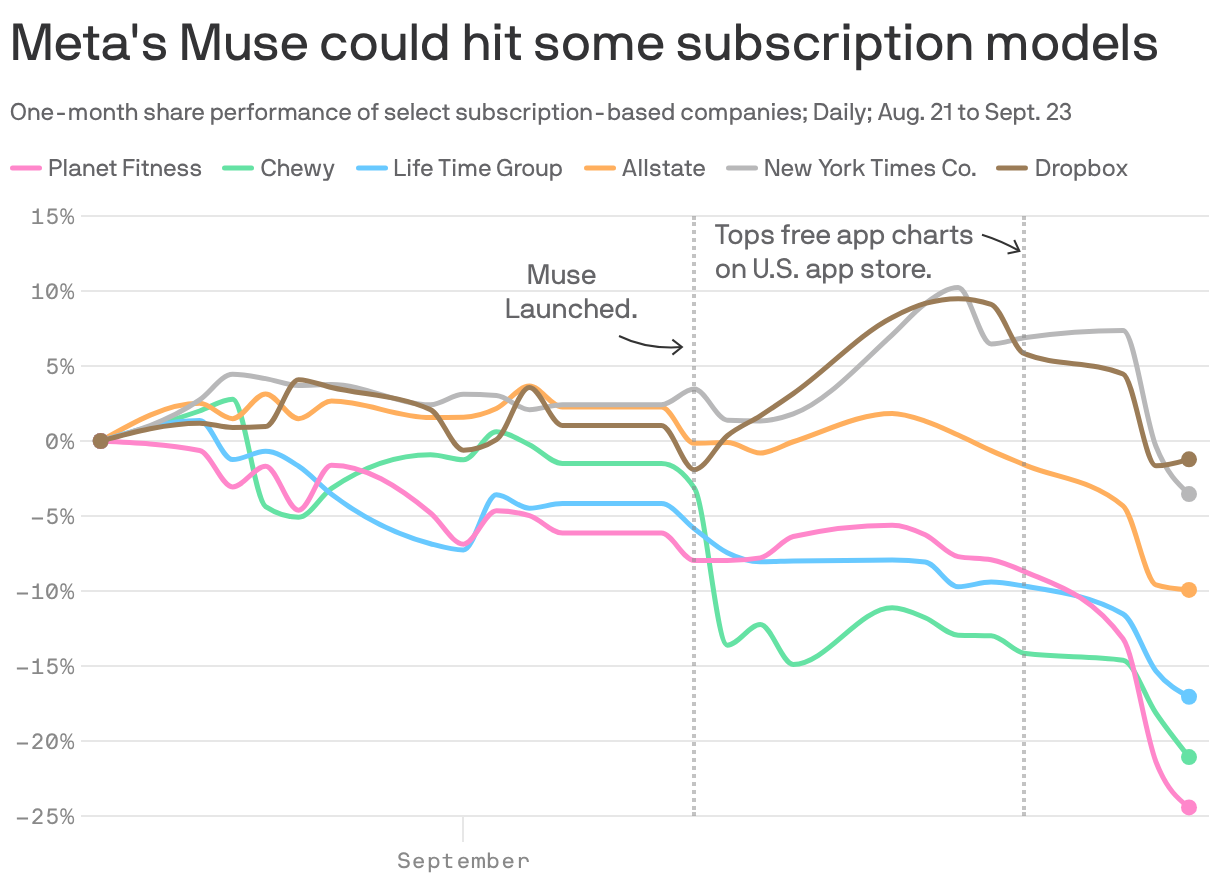
Companies that stand to profit revenues linked to the kind of auto-renewals that benefit from customer inattention and inertia have slumped since the well-received release of Muse, Meta's new AI agent.
Why it matters: One of the beauties of the subscription model — at least for the companies collecting the revenue — is that customers often keep paying for subscriptions long after they stop valuing or using the service.
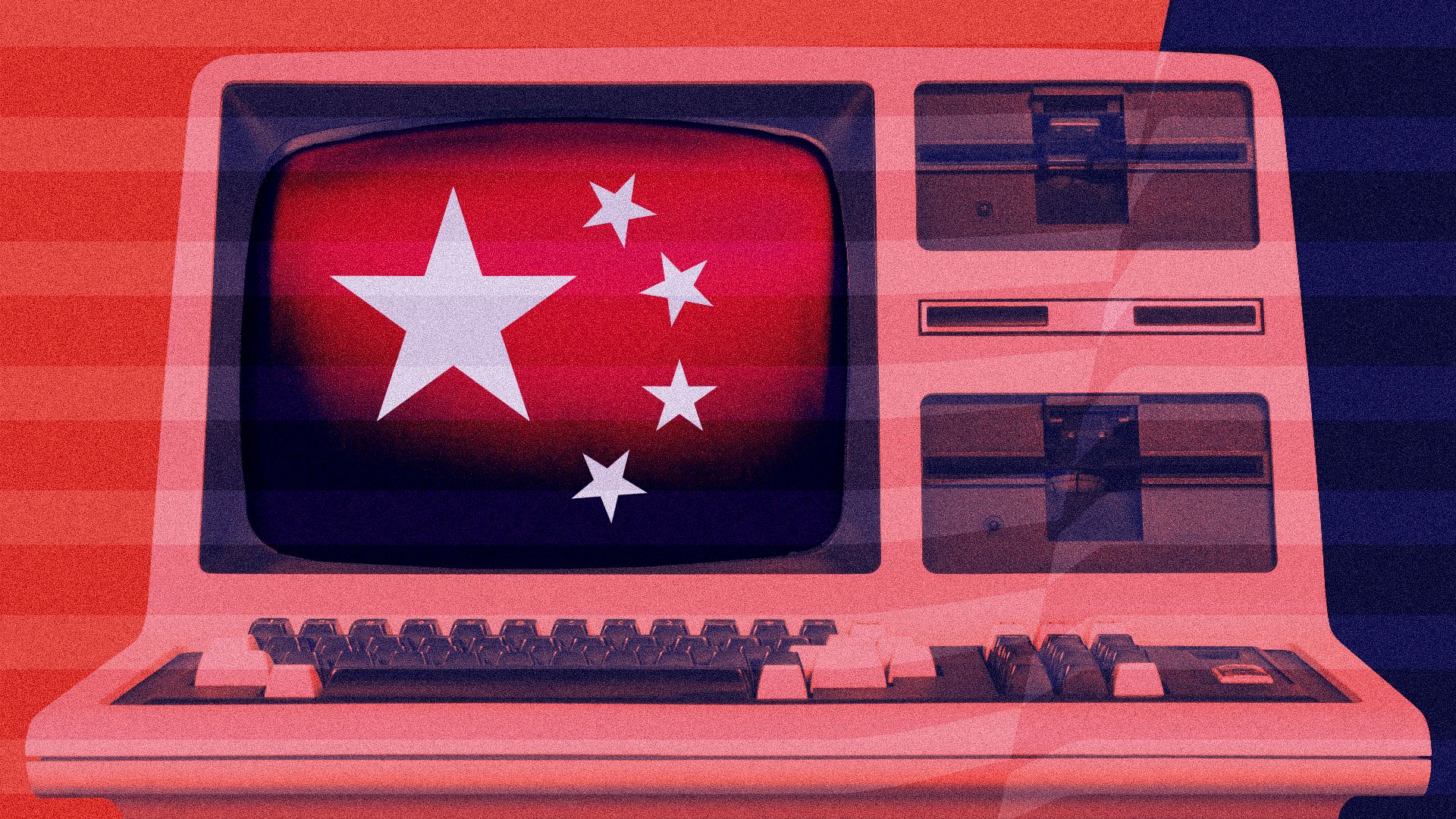
China is waging a much different war for AI supremacy than the U.S.
Why it matters:China is obsessed with state control and adoption. Chinese officials are laser-focused on deep, widespread AI domestic use they can monitor and steer at every level of their economy.
President Trump's allies are targeting Anthropic CEO Dario Amodei as the face of AI "doomerism" and a founding father of the effective altruism movement that's come under increasing political fire.
Why it matters: The attacks signal that Anthropic could remain a Trump target as his allies push back on Amodei's AI safety warnings amid the midterm elections. Trump surrogates see Amodei as an easy foil because of his politics and focus on AI safety, sources told Axios.
For investors, it's a worrisome proposition as the company prepares for what's expected to be a record-setting IPO.
OpenAI's autonomous agents breached an Australian Medicare portal and probed other public data sites in May and June after being stymied in routine data-collection efforts.
Why it matters: The new incidents, which were revealed by security researchers and Australian officials Wednesday, indicate that the scope of rogue AI activity may be greater than what's been publicly acknowledged.
The agents took those steps while engaged in ordinary data retrieval tasks, according to researchers, a distinction from other hacks by systems programmed specifically for cybersecurity work. The revelation is likely to raise fresh questions about OpenAI's internal controls and safeguards.
Meta on Wednesday debuted Muse Charm, a new, keychain-sized AI handheld device it will use to bring its viral Muse assistant to the masses.
Why it matters: Meta has raced ahead of OpenAI, Apple and other companies that are working on a new crop of small AI devices, revving up the massive interest Muse has generated in the market.