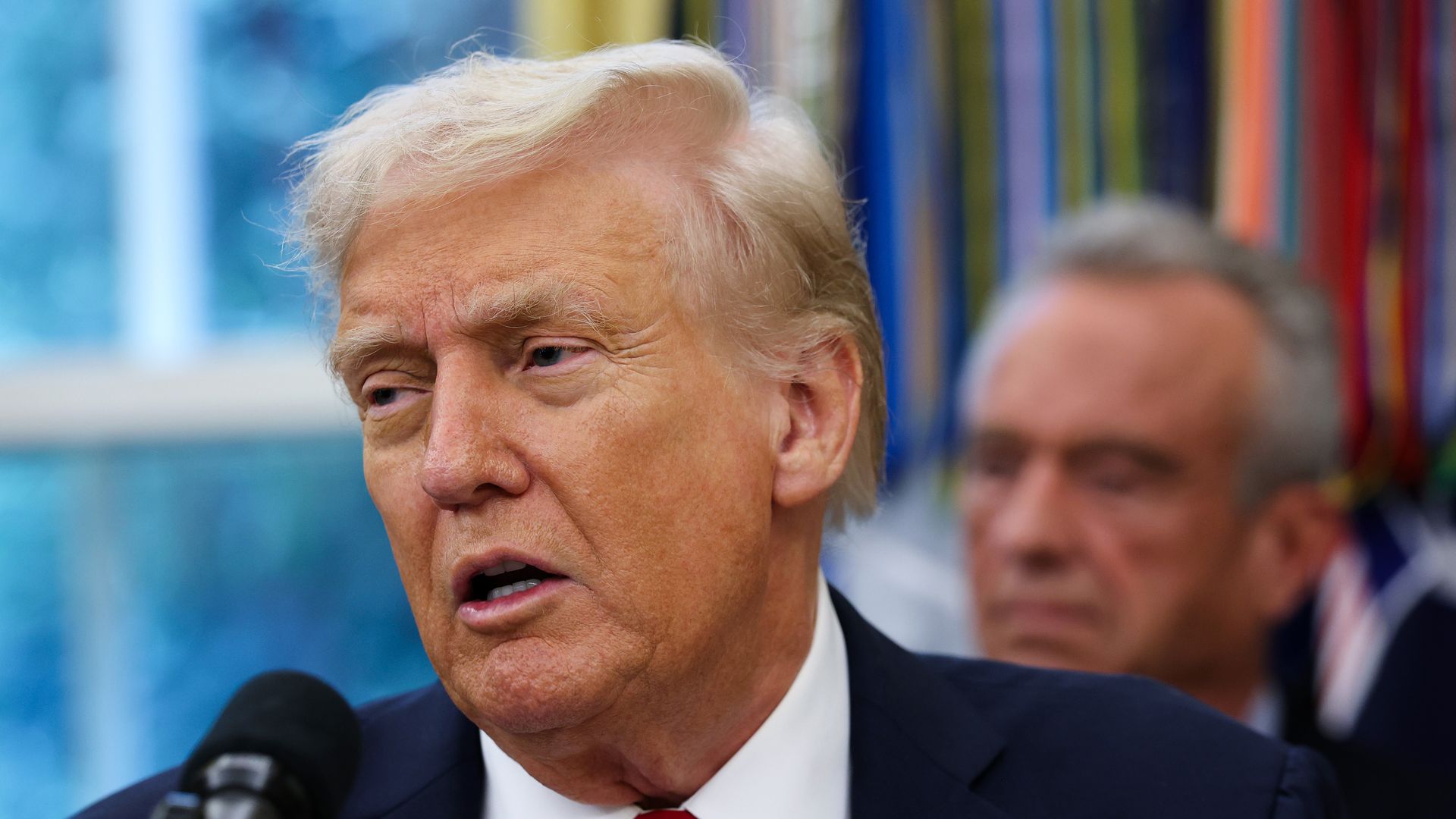
President Trump signed an order Tuesday directing his administration to invest $50 million in AI-driven pediatric cancer research.
Why it matters: The move is part of a broader embrace of artificial intelligence across federal agencies but comes as the administration is slashing biomedical research spending and pausing grants.
The Walt Disney Company last week sent a cease and desist letter to Character.AI demanding the personalized AI chatbot developer immediately stop using its copyrighted characters without authorization, according to a copy of the letter obtained by Axios.
Why it matters: In the letter, Disney emphasizes its main concern isn't just financial, but that Character.AI's platform weaponizes Disney characters in a way that could damage its brand long term.
OpenAI is launching a social video app powered by its generative AI video tool, Sora, which can generate AI videos featuring copyrighted material unless rights holders explicitly opt out, per Axios' Ina Fried.
Why it matters: The opt-out feature suggests OpenAI is willing to take an aggressive stance toward testing the limits of copyright law in an effort to win the short-form video attention battle.
The assailants in several recent mass shootings left behind messages inscribed on bullet casings, posing a dilemma for journalists who want to inform the public without inspiring copycats.
Why it matters: Media outlets don't typically publish manifestos from shooters, but extremism experts warn the messages on the bullets may play the same role.
Tony Haile, the founding CEO of both media analytics company Chartbeat and Scroll, a news startup that sold to Twitter, has raised $10.7 million in seed funding to launch Filament, an invite-only professional conversations platform.
Why it matters: Haile believes professional networking is shifting from open feeds on platforms like LinkedIn to closed spaces where executives can have more private conversations.
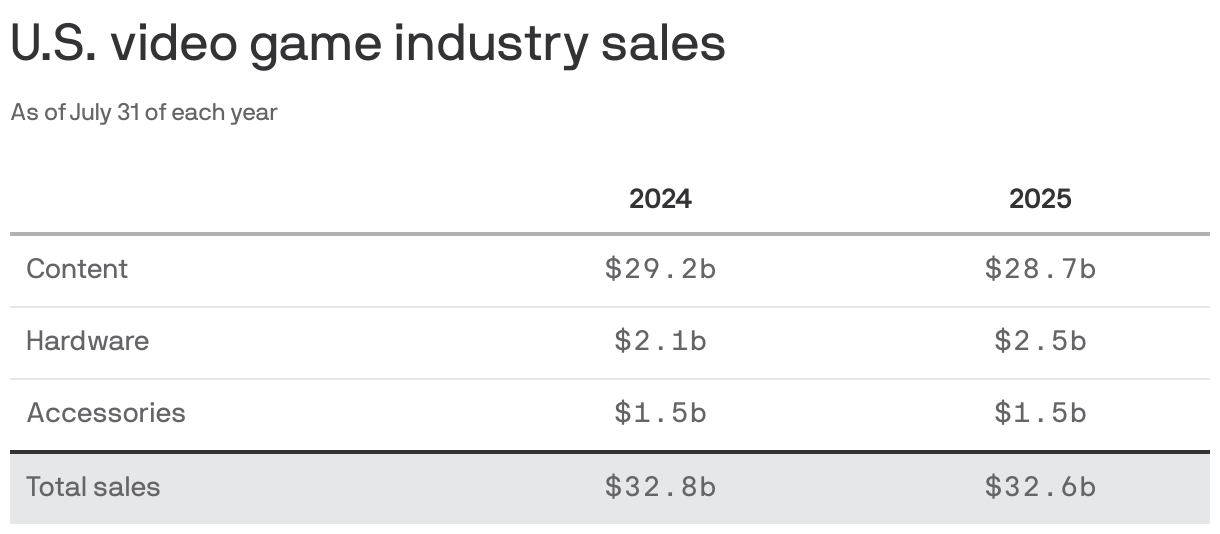
Data: Circana; Note: Data includes physical and digital purchases as well as subscription spending across various platforms; Table: Axios Visuals
Electronic Arts is the latest video game giant to be acquired, as the sector still wrestles with post-pandemic headwinds, such as slower sales, franchise fatigue and inflationary impacts on consumer spending.
Why it matters: Analysts are bullish on the gaming sector long term, but they see most of the new growth coming from companies that focus on tools and tech serving the sector, not large studios that bet on content.
Spotify CEO and founder Daniel Ek, who has led the audio giant for almost 20 years, is stepping aside and will transition to a new role as executive chair beginning next year, the company said in a statement.
Zoom in: Two co-presidents, Gustav Söderström and Alex Norström, will become co-CEOs, reporting to Ek. They will serve on the board of directors, subject to shareholder approval.
Mothers are using AI as a personal assistant to manage the invisible work of raising today's kids.
Why it matters: Parents have long outsourced domestic chores to dishwashers, laundry machines and in-home help, but the mental load tied to coordinating child care and family logistics still falls mostly on women.
The world's super wealthy (people with at least $30 million) grew to about 1% of the global millionaire population by the middle of 2025, says Altrata, a wealth data firm. This top cohort now holds 32% of the wealth among the ultra-rich.
Why it matters: Yes, there's a wealth gap even among the rich, as the richest of them all keep gathering a higher percentage of overall wealth.
A group of more than 80 leaders from the public, private and nonprofit sectors are calling for a whole-of-government strategy to crack down on scams, according to a new strategy proposal shared first with Axios.
The big picture: Last year, Americans lost more than $158 billion to fraud and scams, or roughly $300,476 per minute, according to the Federal Trade Commission.
Scams are about more than just filling the bank accounts of one-off cybercriminals: They're often linked back to complex overseas operations that fund various regimes.
Yet companies and law enforcement have often worked in silos when trying to crack down.
Threat level: Advancements in AI tools will make it easier for scammers to target even more people.
Driving the news: The Aspen Institute's National Task Force on Fraud and Scam Prevention published a 116-page strategy for fighting scams and sent a letter to Congress today calling on policymakers to make the issue a top priority.
"This is a different kind of crime, and we can't do it alone," Kate Griffin, director of inclusive financial system at the Aspen Institute Financial Security Program, told Axios.
The task force includes nearly 80 members of the public and private sectors, including major technology vendors, telecommunications providers and federal law enforcement agencies.
Zoom in: Some of their recommendations include:
Modernizing the way key law enforcement databases that track scams collect and share data;
Enacting liability protections for companies to share information about how scams have targeted individuals, given most cyber information-sharing laws have only been applied in the context of hackers targeting companies;
Applying sanctions and diplomatic pressures on foreign governments and private organizations that aren't perceived to be taking scam activity seriously;
Exploring the creation of a U.S. National Anti-Scam Center, modeled after similar organizations in the U.K., Australia and Singapore;
Encouraging the private sector to develop new consumer-facing tools and technologies that can stop scams as they happen.
Between the lines: Kathy Stokes, director of fraud prevention and programs at AARP, a member of the task force, told Axios that coordination is the only way to squash scams.
"We coordinate much worse than the criminals do," Stokes said.
For years, companies, law enforcement and other nonprofits would over emphasize the need to educate the public about how to spot scams. But Stokes notes that the new strategy goes beyond that, because "we cannot educate our way out of the fraud crisis."
The intrigue: Many task force members have already started working on programs that follow the strategy's recommendations.
AARP has a Fraud Watch Network, which offers a free helpline for people who have been targeted by scams and connects them with law enforcement as needed.
Visa, another member, created its own internal scam detection practice this year that proactively hunts and takes down scams on its own payment networks and beyond.
What's next: Several current government officials are already a part of the task force, and the Aspen Institute plans to continue to use its convening power to bring people across sectors together to keep working on these issues, Griffin said.
"We're here to keep creating the spaces where those leaders can come together to turn that blueprint into action."
Saudi Arabia's $925 billion Public Investment Fund (PIF) is backing the largest buyout ever, in a deal that speaks to the kingdom's renewed ambitions to become a cultural powerhouse.
Why it matters: The deal, for video game maker Electronic Arts, is the latest U.S. entry point for Riyadh, as the oil-rich nation aims to diversify its economy — in large part by investing in industries with outsized male audiences, from console gaming to combat sports.
As Washington races ahead with a hands-off approach to AI, much of the rest of the world is slowing down to set rules.
Why it matters: Companies that work across the globe will be dealing with different regimes, compliance costs and expectations —and the U.S. could get left out of this AI conversation.
One of the most popular PBS shows is back with fresh episodes, a new host and celebs spreading some literacy love.
Why it matters: "Reading Rainbow"emerged as one of public television's most viewed programs and it's returning some two months after Congress voted to cut nearly $1.1 billion in federal funding for the Corporation for Public Broadcasting, which provides critical support to PBS and NPR.