Gaming industry reckoning


Add Axios as your preferred source to
see more of our stories on Google.
Electronic Arts is the latest video game giant to be acquired, as the sector still wrestles with post-pandemic headwinds, such as slower sales, franchise fatigue and inflationary impacts on consumer spending.
Why it matters: Analysts are bullish on the gaming sector long term, but they see most of the new growth coming from companies that focus on tools and tech serving the sector, not large studios that bet on content.
The big picture: "One of the themes of the last couple of years has been the high cost of development and long development timelines," Derek Douglas, head of games at CAA, tells Axios.
- "This increases the risk of each title and can lead to fewer tentpole releases and creates revenue gaps for the publisher," which Douglas notes has a bigger impact on large incumbents like EA.
- Meanwhile, user-generated gaming platforms such as Roblox, Fortnite and Minecraft are seeing double-digit user growth, outpacing traditional console and PC games. Roblox has drawn more than 40 million concurrent users, Game File reporter Stephen Totilo tells Axios.
- "The long-running business of gaming involved the creation of frequent release of new games that might be hits or flops. ... The emerging rules of gaming upend that. Gamers are spending more time on fewer games," Totilo says.
Driving the news: EA on Monday agreed to be taken private in what would be the largest leveraged buyout ever, by Saudi Arabia's Public Investment Fund, Silver Lake Partners and Jared Kushner's Affinity Partners.
- The total deal value is $55 billion, representing a 25% premium to where EA shares closed last Thursday.
Zoom out: Gaming studios have been eyeing buyouts as a way to hedge against short-term headwinds.
- Microsoft closed its $69 billion acquisition of Activision Blizzard in 2023 after a long-winded regulatory approval process, and Take-Two Interactive bought Zynga in 2022.
- "Consolidation interest is rising, but so is scrutiny of costs, regulation and labor risks," Bain partner Anders Christofferson says.
By the numbers: While sales have slowed in the past year, analysts are still hopeful the industry has steam.
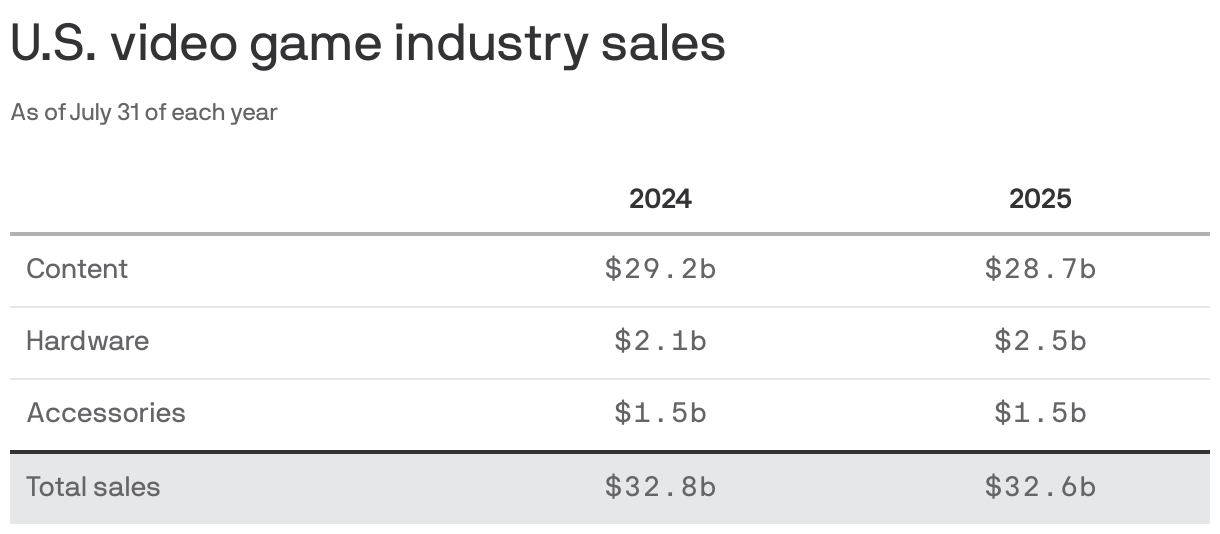
- Total U.S. game sales have hit $32.6 billion so far in 2025, down slightly from $32.8 billion for the same period in 2024, per Circana.
- PwC projects U.S. video games and esports revenue will grow from $62.8 billion in 2024 to $87.4 billion in 2029, for a 6.8% compound annual growth rate that outpaces most other entertainment categories.
- Social and casual gaming, which already makes up more than 60% of revenue, is expected to hit $57.2 billion in 2029.
Reality check: "From a macro perspective, the industry is healthy and growth is modest, if not explosive," Douglas says. "However, the industry is still recovering from the pandemic."
Between the lines: As more games shift to the cloud, few video game makers have been able to capitalize on digital advertising, slowing the industry's revenue growth potential.
- Traditional growth engines like new consoles and graphics updates are no longer delivering the same wow factor, Totilo says, as audiences are content with playing older games.
The bottom line: "Gaming is in a transformative moment, as the rules of who can or can't succeed in gaming are being rewritten," Totilo says.
- "What's holding things back are companies that can't pivot to this new reality, that take years and hundreds of millions of dollars to make games that they can't afford to have fail."
