Monday's technology stories

Sega of America workers announce plans to form a union

Not even Sonic the Hedgehog can outrun the wave of unionization sweeping across the games industry.
Driving the news: Workers from Sega of America announced today that they plan to unionize and have filed for an election with the National Labor Relations Board.

Exclusive: Google opens its security tools to competitors' platforms

Google is leaning into flexibility as part of a new strategy to stymie the impact of belt-tightening among cyber chiefs.
Driving the news: Google Cloud and Mandiant, the threat intelligence unit it acquired last year, unveiled at the RSA Conference in San Francisco today that they're opening their security products to integrations from competitors, as well as offering new Google plug-ins for other vendors' tools.
- The news, which was shared first with Axios, means that Google customers will now have more options to embed Google's tools in partner companies' products, like CrowdStrike, Trellix and SentinelOne.
- Other companies, like Accenture and login management company Okta, will also be integrating their products into Google's as part of the plan.
Why it matters: Chief information security officers are facing increasing board pressure during a wobbly economy to cut down the number of vendors they work with and simplify their security programs.
- As a result, vendors have started to intertwine their competitors' products into their own tools in recent years to reach more customers.
What they're saying: "Ultimately we think we reach more of the world if we can work with more partners and really look at these win-win situations," Eric Doerr, vice president of engineering for cloud security at Google Cloud, told Axios.
- "It doesn't have to be our way or our technology," Marshall Heilman, chief technology officer at Mandiant, told Axios. "And that's what it really means to have an open end-to-end ecosystem."
How it works: Google Cloud's partnership expansion will let customers integrate various threat intelligence and product security products into its offerings.
- Accenture, an IT services and consulting group, is integrating its entire cloud infrastructure managed services operation with Google Cloud's Chronicle Security Operations hub for incident response, threat intelligence and event management tools.
- Customers of Google Workspace will soon be able to integrate login verification tools from Okta and device management tools from VMWare into their Google dashboards.
- Customers of CrowdStrike, SentinelOne, Trellix and other partners can also now plug in Mandiant's threat intelligence tools to their programs. Doing this allows those customers to see information about an ongoing attack inside the same security programs they'd need to deploy to fix it.
Between the lines: Google executives argue their push towards product integrations is more in-depth than similar approaches from competitors.
- "We want to figure out how we can augment the technology you already have in place to make your security posture that much stronger — not rip-and-replace so we can make a bunch of money," Heilman said.
Yes, but: Integrating third-party vendors into a company's security operations bring additional risk for supply chain attacks, where hackers gain access to a network through a weakness in another vendor.
- "We just wouldn't do business with someone who we didn't think was taking security seriously," Doerr said.
Sign up for Axios’ cybersecurity newsletter Codebook here

Cybereason cuts valuation by more than 90%, loses unicorn status

Boston-based cybersecurity "unicorn" Cybereason earlier this month announced $100 million in new funding from existing investor SoftBank.
What it didn't mention was that the new Series G shares were sold at more than a 90% discount to Cybereason's prior round in mid-2021, when it was valued at around $2.7 billion, according to a Delaware stock authorization form first noticed by Nasdaq Private Market.

Reverse ATMs take bills, dispense cards as stores go cashless
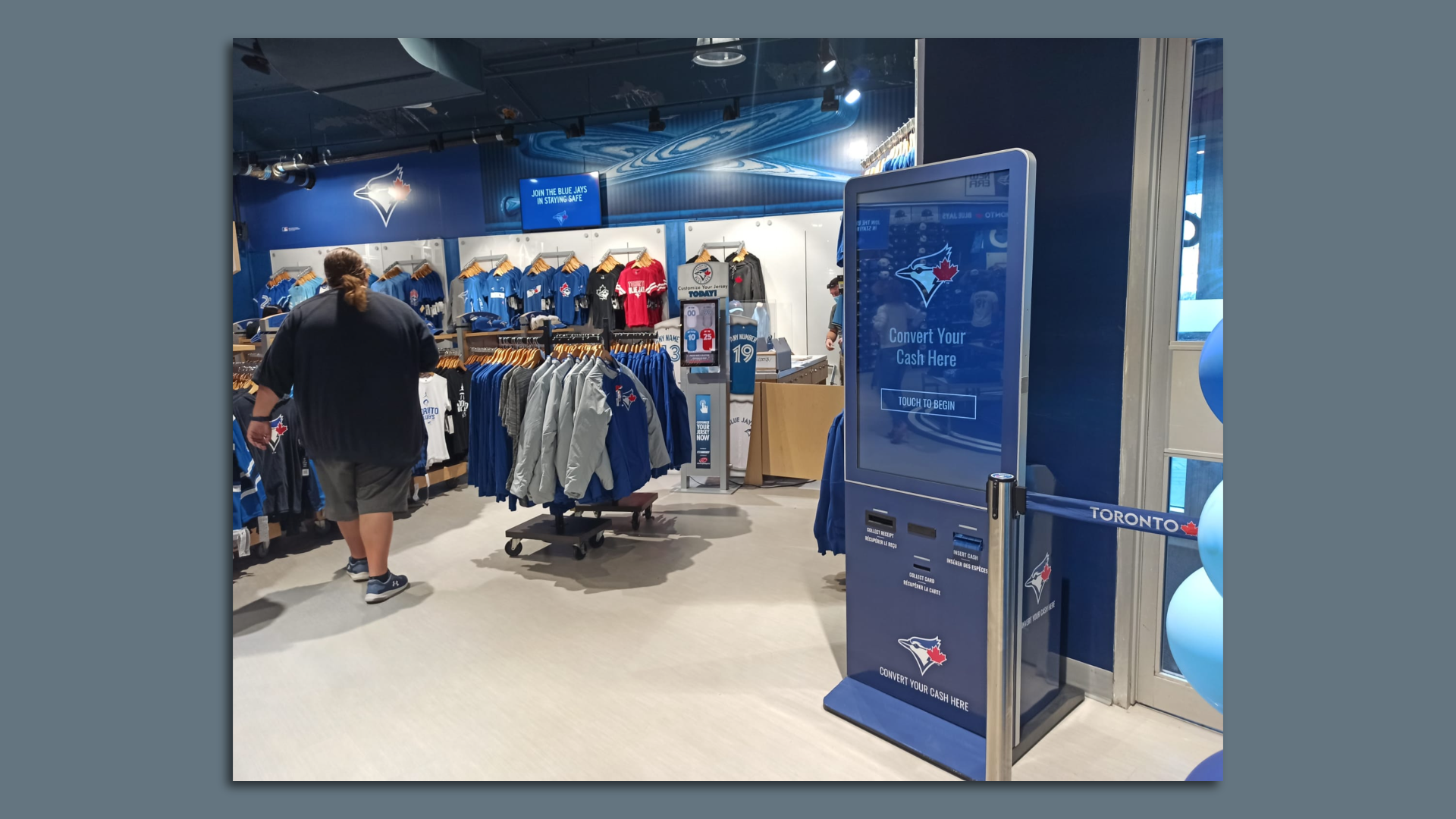
As stores and restaurants attempt to go cashless, they're installing "reverse ATMs" that dispense stored-value cards in exchange for greenbacks.
Why it matters: More businesses are eschewing cash — a trend accelerated by the pandemic — but states and cities are passing laws banning them from doing so, in deference to people who don't have bank accounts or credit cards.

How we all became AI's brain donors
/2023/04/24/1682340972961.gif?w=3840)
The AI boom is built on data, the data comes from the internet, and the internet came from us.
Driving the news: A Washington Post analysis of one public data set widely used for training AIs shows how broadly today's AI industry has sampled the 30-year treasury of web publishing to tutor their neural networks.


"Verified" becomes a badge of dishonor

Twitter users are pushing back against Elon Musk's new pay-for-verification policy, with many journalists and celebrities opting to cancel their subscriptions out of embarrassment instead of keeping their blue checks.
Why it matters: Internet verification used to be a badge of honor. Now that it's achievable to anyone who is willing to buy it, it's become a signal of desperation.
Over-50 gamers feel overlooked, study finds

More Americans aged 50 and up play video games than ever before. But they feel overlooked by the gaming industry, according to a new study by AARP.
Why it matters: Video games are not just a pastime for the young, contrary to the popular image of who does or doesn’t play.