Sales of Nintendo games, consoles and other products dropped nearly 5% in the spring compared to the same period a year ago, according to the company's latest financial results.
Why it matters: It's another sign that the game industry has reached choppy waters after surging during the pandemic.
Drive-by regulating usually happens on roads where set rules don't really exist, explaining the steady drumbeat of enforcement action levied against crypto firms. But that style of regulation has now hit New York, where crypto rules are deemed so onerous by the industry that they prompted mass exodus.
What's happening: The New York State Department of Financial Services on Tuesday imposed a $30 million fine on the crypto trading division of Robinhood Markets, citing alleged violations of anti-money-laundering and cybersecurity regulations, among other things.
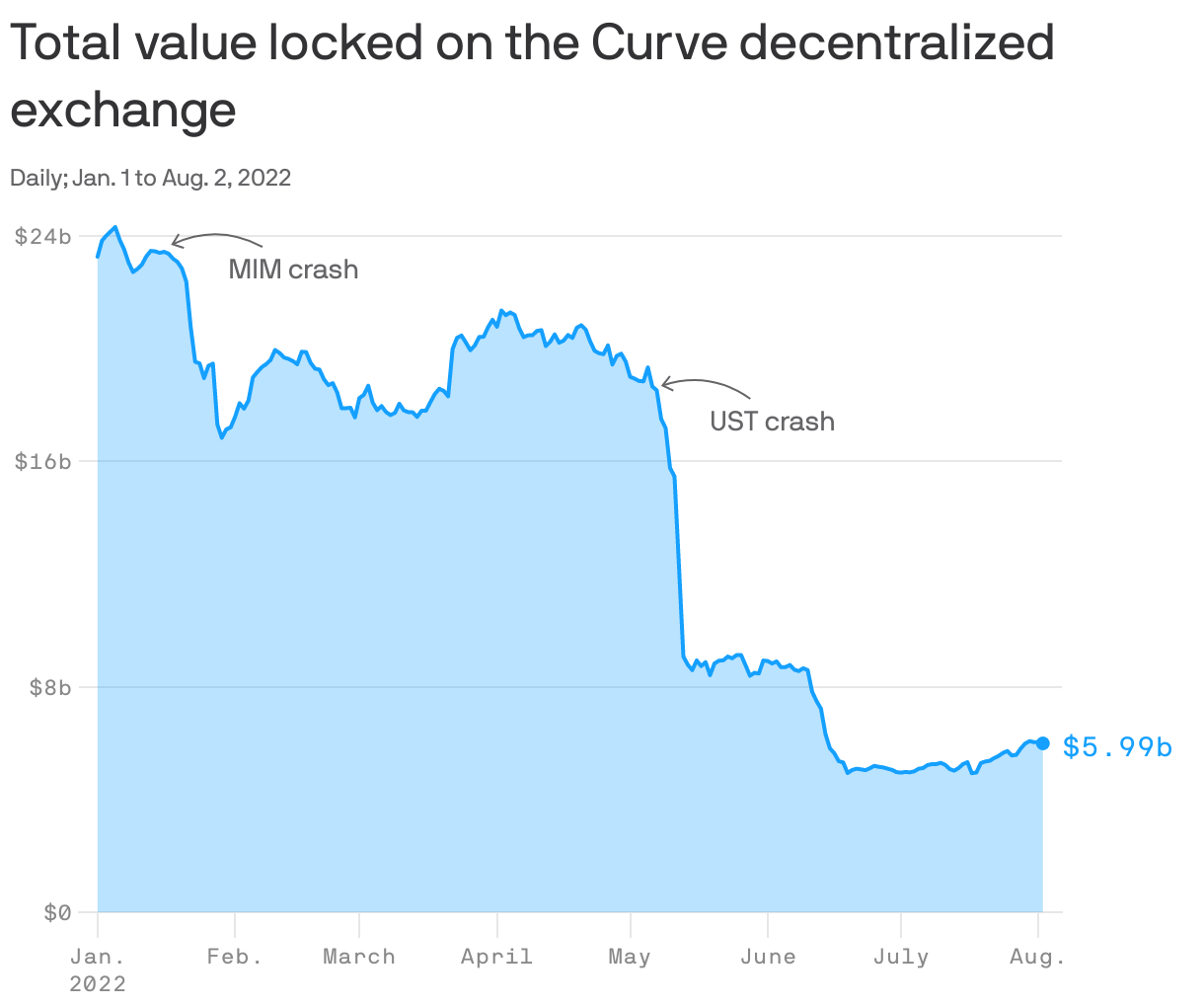
At the end of the crypto bull market, Curve was solidly the number one place in decentralized finance (DeFi) for investors to tuck away funds to earn more. It has fallen to fifth place today, according to DeFiLlama.
Why it matters: Curve's drop is largely a reflection of falling demand for stablecoins, the efficient trading of which is the focus of its protocol. Investors in decentralized finance (DeFi) make deposits onto different applications to earn passive income. How much they entrust to which projects reflects, in part, which ones they believe have the best prospects.
Crypto venture capital activity has slowed amid price plunges and near-daily hacks. But one of the market's most active players is pledging to "invest even more aggressively."
Driving the news:Crypto exchange Binance tells Axios that it has named co-founder Yi He as head of Binance Labs, its VC and incubator arm.
Thoma Bravo on Wednesday agreed to buy Ping Identity (NYSE: PING), a Denver-based authentication software company, for around $2.8 billion. Sellers would include Vista Equity Partners, which took Ping public in 2019 and currently holds just under a 10% stake.
Why it martters: Expect this to be just the tip of the spear when it comes to private equity carousel deals, in which PE-backed companies that IPO'd during the bull run are returned to private hands.
What would the busiest street in your hometown look like with fewer cars and more people, and bike lanes, and light rail? Urban planning advocate Zach Katz cannot only tell you, he can show you — using the AI image-generation platform DALL-E, Alex Fitzpatrick reports.
Katz, a 28-year-old Brooklyn-based artist and musician, is all the rage on urbanist Twitter, thanks to his AI-generated images that show real-world, car-dense streets in cities like New York and Boston as pedestrian and public transit utopias.
The federal government is doling out $5 billion to states to build a nationwide network of highway charging stations intended to get more people to buy electric vehicles.
Why it matters: The taxpayer-funded charging network is a cornerstone of President Biden's ambition to electrify America's transportation sector.
With reproductive rights in flux across the U.S., activists on both sides of the issue are using the uncertainty to pressure tech companies to change the way abortion information gets shared and labeled.
The big picture: The absence of a nationwide law means that companies will likely have to interpret a patchwork of competing state rules — as they already do with privacy and other tech issues.
A federal judge has granted a motion to dismiss three wire fraud charges against Joseph Sullivan, Uber's former chief security officer who allegedly tried to conceal a 2016 data breach in which hackers stole the account information of 50 million customers and seven million drivers.
Yes, but: Sullivan still faces charges for obstructing a U.S. Federal Trade Commission (FTC) proceeding and failing to report a felony.
Drivers have been flocking to Uber despite high gas prices, the company's second quarter earnings report shows.
Driving the news: The number of Uber drivers and delivery earners reached a record last quarter — of nearly 5 million, up 31% from last year — the company reported this morning.
Several Taiwanese government websites went offline on Tuesday as House Speaker Nancy Pelosi landed in the country for her controversial visit.
Why it matters: Although the website outages haven’t been attributed, Chinese state hackers have been known to retaliate through low-level distributed denial of service attacks, which overwhelm a site with abnormally high traffic until it shuts down. The Chinese government has also warned that Pelosi’s visit would prompt “strong and resolute measures” in response.
BuzzFeed and more than 90 of its former employees remain locked in a legal fight over the company's public listing last December, during which the ex-employees claim to have been improperly prevented from selling their shares.
Why it matters: The two sides are currently bickering over venue, and the outcome could be consequential for other companies that go public via SPAC.
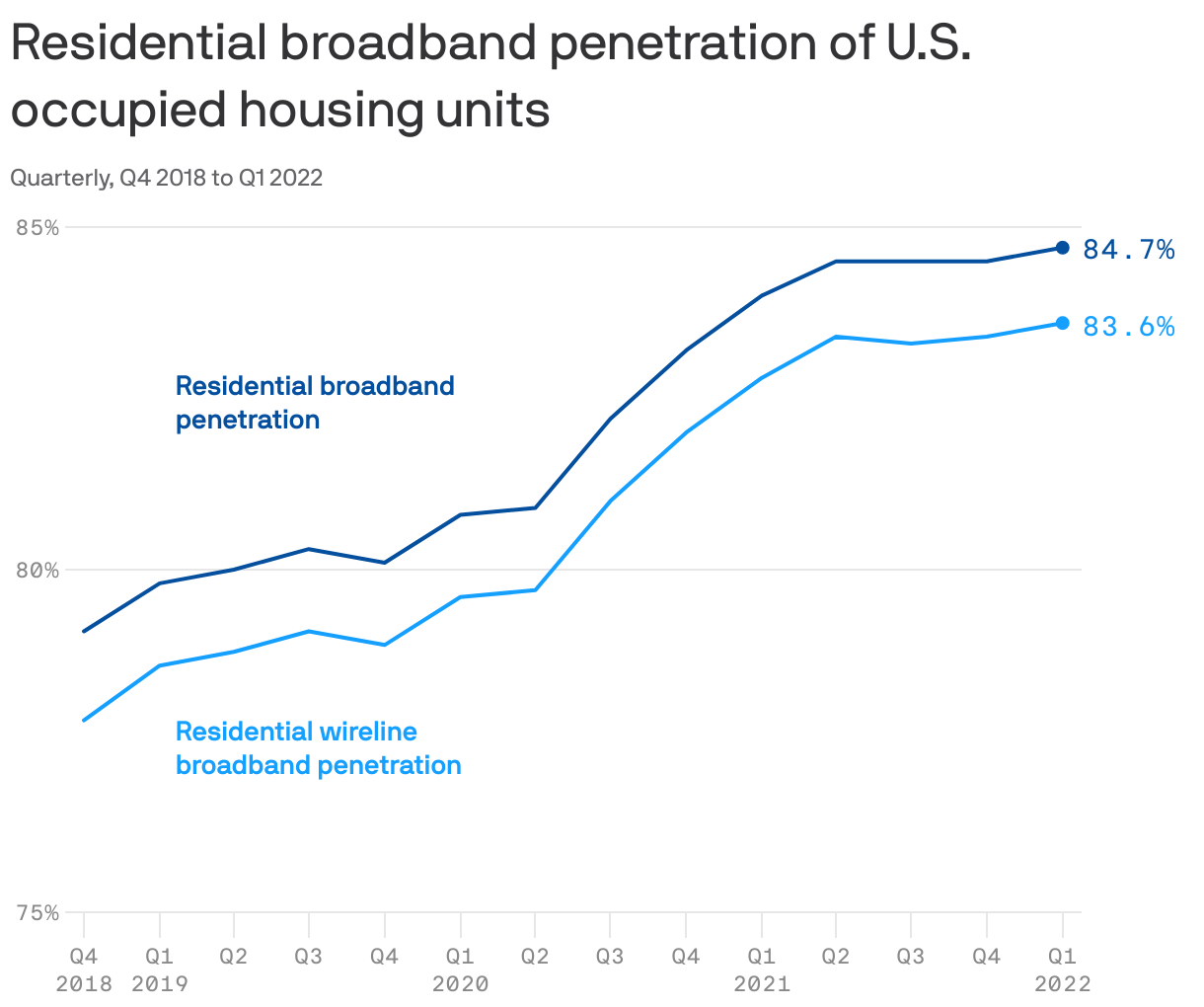
Data: S&P Global Market Intelligence; Chart: Axios Visuals
Cable companies are being downgraded by Wall Street analysts in response to weak broadband growth coming out of the pandemic.
Why it matters: Cable companies have managed to stay afloat amid the cord-cutting crisis thanks to their booming broadband businesses. But some analysts see that safety net beginning to fade.
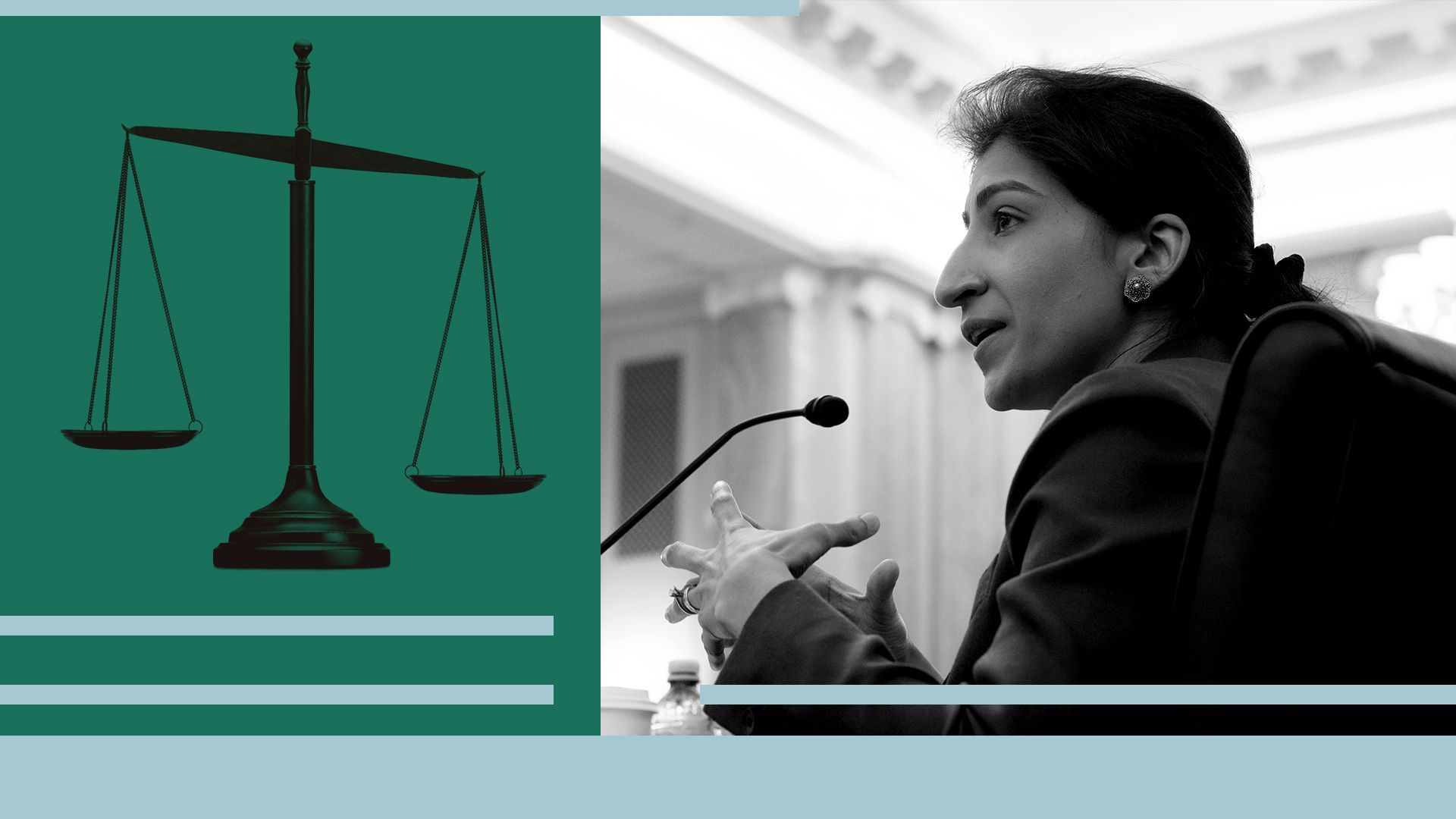
Federal Trade Commission chair Lina Khan's decision to challenge Meta's acquisition of a small VR gaming startup has cheered her supporters and left critics wondering what she was thinking.
The big picture: Critics see the case as a legal stretch the agency is unlikely to win. Supporters see it as a necessary first test of a bold new doctrine aimed at stopping tech monopolies before they take root.
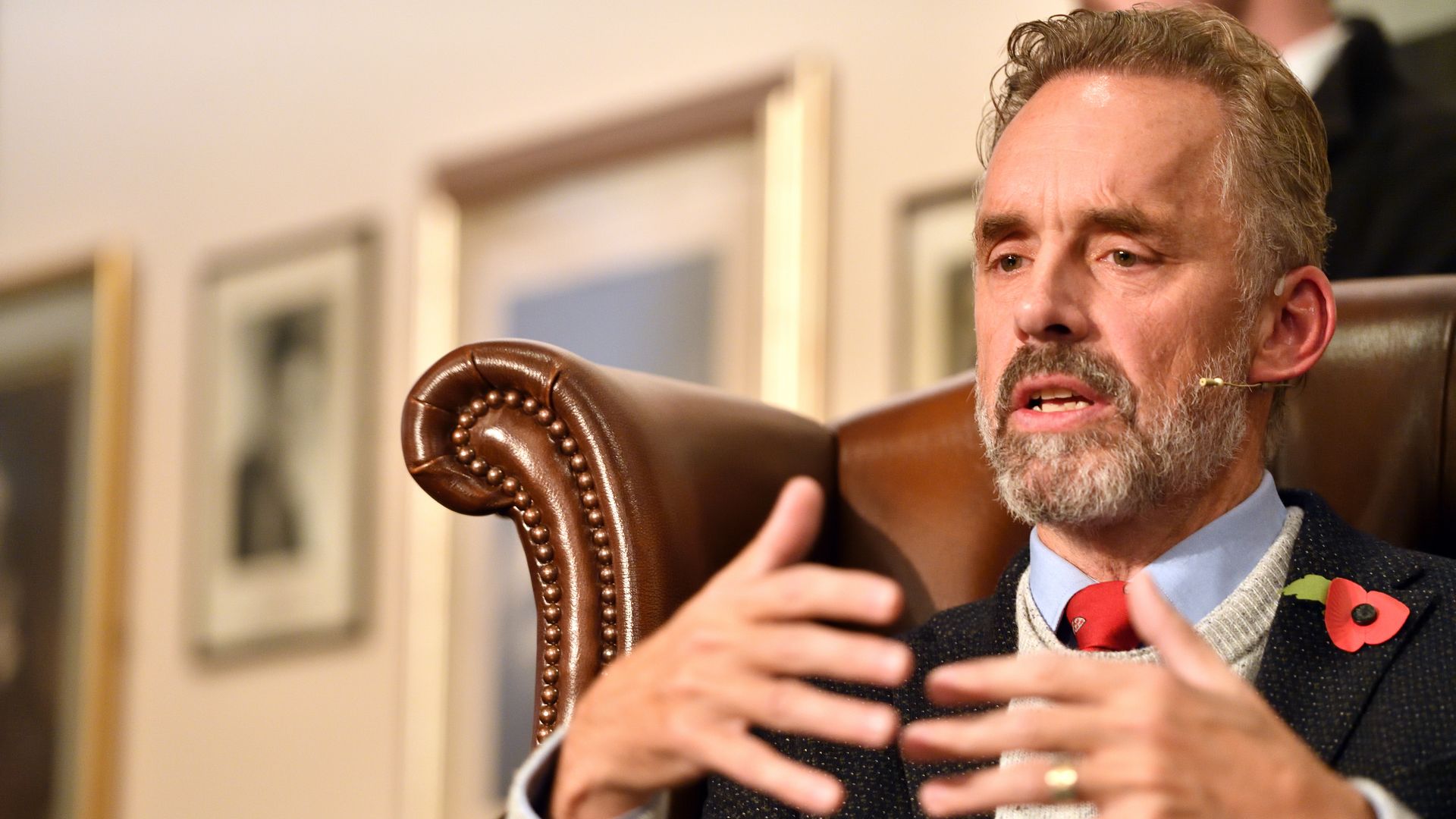
YouTube has quietly stopped serving ads for a pair of videos that feature controversy-stirring Canadian professor Jordan Peterson deliberately misgendering actor Elliot Page and likening gender-affirming care for transgender people to Nazi-era medical experimentation.
Why it matters: The move is likely to anger Peterson's online supporters, who say the platform should not interfere with his speech at all — but it also won't satisfy his critics, who believe his words amount to prohibited speech that should be removed.
Advertisers and digital publishers are nowhere near an agreement on how to replace third-party tracking cookies, and instead have clung to various ad hoc solutions that don't all work well together and lack sufficient oversight.
Why it matters: The push to be more privacy-centric has muddled an already messy digital ad ecosystem, and many of the changes being introduced could easily be upended by future legislation.