Amazon on Thursday announced the first companies to receive money from a $2 billion venture capital fund it formed to help combat climate change.
Axios Re:Cap digs into how Amazon hopes the fund will help achieve its goal of being carbon neutral by 2040, and whether the plan is more substance than spin, with Matt Peterson, Amazon's director of new initiatives and corporate development.
Partnering with oil and gas producers is necessary for Amazon and other companies to achieve their climate goals, the tech giant's chief of sustainability, Kara Hurst, said during an Axios virtual event on Thursday.
The big picture: Amazon aims to hit carbon neutrality in 2040, 10 years earlier than the Paris climate accord. The company plans to reach its goal in part by helping companies develop climate-friendly technologies through a $2 billion venture fund. The first recipients were announced on Thursday.
All significant merger-and-acquisition transactions require regulatory approval — and a new regulator just got to town.
Why it matters: We're in a tit-for-tat trade war, which means that any action the U.S. takes against China is going to be reciprocated by a similar action taken by China against America. That includes regulatory actions.
Snowflake shares more than doubled on Wednesday, after having the biggest software IPO in history, while JFrog also posted strong first-day gains.
Why it matters: The moves show that Wall Street's appetite for new tech stocks remains significant, with concerns about both the pandemic and high valuations taking a back seat.
Facebook's foray into virtual and augmented reality, which it doubled down on this week, is a bet on where the future of online social interaction is heading. But even more important to Facebook, it's also a plan to make sure the company owns a big piece of whatever platform ultimately supplants the smartphone.
Why it matters: In the smartphone era, Facebook has found itself at the mercy of Apple and — to a lesser degree — Google and Android phone makers. The company doesn't want to see history repeat itself.
Snapchat is launching a new original series called “The Solution Committee,” starring Jaden Smith. The unscripted show features young activists and celebrities discussing racial and social justice issues, like criminal justice reform and voting access.
Why it matters: The show is part of Snapchat's effort to educate its user base about important election issues. All episodes will include a swipe-up function at the end, encouraging users to register to vote.
A new coalition will work to change the status quo among U.S. patent holders, who are largely white males, and introduce more diversity in inventing and patenting, according to an announcement shared exclusively with Axios.
Why it matters: The patent diversity gap limits opportunities for the majority of Americans and leaves the U.S. with less innovation serving a narrower population, advocates say.
Facebook on Thursday launched a new app named Facebook Business Suite that lets small businesses manage their pages and profiles across Facebook, Instagram and Facebook Messenger from a single interface.
Why it matters: The app is the first product Facebook has launched that combines the backend infrastructure for three of its messaging apps. The company has teased this move for over a year.
Dozens of celebrities, including Kim Kardashian West, aren't posting to their Facebook or Instagram feeds Wednesday, as part of the "Stop Hate for Profit" campaign.
Axios Re:Cap digs into whether this temporary boycott matters, and how the broader advertising market has morphed in 2020.
Enterprise tech company Snowflake went public Wednesday morning, opening its trading at an eye-popping $245 a share.
Yes, but: Long before its blockbuster IPO and prior to catching Warren Buffett’s eye (and dollars), it was a quietly ambitious startup whose founders hailed from old-school companies like Oracle, and wanted to take on Amazon Web Services.
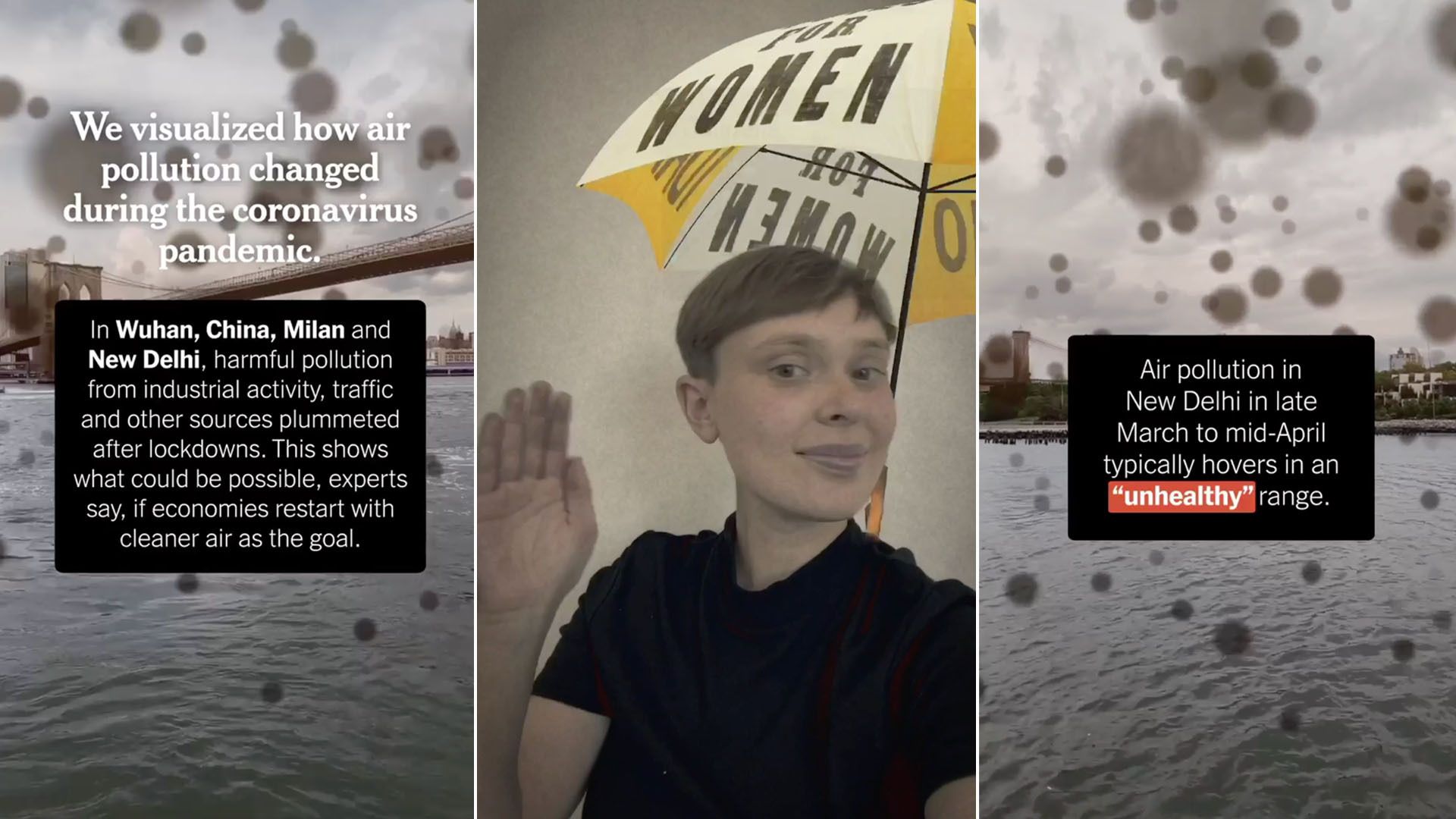
The New York Times and Facebook have struck a multi-year partnership to co-develop augmented reality (AR) filters and effects on Instagram that help users access and contextualize New York Times journalism, executives tell Axios.
Why it matters: It's the first time that The Times has experimented with augmented reality technology at scale and off of its own website and apps. The partnership also represents an evolution in the relationship between publishers and tech companies.
Facebook on Wednesday introduced a new version of its Oculus Quest and took the next step in a longer-term push toward augmented reality glasses.
Why it matters: Facebook has made big bets on virtual reality and augmented reality as key to its future and it is moving forward despite concerns from regulators and privacy advocates.
Snowflake, a Silicon Valley cloud data warehousing company, on Tuesday night raised $3.4 billion in what is the largest software IPO ever.
Between the lines: Snowflake loses money, but got a big boost of confidence when Warren Buffett's Berkshire Hathaway agreed to invest $500 million concurrent to the IPO.
President Trump hasn't yet blessed ByteDance's proposed savior plan for TikTok, featuring Oracle as a "trusted technology partner."
The state of play: This deal is not fait accompli, despite some media reports yesterday that there would be an announcement before nightfall. But the odds remain in its favor.
ManiMe, a startup that sells stick-on gel nails, tells Axios that it has raised $6 million in venture capital funding led by Canaan Partners and Trinity Ventures.
Why it matters: Since the pandemic forced many beauty salons to close, manicure lovers have resorted to do-it-yourself and at-home alternatives.
As expected Tuesday, Apple debuted new iPads and Apple Watch models featuring new colors and modest hardware advances. But the really significant long-term move for Apple was the further expansion of its services business.
Why it matters: With the slowing down of the smartphone market, Apple has turned to services to become its key growth engine.
Most American teens think online school is worse than going in person, but less than a fifth of them think that it makes sense to be in person full-time while COVID is still circulating, according to results of a new survey shared first with Axios.
The big picture: Parents badly want their kids back in school, and students want to be there, too. But most feel it's still not safe, according to the survey, which was conducted by Common Sense Media and SurveyMonkey.
Conspiracy theories about the origin of fires in Oregon are still spreading through private Facebook groups days after the social media giant announced it would remove the false claims, according to research from the German Marshall Fund of the United States shared exclusively with Axios.
Why it matters: Facebook's efforts to control misinformation on its vast platform continue to lag behind the spread of rumors and conspiracy theories about life-and-death crises, and researchers are urging earlier and stronger action, especially as the election gets closer and the coronavirus continues to rage in the country.
The shift to online schooling is running roughshod over children's privacy rules and rights, experts say, and creating new inequalities.
The big picture: Minors are the only group that enjoys federal online privacy protections in the U.S., but that's not enough to protect their privacy rights as school districts and teachers scramble to move all classwork to the internet amid the pandemic.
















/2020/09/16/1600265742057.gif?w=3840)