Qualcomm is asking a Chinese court to ban Apple from selling or manufacturing iPhones in China that infringe on its patents, in a major escalation of the legal battle between the two tech giants, Bloomberg reports.
Why it matters: The two companies were already at war, legally, but had kept the battle from stopping the two companies from doing business. Despite the fight, Apple remains one of Qualcomm's biggest customers and Apple relies on Qualcomm for a key modem chip, although it gets some modem chips from Intel.
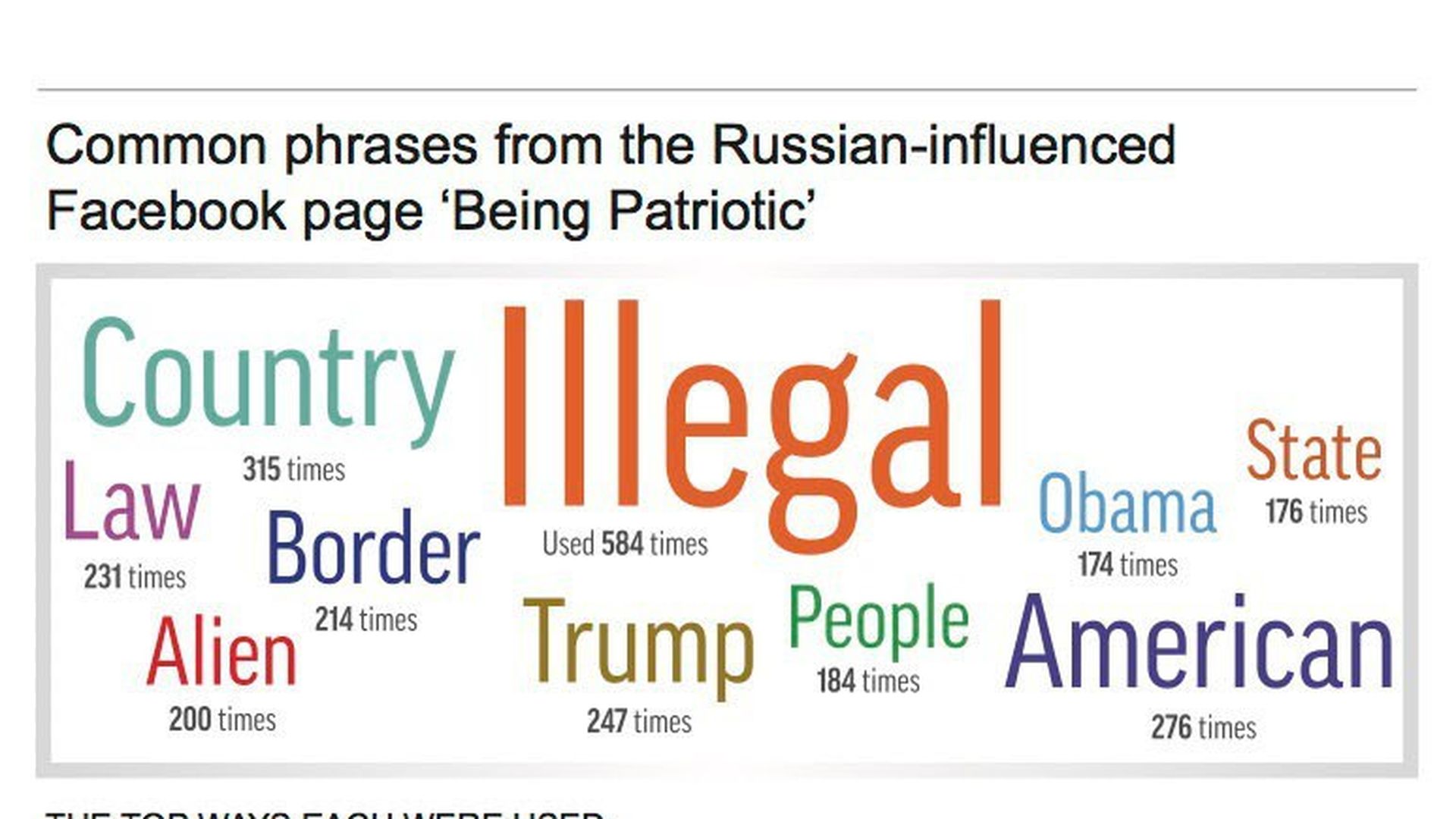
One of the key Russian Facebook pages was colored with hot-button words and phrases like "illegal alien," ''Sharia law" and "welfare state," AP's Ryan Nakashima and Larry Fenn find:
"'Being Patriotic' was among 470 pages and accounts that Facebook shut down ... in response to a congressional probe into Russian meddling in last year's election."
"While Facebook says it deleted the posts this week, the AP was able to perform a content analysis based on the 500 most popular posts on the page, which was one of six Russia-influenced Facebook pages examined by Jonathan Albright, research director at the Tow Center for Digital Journalism at Columbia University."
In her swing through DC (which included an interview with Axios), Sheryl Sandberg made the case that Facebook is ready to work with legislators. It seems that, at least so far, concerned lawmakers are willing to wait and see before pushing for major new legislation.
The bigger picture: In various meetings, Sandberg argued that while Facebook can remove some content from its platform, it needs to tread carefully to uphold broad values of free speech. Here's how that message was received by lawmakers:
Sen. Chuck Grassley (R-IA) slammed President Trump on Twitter Thursday morning, firing off a series of tweets to fact check the president's math on his tax cuts, which Grassley insists doesn't add up:
When asked whether Facebook considers itself a media company, COO Sheryl Sandberg told Axios' Mike Allen, "At our heart we're a tech company... we don't hire journalists."
On privacy: "When you share on Facebook, you need to know that nobody is going to steal your data, nobody's going to get your data who shouldn't have it, we're not going to make money in a way you wouldn't feel comfortable with your data." She explained that although they use ads and target ads using the data from people's Facebook pages, they don't sell that data to advertisers.
ANN ARBOR, Mich. — On the outskirts of the University of Michigan campus, there's a sight that instantly shows how much the area has changed: A sensor-connected car steered by an Xbox controller roams the streets of what is known as "M-City" to test self-driving and other connected-car technologies.
Why it matters: Michigan is known for its auto industry expertise but experienced a steep decline a decade ago when Detroit — its biggest city — lost half its population as manufacturing jobs left in droves. Detroit is fighting its way back to build a burgeoning tech scene. Ann Arbor, only 40 minutes away, is taking a complementary path: It's harnessing the university's high-tech talent factory and the state's auto factory history to be at the forefront of next-generation vehicle development.