Wednesday's technology stories

Facebook updates controversial "Trending" feature
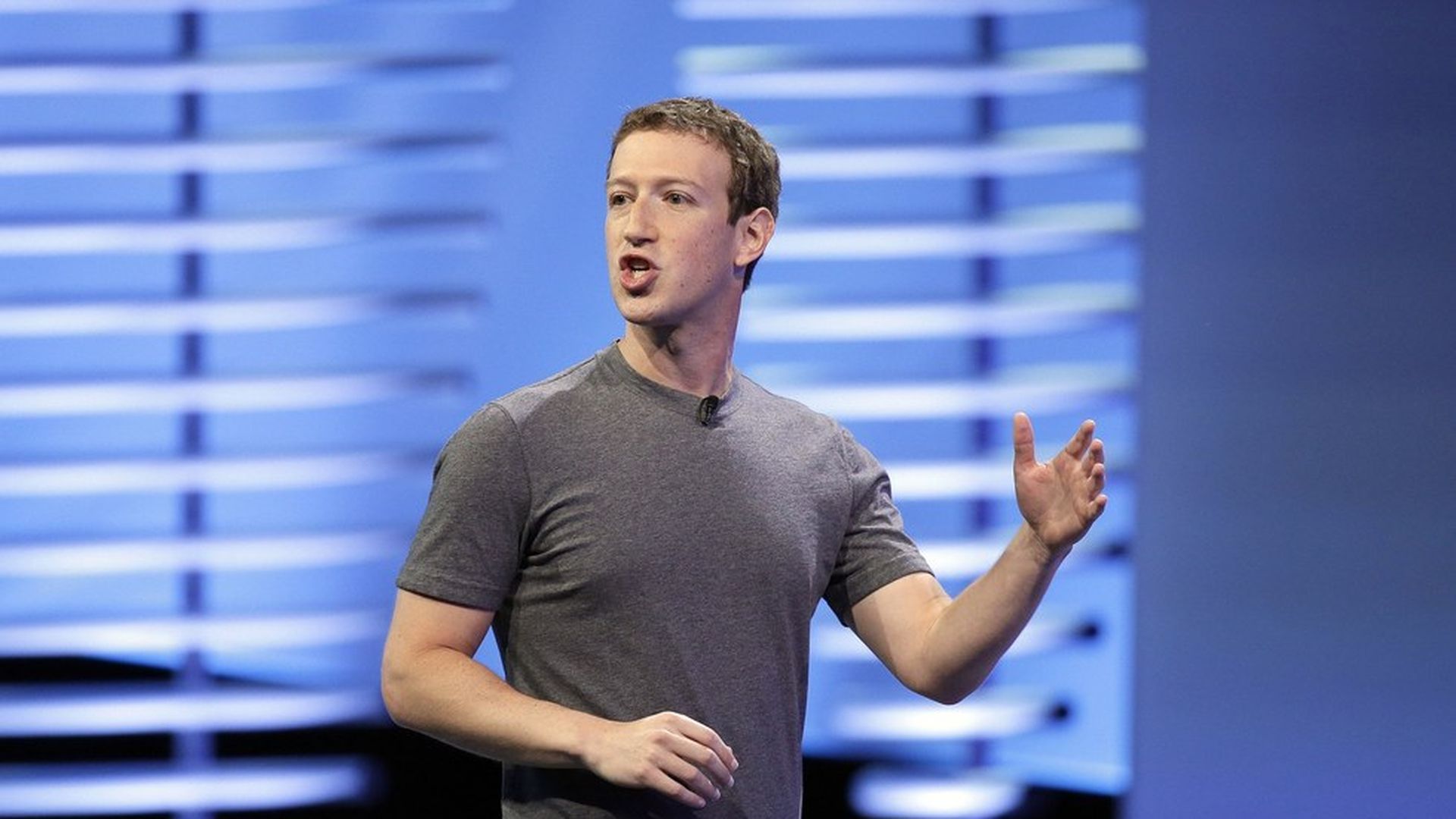
Facebook says they're updating their trending featuring to improve user experience and help prevent hoaxes and fake news from appearing in the trending module.
Updates:
- Trending topics will now feature a publisher headline below each topic name.
- An improved system to determine what is trending.
- Everyone in the same region will see the same topics.
Why it matters: Facebook faced backlash in 2016 for reportedly suppressing conservative news stories in their trending feature. In their statement Wednesday, the company says its curation model will still be algorithmic, but that people do monitor the trending feature.

Amazon taking to high seas
Amazon has shipped at least 150 containers from China to the U.S. since October. The WSJ found the details in shipping documents from ports of entry. Amazon hasn't bought ships, it's just booked space.
Why this matters: Amazon has been trying to take control of all the steps of a product's life from factory to customer's front door. It already plans to lease 40 cargo jets and has bought shipping trucks.

Trump's CEO team is big on automation

Donald Trump has talked far more about global trade's effect on jobs than about how jobs are being lost to automation, even though experts say the latter poses a serious threat to the nature of work in the coming years. Even has he stays quiet on the issue, some of Trump's key advisers are invested in automation:


Cisco spikes AppDynamics IPO

The first tech IPO of 2017 is no more.
AppDynamics, at the 11th hour, has sold to Cisco Systems for a whopping $3.7 billion in cash and assumed equity awards, according to a press release published on Tuesday. The San Francisco-based company, whose tools help businesses spot and fix bugs in their applications, was due to price its IPO on Wednesday night and begin trading on Thursday.
Last minute deal: A source close to the deal says that Cisco and AppDynamics have been in talks for several weeks, but that the final agreement wasn't signed until just a few hours ago. In fact, the senior AppDynamics team was still meeting with IPO investors in Los Angeles as of noon local time this afternoon, at which point they canceled all further meetings and hopped a flight back to San Francisco. At this moment, there are still AppDynamics employees in New York, who had been sent ahead of the Wednesday night pricing.
Snapchat updates publisher guidelines to filter sensitive material

What are the updates?
- More specific guidance on helping viewers navigate how they receive sensitive information, like warning labels, and clear exceptions for when sensitive information is appropriate for newsworthy stories
- Criteria that reinforces what type of content their they consider to be misleading or fraudulent
- More explicit guidance on what Snapchat considers to be sensitive information
- New tools that will allow publishers to isolate or "age gate" content that might be too sensitive for audiences younger than 18-years-old
Why?
- Snapchat hadn't updated their guidelines since they launched their Discovery channel in a much different media environment two years ago
- They now have new technological features that they want to make available to better serve their audience and publishers, like the aforementioned "age-gating" tool
- They take information quality seriously, and amid a fake news climate, they've added more guidance to their partners about what they consider to be misleading
Our thought bubble: Snapchat was selective from the start about the partners they allowed to distribute content on their site. Their selectivity and upfront content guidelines helped them generally avoid a fake news problem. That's why these guidelines address the handling of sensitive information more than the quality of news on their platform. Right now, this differentiates them from their competitors, like Facebook, which have taken many recent steps to combat fake news. Snapchat Discover's early filter for quality has also helped them develop an engaged and loyal audience. In a meeting with investors last week, Snapchat executives touted engagement metrics as a source of future advertising revenue growth.
Zuckerberg shuts down the rumors

Does Mark Zuckerberg, CEO of Facebook, plan to run for U.S. president?
"No," he told BuzzFeed on Tuesday when asked. "I'm focused on building our community at Facebook and working on the Chan Zuckerberg Initiative" (the philanthropic organization he's started with his wife).
With that said, it's unclear exactly how BuzzFeed phrased the question and whether Zuckerberg means he has no current plans or never will—details that are crucial in today's carefully crafted communications with the press.
But the signs were there! Speculation over Zuckerberg's potential interest in public office began to swirl earlier this month when he announced he would be traveling to each state around the country to meet with locals. Vanity Fair even rounded up the clues.
- Zuckerberg had also previously convinced his board to include a clause that would allow him to take a government job without losing control of Facebook.
- He's hired a former White House photographer, he's dialed back his atheism, and he hired Obama's former campaign manager to run policy efforts for the Chan Zuckerberg Initiative.
Alternative scenario: If anything, Zuckerberg is more likely taking a deeper interest in the political system, which he knows he'll have to work with (and sometimes against) to achieve the Chan Zuckerberg Initiative's goals, which are lofty.

Got a warrant? It’s not enough for overseas data
Microsoft just scored a major win in a landmark cloud computing case centered on how law enforcement agencies can access data storied outside U.S. borders.
What it means: It sets a key precedent that law enforcement can't rely on U.S. warrants to access data stored internationally—a win for tech companies storing huge amounts of consumer data and a set-back for law enforcement trying to access that data to solve crimes.
The backstory: Law enforcement wanted to access a consumer's emails stored on a Microsoft server in Ireland as part of a drug case. Microsoft argued the data in question was subject to Irish rather than U.S. law and that a U.S. warrant wasn't enough to access that data. Six months ago, the court sided with Microsoft, and the government appealed. Today, a split federal appeals court declined to hear the appeal.
What's next: Both Microsoft and dissenting judges say Congress needs to address the legal gap to keep up with the cloud computing era. The 30-year old law governing data access is no longer relevant to the way consumers access data stored in the cloud today, said Aaron Cooper of BSA, which represents software companies. "Congress needs to step in to create a balance that respects foreign borders and law enforcement as well as consumer privacy," he told Axios.

5 teams chase Google's $30 million Lunar XPRIZE

XPRIZE and Google announced today that there are five finalists for the $30m Google Lunar XPRIZE, a competition for privately-funded teams to land a rover on the Moon.
To become a finalist, each team had to secure a launch contract by the end of 2016. Now, to stay in the running, the finalists will have to initiate a launch to the Moon by the end of this year.
To win the $20m grand prize: Teams must land a rover on the Moon's surface that moves at least 500 meters and sends HD video back to Earth. There are also bonuses teams can score, like visiting an Apollo landing site.
Hot in Silicon Valley: Nest's big hire
Nest, the maker of connected home devices, has hired back Yoky Matsuoka, who previously the company's VP of technology from 2010 to 2015, as Bloomberg reported and Matsuoka confirmed on LinkedIn.
She's an accomplished robotics expert and helped found GoogleX, the Alphabet's experimental division. Matsuoka recently left Apple, where she worked on health-related projects, after only six months.
Why now? Her arrival at Nest is some sorely-needed good news for the company.
- Nest made headlines in early 2014 when it sold to Google's parent company for $3.2 billion, but it's had some rough times since then.
- Last year, co-founder and CEO Tony Fadell (also known as the "father of the iPod") left the company after scathing reports exposed staff frustrations with his management style.
- Nest's development and release of new products has also reportedly frustrated its parent company, which has since taken to building its own home connected devices.