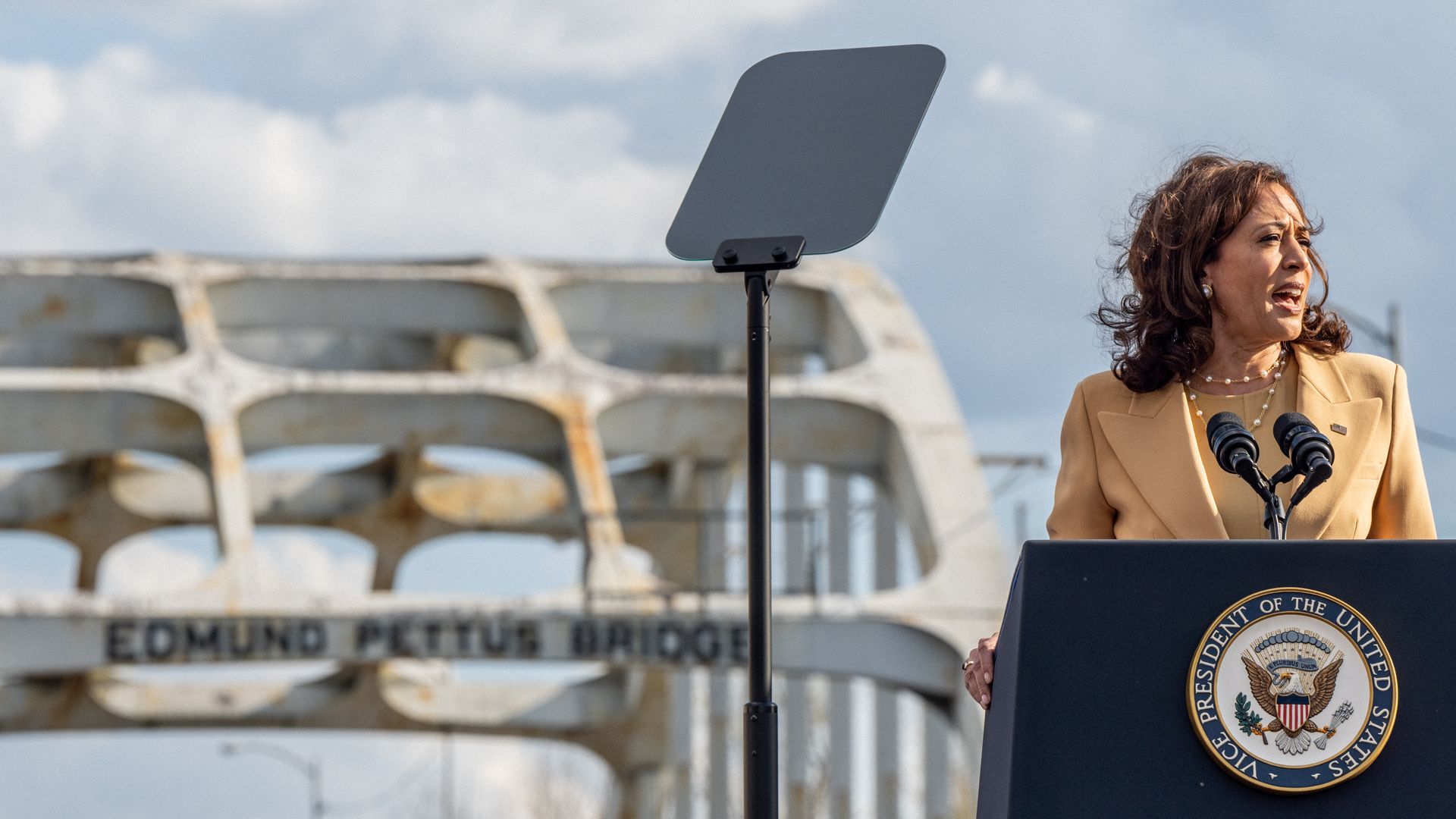
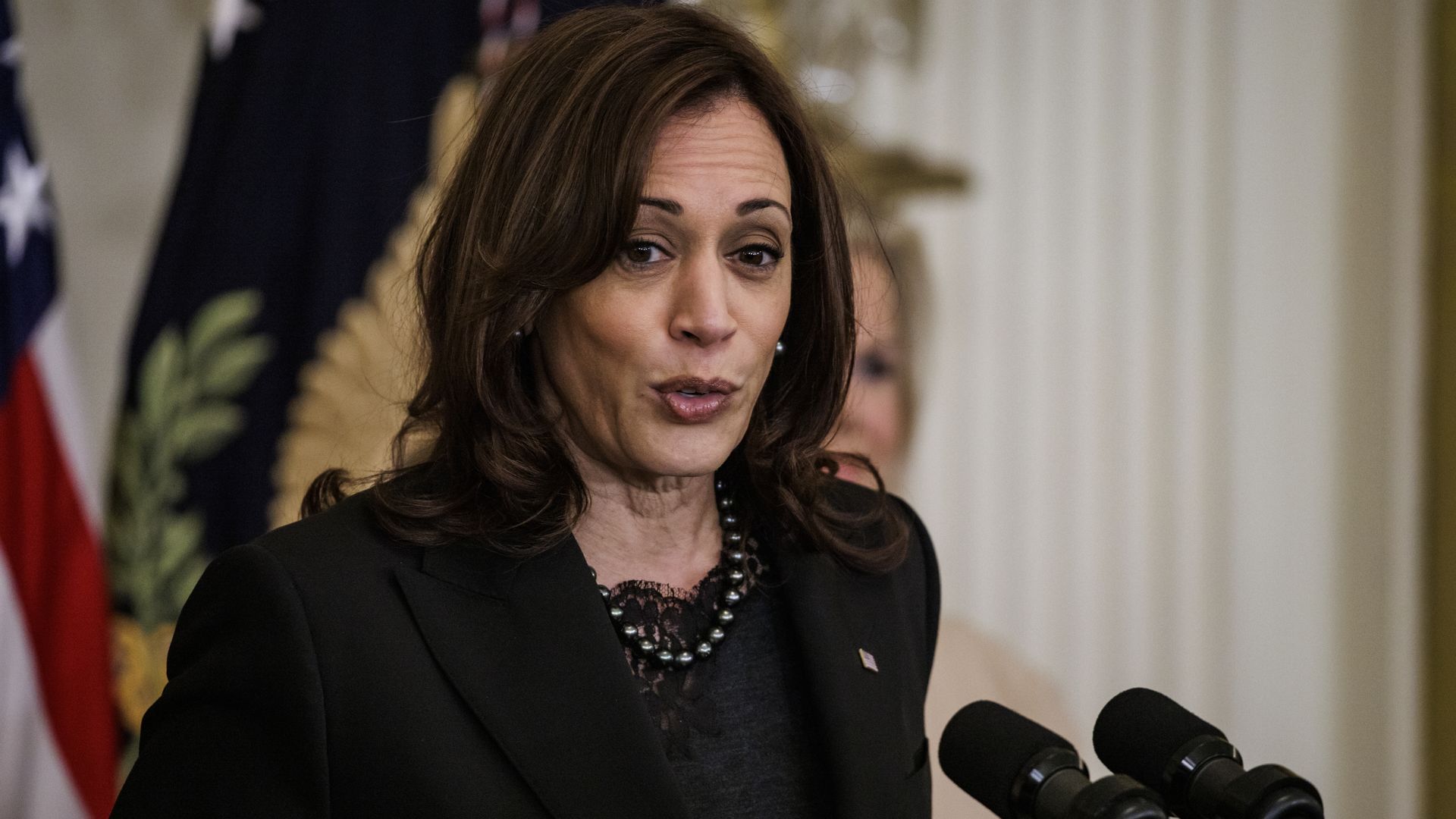
Vice President Kamala Harris traveled to Selma, Alabama, on Sunday to commemorate the 57th anniversary of "Bloody Sunday," a critical day in the history of the civil rights movement.
Driving the news: Harris— the nation’s first Black female vice president— returned to where demonstrators in 1965 marched to demand an end to discrimination in the voting process to extol the current need to safeguard voting rights.
"Instead of forgiveness, there will be judgment," Ukrainian President Volodymyr Zelensky said in a video shared on the last Sunday before Lent.
Driving the news: “Today is Forgiveness Sunday. But we cannot forgive the hundreds upon hundreds of victims. Nor the thousands upon thousands who have suffered," according the latest video that the leader posted to his Telegram account on Sunday night local time. "God will not forgive. Not today. Not tomorrow. Never."
Israeli Prime Minister Naftali Bennett spoke on Sunday with Russian President Vladimir Putin and Ukrainian President Volodymyr Zelensky and continued his efforts to promote a cease-fire.
Why it matters: Bennett’s overtures are part of a wider effort that includes French President Emmanuel Macron and German Chancellor Olaf Scholz. The three leaders are coordinating their outreach to Putin and Zelensky.
President Biden’s advisers are discussing a possible visit to Saudi Arabia this spring to help repair relations and convince the Kingdom to pump more oil, Axios has learned.
Why it matters: A hat-in-hand trip would illustrate the gravity of the global energy crisis driven by Russia's invasion of Ukraine. Biden has chastised Saudi Arabia, and the CIA believes its de facto leader, Crown Prince Mohammed bin Salman, was involved in the dismemberment of Washington Post columnist Jamal Khashoggi.
Progressives are bringing a seven-figure budget and roster of top Democratic talent to their fight to confirm Supreme Court nominee Ketanji Brown Jackson, Axios has learned.
Why it matters: While Jackson's confirmation is likely, both sides are looking to milk the process for every ounce of political advantage this midterm year. Demand Justice, a progressive judicial advocacy outfit, is slated to lead the fight on the left.
American truckers and other drivers, calling themselves the "People's Convoy," are slowing traffic on Sunday as they drive around the Capital Beltway, a highway that encircles Washington, D.C.
What's happening: The group is emulating the "Freedom Convoy," which saw truckers in Canada blocking the streets of Ottawa for weeks and jamming several U.S.-Canada border crossings, in protest of COVID-19 health restrictions.
Ukraine has a plan should President Volodymyr Zelensky be killed during the Russian invasion, Secretary of State Antony Blinken said on Sunday.
Driving the news: “The Ukrainians have plans in place that I'm not going to talk about or get into any details on to make sure that there is what we would call continuity of government one way or another. And let me leave it at that,” Blinken said on CBS' "Face the Nation."
House Republicans who'd assume control of oversight committees should their party return to power next year are sketching out familiar targets: Hunter Biden, D.C. Mayor Muriel Bowser and the origins of the coronavirus.
Why it matters: President Biden and the Democratic Party have been able to control the government narrative to a degree through their unified control of the White House and Congress. A GOP majority in even one chamber would trigger fresh scrutiny of the executive branch and upheaval in the legislative branch.
Israeli Prime Minister Naftali Bennett on Saturday secretly traveled to Moscow to discuss a possible cease-fire with Russian President Vladimir Putin, an Israeli official confirmed to Axios.
Why it matters: This is a highly unusual move by Bennett, who has been communicating in recent days with both Putin and Ukrainian President Volodymyr Zelensky. Bennett briefed Zelensky by phone after Saturday's meeting.
Far-right Reps. Marjorie Taylor Greene (R-Ga.) and Paul Gosar (R-Ariz.) are untouchable inside the House Republican conference.
Why it matters: Greene and Gosar can attend as many white supremacist conferences as their hearts desire, safe in the knowledge there's nothing they need from leadership — and nothing left for leadership to take from them.
Some Russian restaurants and businesses in the U.S. are facing threats, harassment and vandalism in the days since Russia launched its invasion of Ukraine.
Driving the news: Russia House Restaurant and Lounge in Washington, D.C., was vandalized twice last weekend, resulting in smashed windows, a broken door and what is believed to be anti-Russian rhetoric posted on the walls, WUSA9 reports.
Worldwide expressions of support for Ukraine have offered a symbolic boost to a besieged nation, but its leaders are seeking even more of the substantive support that's been slowed by logistical and timing hurdles.
Why it matters: Ukrainians are viewing the survival of some cities in terms of hours or days. While missiles are arriving in Ukraine and crushing sanctions are being felt in Moscow, neither is stopping the invasion as quickly as would Western air support, for example.
Congress is getting close to finally passing anti-lynching legislation after decades of pleas from advocates — and centuries of racial terror in the American South and Southwest.
The big picture: The House last week passed the Emmett Till Antilynching Act of 2022, a bill to designate lynching as a federal hate crime. Sen. Rand Paul (R-Ky.) is co-sponsoring a Senate version after holding up a previous anti-lynching proposal.
Biden administration officials pressured some Democratic senators not to support bipartisan legislation by Sens. Joe Manchin (D-W.Va.) and Lisa Murkowski (R-Alaska) that would ban oil and gas imports from Russia, Senate Democratic aides told Axios.
Why it matters: The quiet lobbying campaign reveals a White House intent on preserving President Biden's authority to decide what costs to impose on Russia for invading Ukraine — and on what timetable.
It also indicates his advisers' frustration with congressional efforts to box him in.
The White House on Friday signaled it is open to reducing the import of Russian oil — without saying exactly how.
The big picture: A ban could translate to higher prices at the pump in parts of the U.S. and increase inflation, a key concern for Biden.
It also could force other countries to follow suit — sending oil prices soaring around the globe. Russia, the world’s third-largest oil producer, sends most of its petroleum products to Europe and Asia.
By the numbers: Oil from Russia accounted for roughly 3% of U.S. crude imports in 2021.
It's mostly imported in Hawaii and the coasts, where refiners don’t have access to the pipelines connecting the big domestic oil fields in places like the southwest's Permian Basin.
Energy analysts and economists disagree about how much of a price spike an import ban would generate.
Driving the news: Cecilia Rouse, chair of the Council of Economic Advisors, told reporters on Friday: "We are looking at options that we can take right now, if we were to cut the U.S. consumption of Russian energy, but what’s really most important is that we maintain a steady supply of global energy.”
That appears to be a shift from the White House's initial dismissal of the congressional effort to effectively impose an embargo on Russian oil for U.S. refiners.
Its behind-the-scenes lobbying effort earlier in the week appeared to be having mixed results. The Manchin-Murkowski legislation now has 20 co-sponsors.
Meanwhile, House Speaker Nancy Pelosi told reporters on Thursday about a ban, "I’m all for that — ban it."
Bloomberg reported on Friday that administration officials were in discussions with officials from the oil and gas industry on the effect a possible ban would have on prices paid by the American consumer.
A spokesperson for the White House declined to comment.
Between the lines: Senate aides told Axios that the White House's response to the Manchin-Murkowski effort looks similar to its requests last week for lawmakers to tamp down demands to expel Russia from the SWIFT financial system — a decision the Biden administration ultimately took.
What they're saying: Michael McFaul, who served as U.S. ambassador to Russia under President Barack Obama, said Friday that he expects the practice of importing Russian oil to "change soon."
"The United States should not be importing Russian oil. Period," McFaul said during an online panel discussion about the Russian invasion of Ukraine moderated by Axios' Jonathan Swan.
"I understand inflation. I understand the arguments. But there's no ethical or moral reason that we should be doing that, and I expect that to change soon."
Many U.S. refiners have effectively stopped purchasing oil from Russia, as they're concerned about how to pay for it if many Russian entities are already under banking sanction.
Preliminary data from the Energy Information Agency shows that U.S. imports dropped to zero in the last week in February.
On Friday, Shell PLC, which is headquartered in the United Kingdom, bought Russian crude at a steep discount, nearly $30 a barrel below international benchmarks, according to the Wall Street Journal.
U.S. gas prices already are running as high as they were in 2014 due to an economic resurgence amid tight global supplies, Axios' Andrew Freedman notes.
The bottom line: The White House has always wanted to keep some sanctions in its back pocket as leverage on Russia and to delay, if not avoid, pain to American consumers.
But with international and domestic opinion turning so strongly against Russia, Biden may get pressed to impose sanctions ahead of schedule.
Driving the news: Newly released data shows that Planned Parenthood health centers in Texas' surrounding states saw a nearly 800% increase in abortion patients from Texas between Sept. 1 and Dec. 31, 2021.
Vice President Kamala Harris will travel to Poland and Romania next week amid Russia's invasion of Ukraine, the White House said Friday.
Why it matters: Harris' overseas trip to Warsaw and Bucharest is intended to be a sign of U.S. support for NATO's eastern flank as Russian troops approach Kyiv, according to a White House statement.
Sgt. Aquilino Gonell testified Friday that the injuries and subsequent surgeries he suffered as a result of the Jan. 6 insurrection continue to hinder his daily life more than a year later, CNN reports.
Why it matters: Duke Wilson, 67, pleaded guilty to assaulting federal officers and obstructing an official proceeding in September. At his sentencing on Friday, Gonell detailed the attack that played out as Wilson used what prosecutors believe was a PVC pipe to repeatedly strike officers.
A convoy of American truckers calling for an end to COVID-19 safety mandates is expected to arrive in the Washington, D.C.-area this weekend.
Why it matters: The approaching convoy is a continuation of the Canadian "Freedom Convoy," where protestors jammed up a trio of border crossings and downtown Ottawa for several days last month.