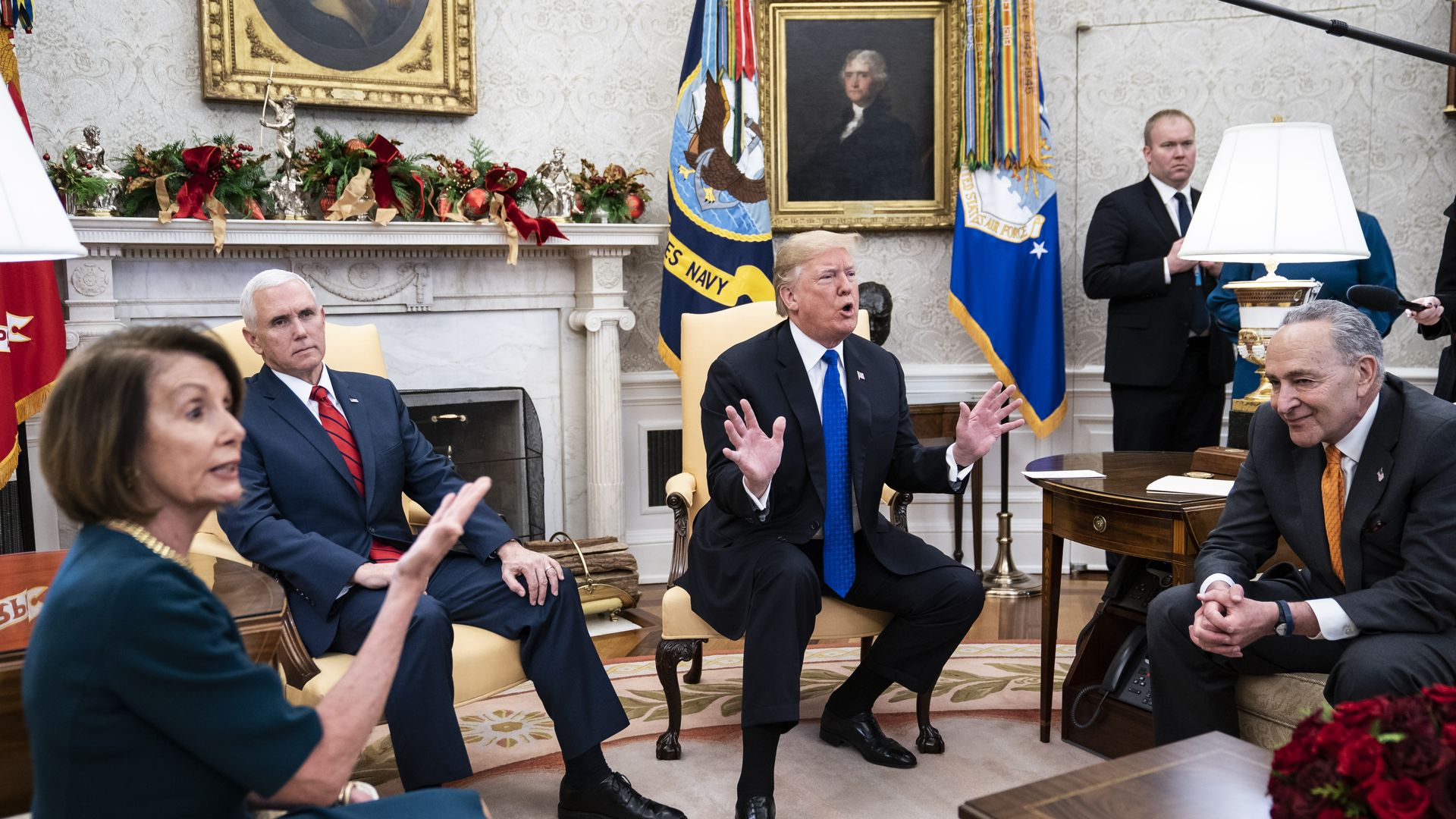
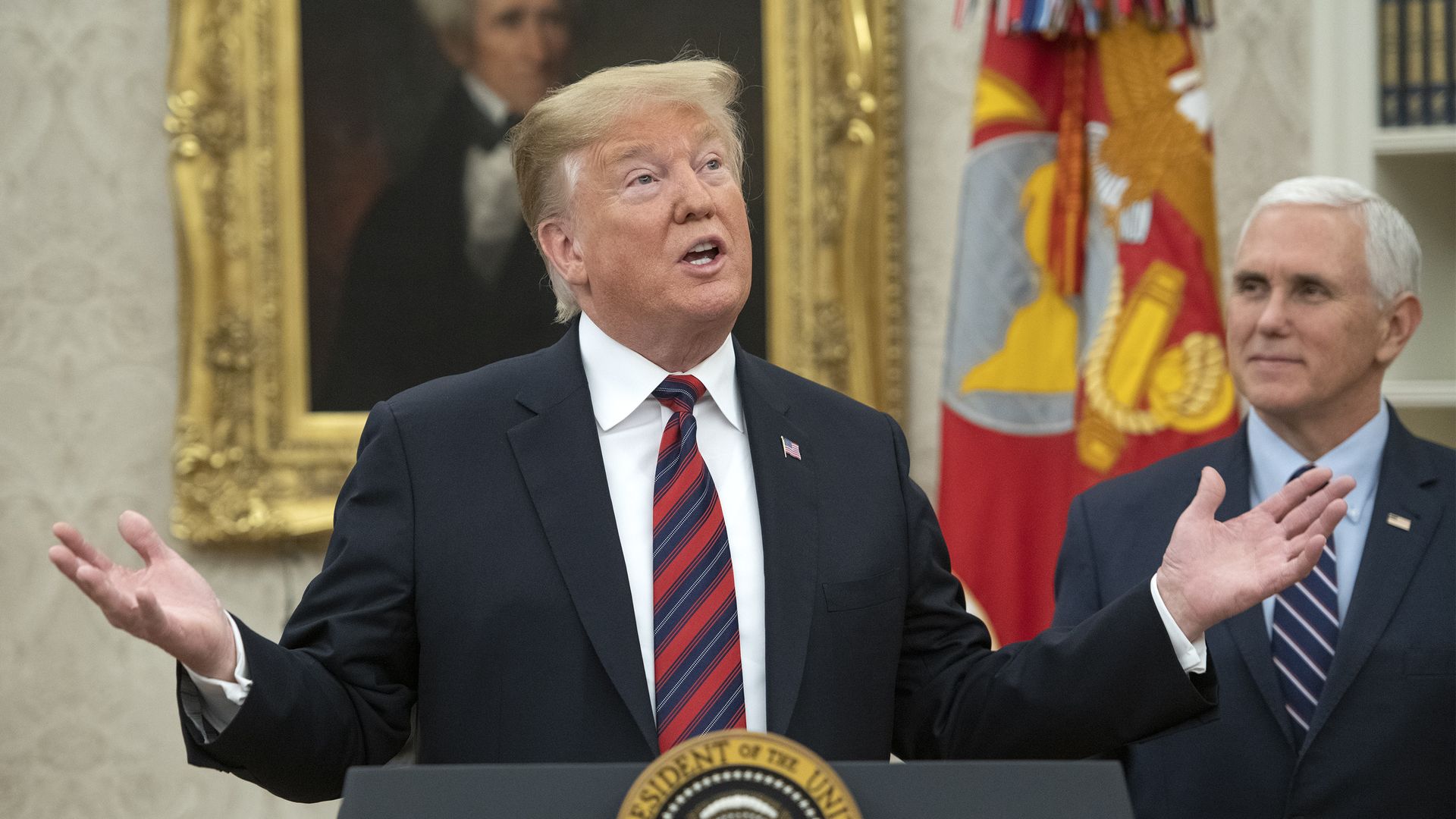
The Senate will be voting on two dueling proposals Thursday to reopen the government. The first is President Trump's proposed compromise for border wall funding in exchange for an extension of DACA and TPS, while the second is a clean continuing resolution that would fund agencies through Feb. 8.
The state of play: Neither bill is expected to get the 60 votes necessary to pass. Democrats have said they will not negotiate on border funding until the government is reopened, and are expected to have the votes necessary to block Trump's proposal. Neither Trump nor Senate Majority Leader Mitch McConnell will be supporting the second bill, which originated in the Democrat-controlled House, CNN's Manu Raju reports.
Senate Minority Leader Chuck Schumer, House Speaker Nancy Pelosi and left-leaning groups are nowhere close to supporting President Trump's attempt at an immigration compromise to reopen the government.
The state of play: Trump has no immediate leverage when it comes to DACA and Temporary Protected Status, programs that give protections to immigrants who came to the U.S. as children or whose home nations are currently unsafe. Federal courts are already upholding these programs in spite of the administration's attempt to end them, meaning Democrats would have little to nothing to gain by accepting Trump's offer.
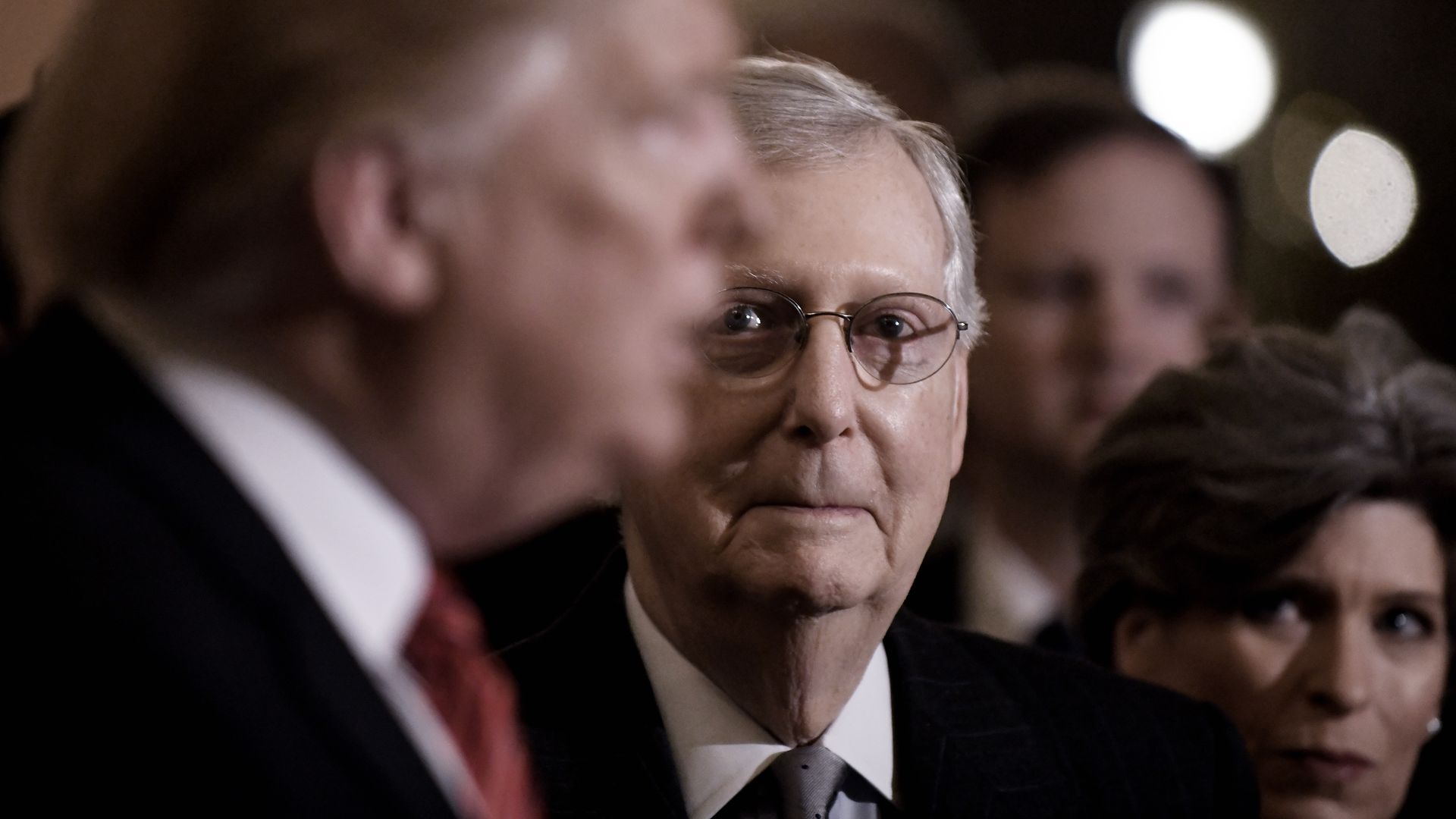
Senator Majority Leader Mitch McConnell (R-Ky.), who blocked former President Obama's Supreme Court nominee Merrick Garland from ever having a hearing in 2016, told the New York Times Magazine that his "decision not to fill the [Justice Antonin] Scalia vacancy" was the "most consequential thing I've ever done."
The big picture: McConnell cited "a longstanding tradition of not filling vacancies on the Supreme Court in the middle of a presidential election year" in his refusal to even meet with Garland after the death of Scalia — a tradition deemed "false" and "entirely a matter of circumstance" by Politifact. Since Trump's election, McConnell has led the effort to reshape the ideological makeup of the federal judiciary, successfully confirming 2 Supreme Court justices and at least 84 lower-court judges.
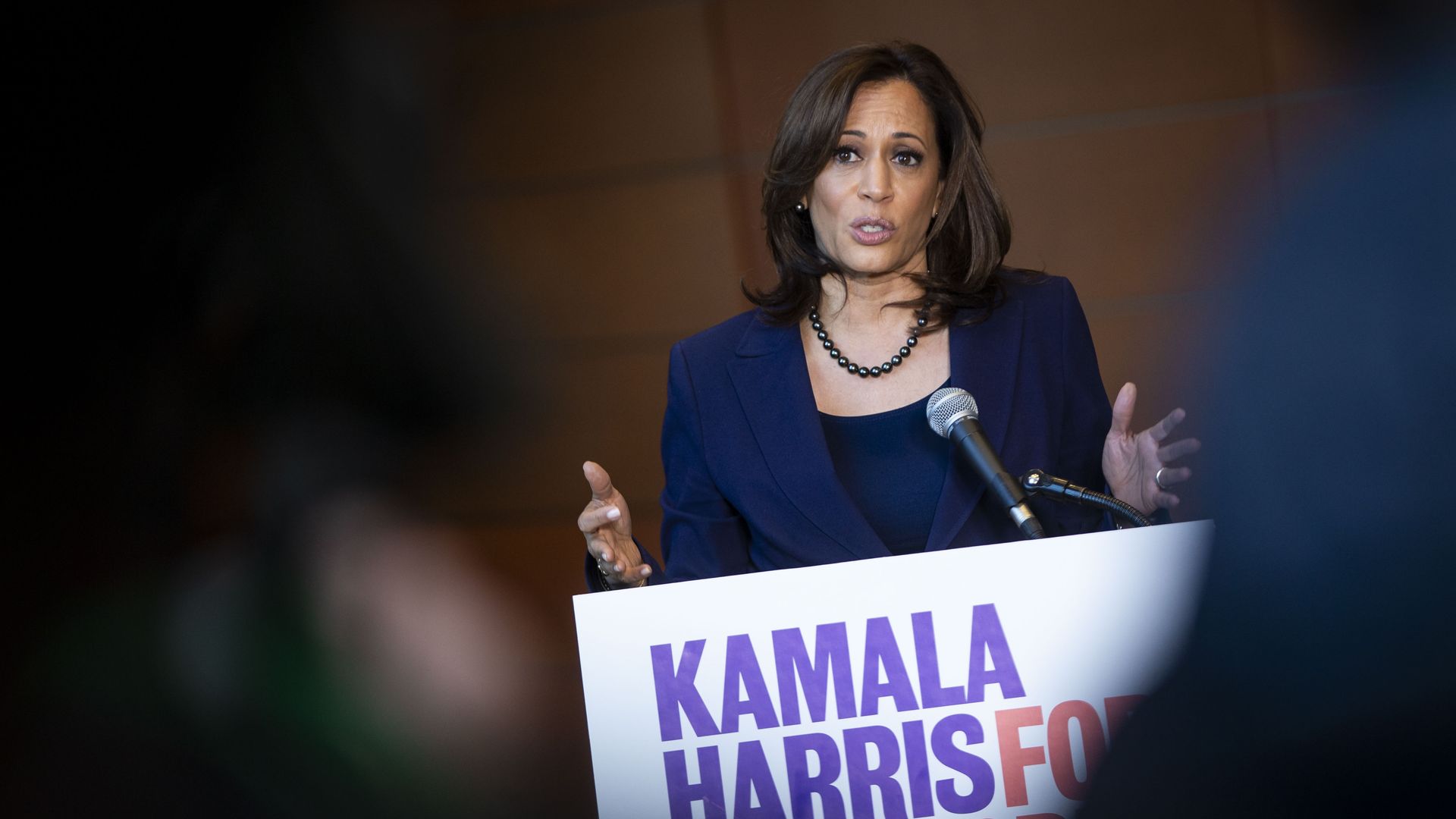
Sen. Kamala Harris (D-Calif.) raised $1.5 million from 38,000 online donors in the 24 hours after she announced her 2020 presidential run, according to her campaign.
Why it matters: Harris has said she will reject corporate PAC money to fund her campaign, making these grassroots donations — the average was $37 — crucial to her bid for the White House. Small-dollar, online donations helped Democratic candidates at all levels across the country in the 2018 midterms and Harris' success suggests the momentum is still there for the 2020 cycle.
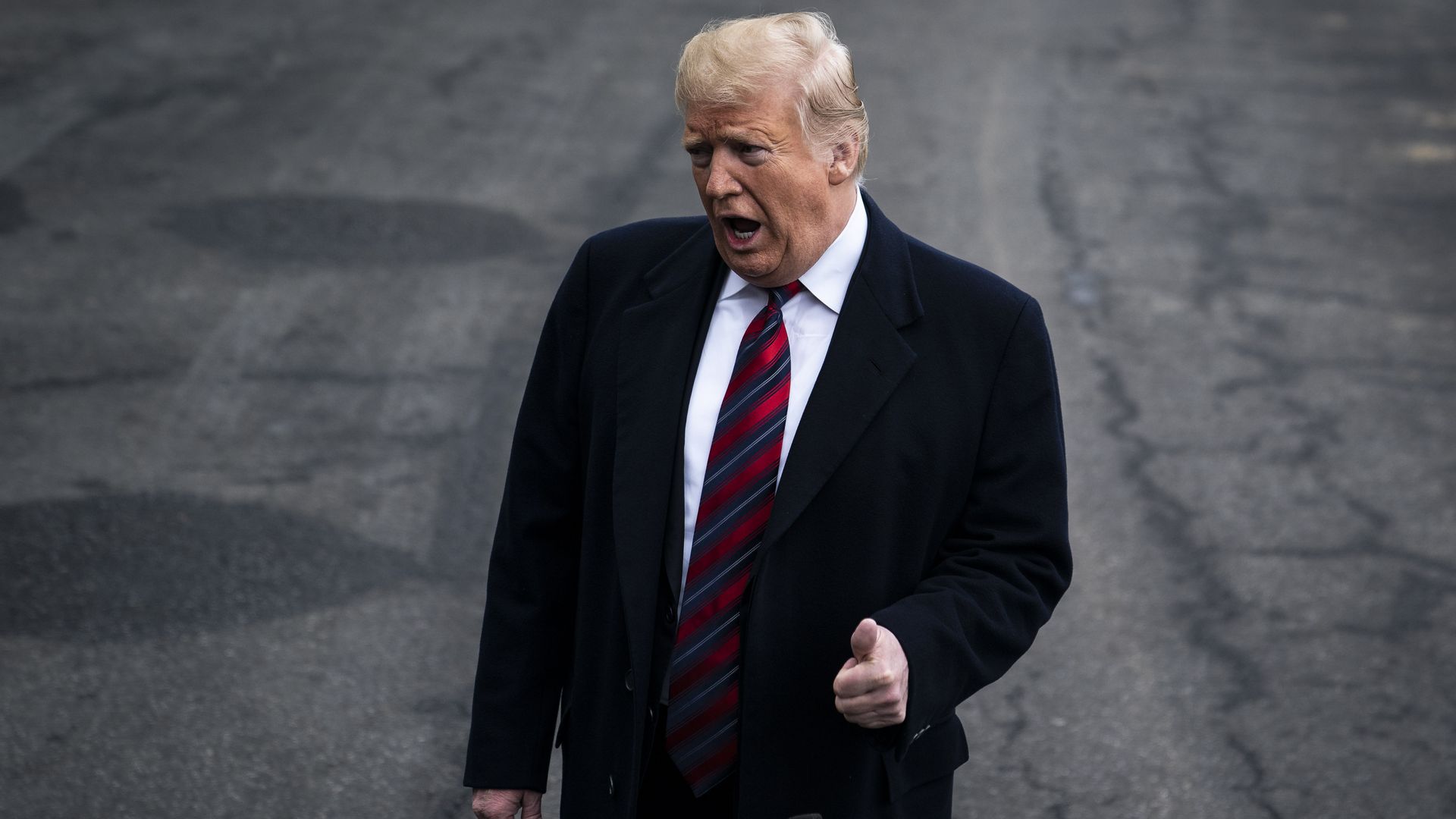
President Trump said in a Tuesday tweet that he's directed White House Press Secretary Sarah Sanders "not to bother" with press briefings because "certain members of the press" cover her "rudely" and "inaccurately."
The big picture: The current 35-day streak without a press briefing from the White House podium is the longest on record since the tradition started during President Bill Clinton's administration, according to ABC News' Alex Mallin. White House Correspondents' Association President Olivier Knox said in a response that "no one in a healthy republic is above being questioned."
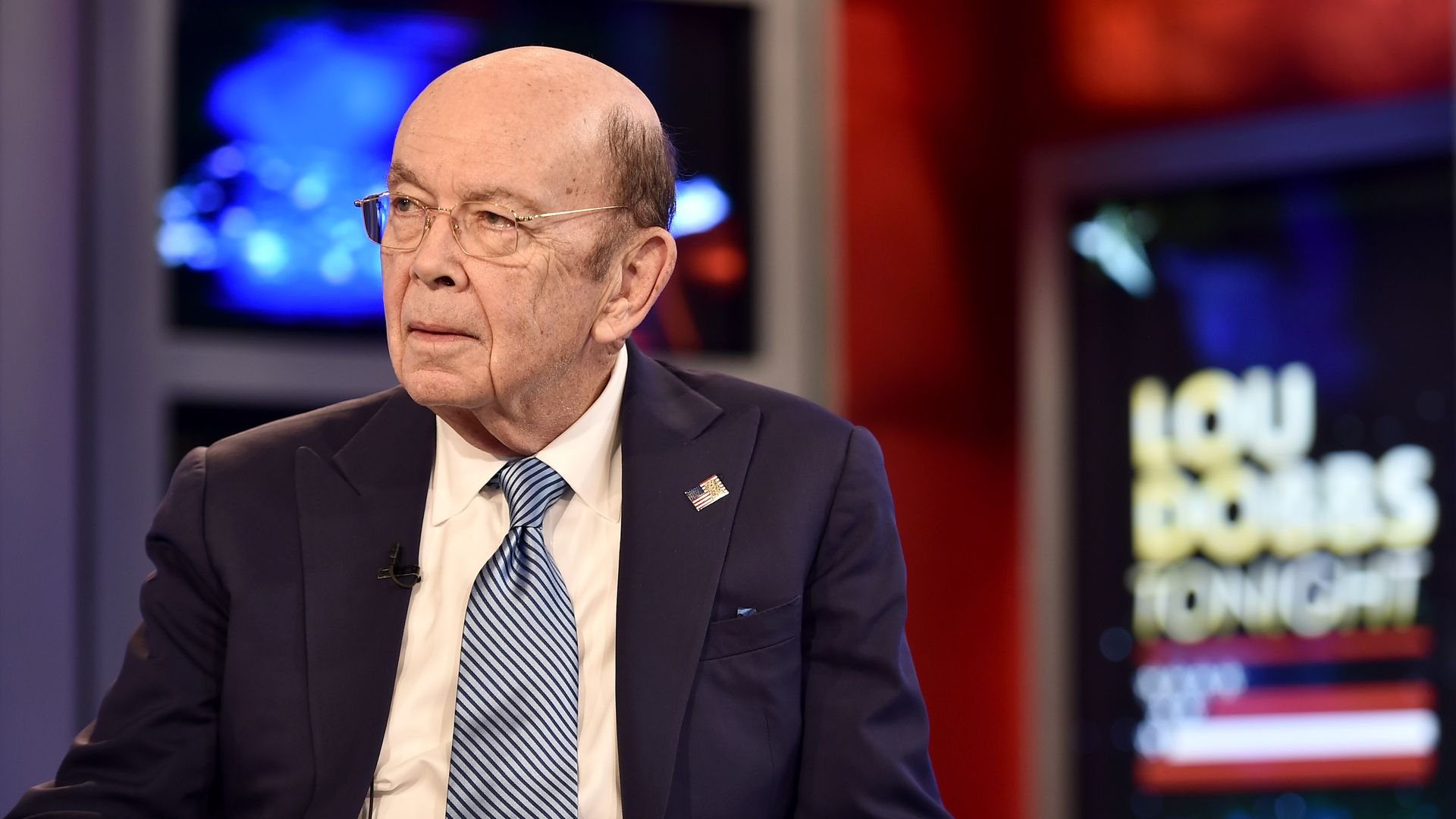
The House Oversight Committee announced Tuesday that Commerce Secretary Wilbur Ross has agreed to testify on March 14, focusing on a citizenship question that was set to be added to the 2020 Census questionnaire.
Why it matters: Last week, a federal judge in New York ruled against the Trump administration's decision to include the question, siding with critics who argue that it's a partisan move that could cause legal and undocumented immigrants to refuse to participate.
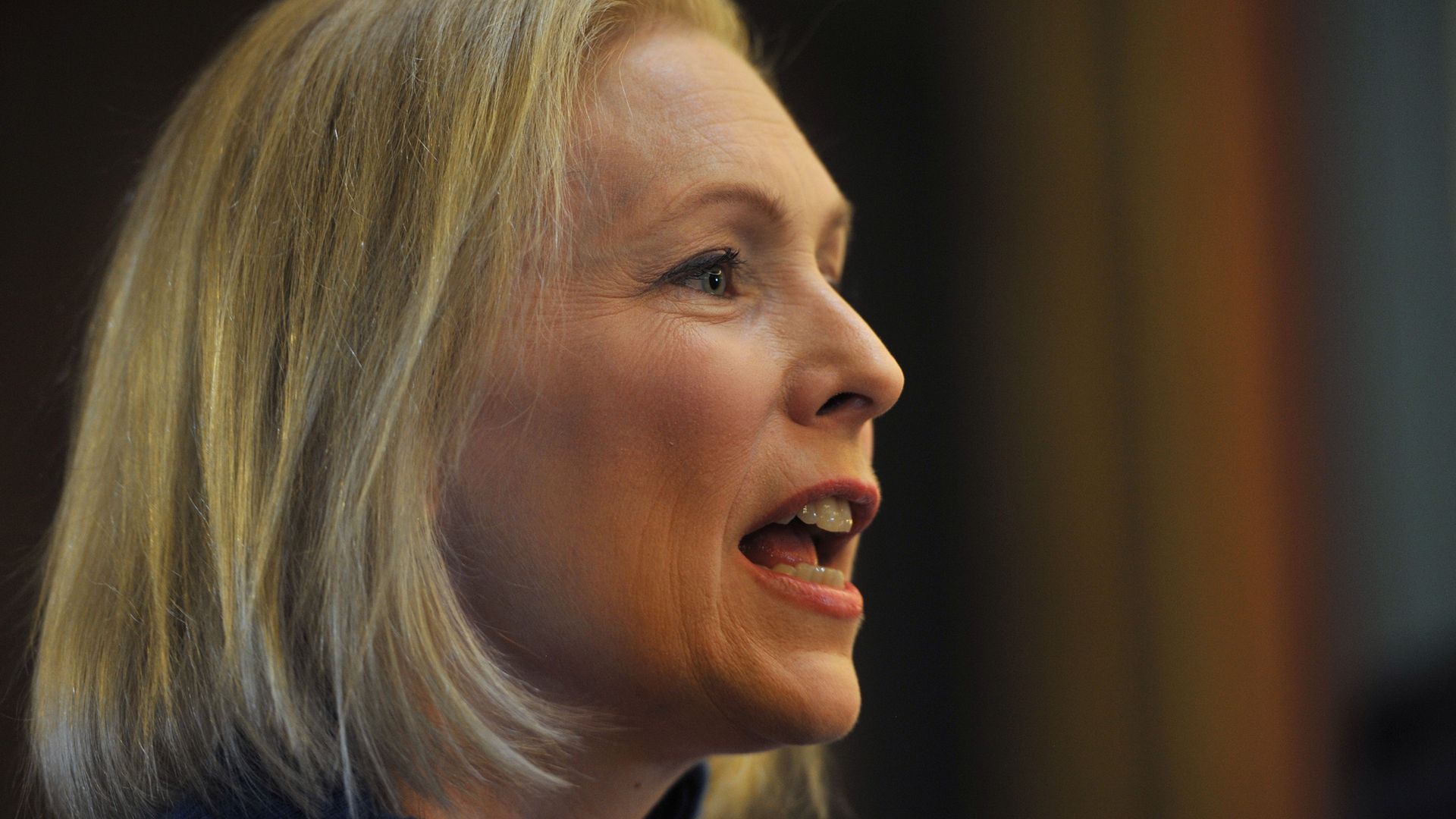
Democratic Sen. Kirsten Gillibrand, who joined the growing field of White House hopefuls last week, backs the "concept" of the Green New Deal, a Senate aide tells Axios.
Why it matters: It shows momentum among mainstream Democrats for the sweeping climate, energy and economic proposal championed by progressive activists and Rep. Alexandria Ocasio-Cortez.
President Trump in a Tuesday morning tweet: "Nick Sandmann and the students of Covington have become symbols of Fake News and how evil it can be. They have captivated the attention of the world, and I know they will use it for the good - maybe even to bring people together. It started off unpleasant, but can end in a dream!"
Driving the news: Sandmann's face became famous on Saturday as he was videotaped wearing a "Make America Great Again" hat and smirking while standing in front of a Native American elder at the Lincoln Memorial.
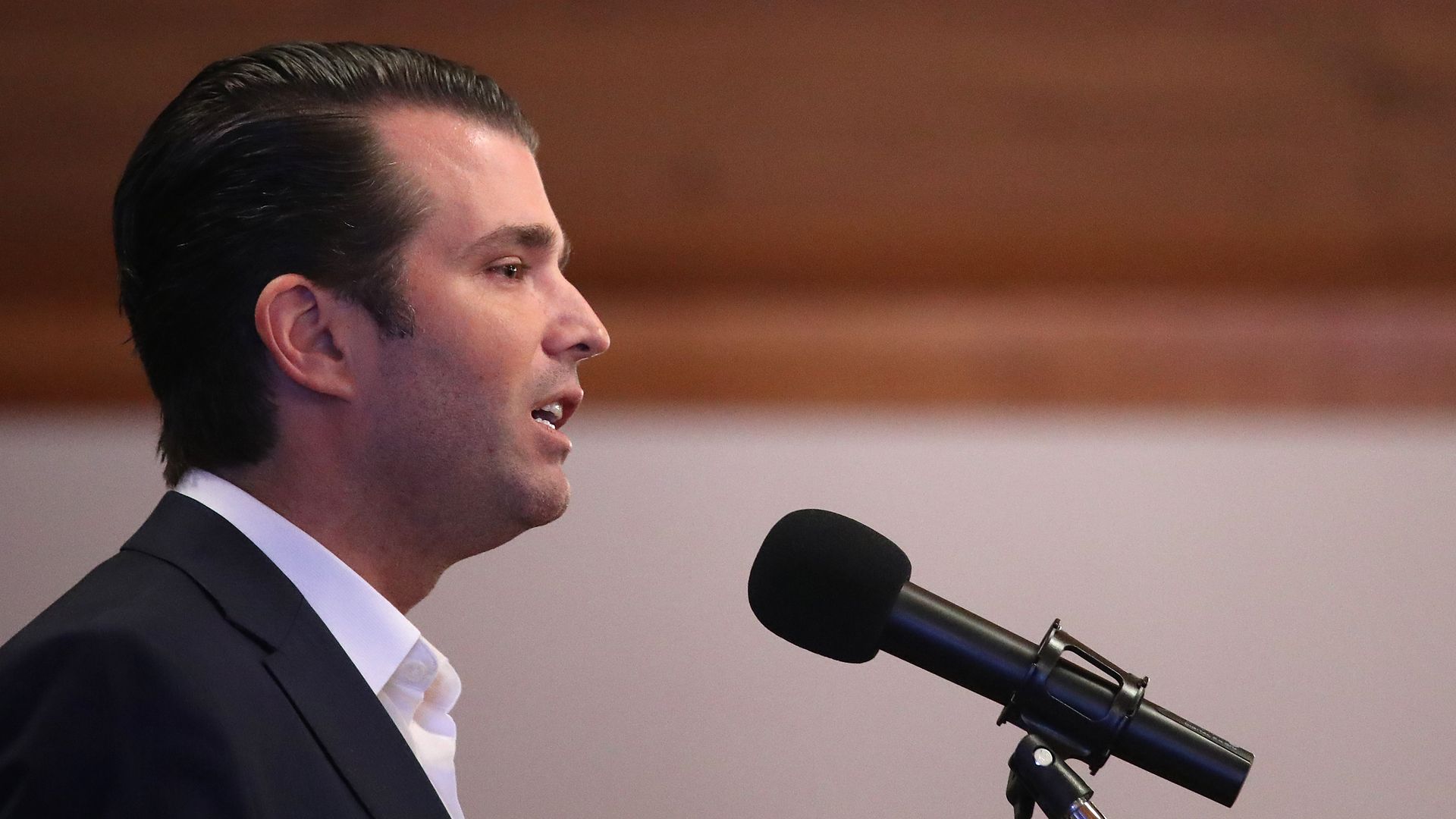
Donald Trump Jr. placed the blame for a Trump Tower Moscow project solely on President Trump's former attorney Michael Cohen in an interview on Fox News' "The Ingraham Angle" Monday night, saying, "We don't know anything about it."
The big picture: Trump Jr.'s statement contradicts multiple facts that have already been made public about the Moscow project — mentioned publicly in a 2013 Trump tweet — which was formalized in a letter of intent signed by Trump in October 2015 with a team of developers first revealed in 2017.
President Trump made 8,158 false or misleading claims in his first two years in office, per the Washington Post's Fact Checker.
Why it matters: More than 6,000 of those were in his second year. The Post notes, "The president averaged nearly 5.9 false or misleading claims a day in his first year. ... But he hit nearly 16.5 a day in his second year, almost triple the pace."
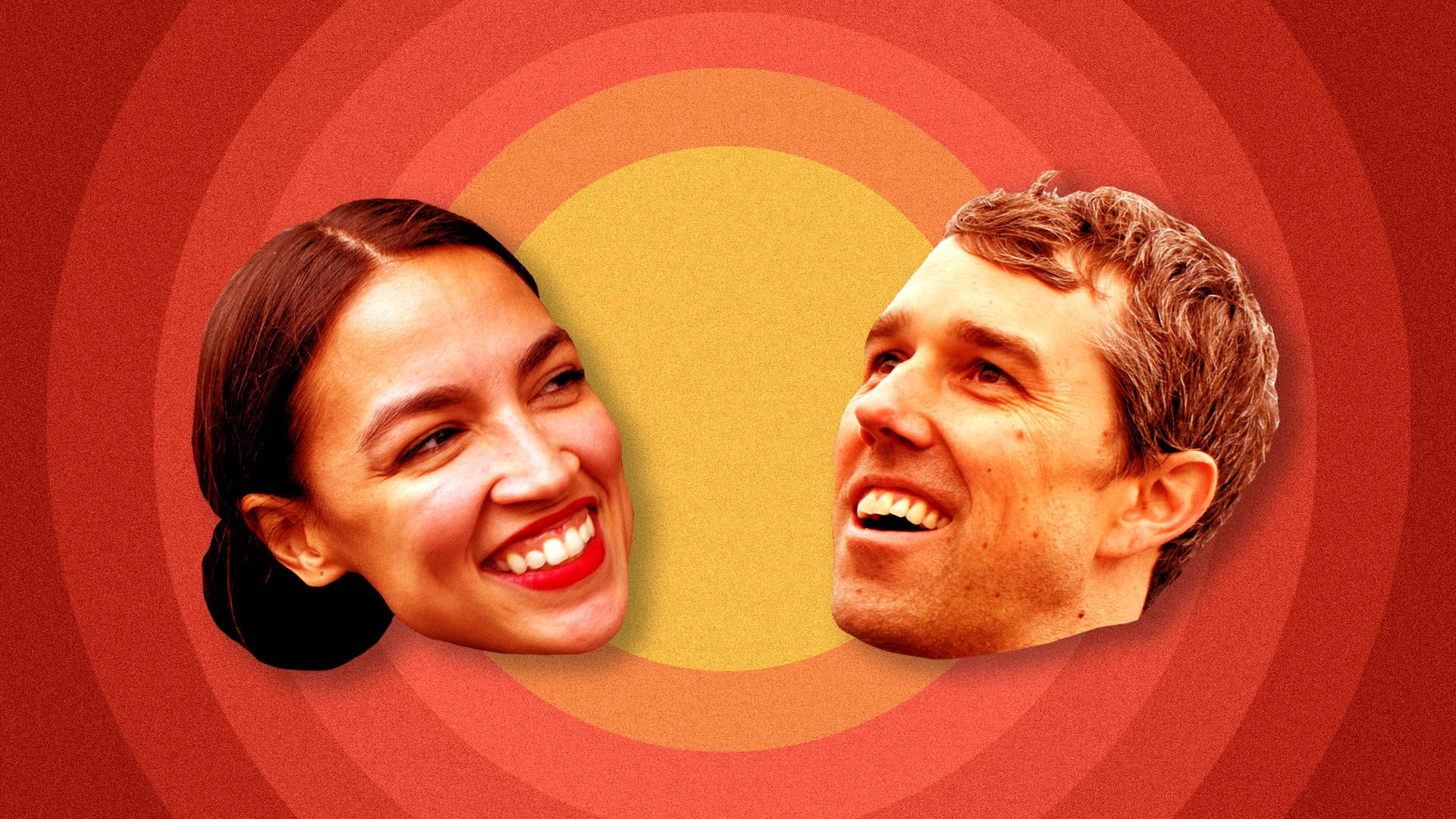
The biggest political story since the election of Donald Trump is the sudden, stark, sustained rise of the political artists also known as AOC and Beto.
The big picture: Rep. Alexandria Ocasio-Cortez (D-N.Y.) and former Rep. Beto O'Rourke are political and cultural phenomena — one known by her initials, one by his first name, like Drake or JFK or RG3. Both arose from nowhere seven months ago, during the midterms, and today are everywhere.
/2019/01/22/1548193787952.gif?w=3840)