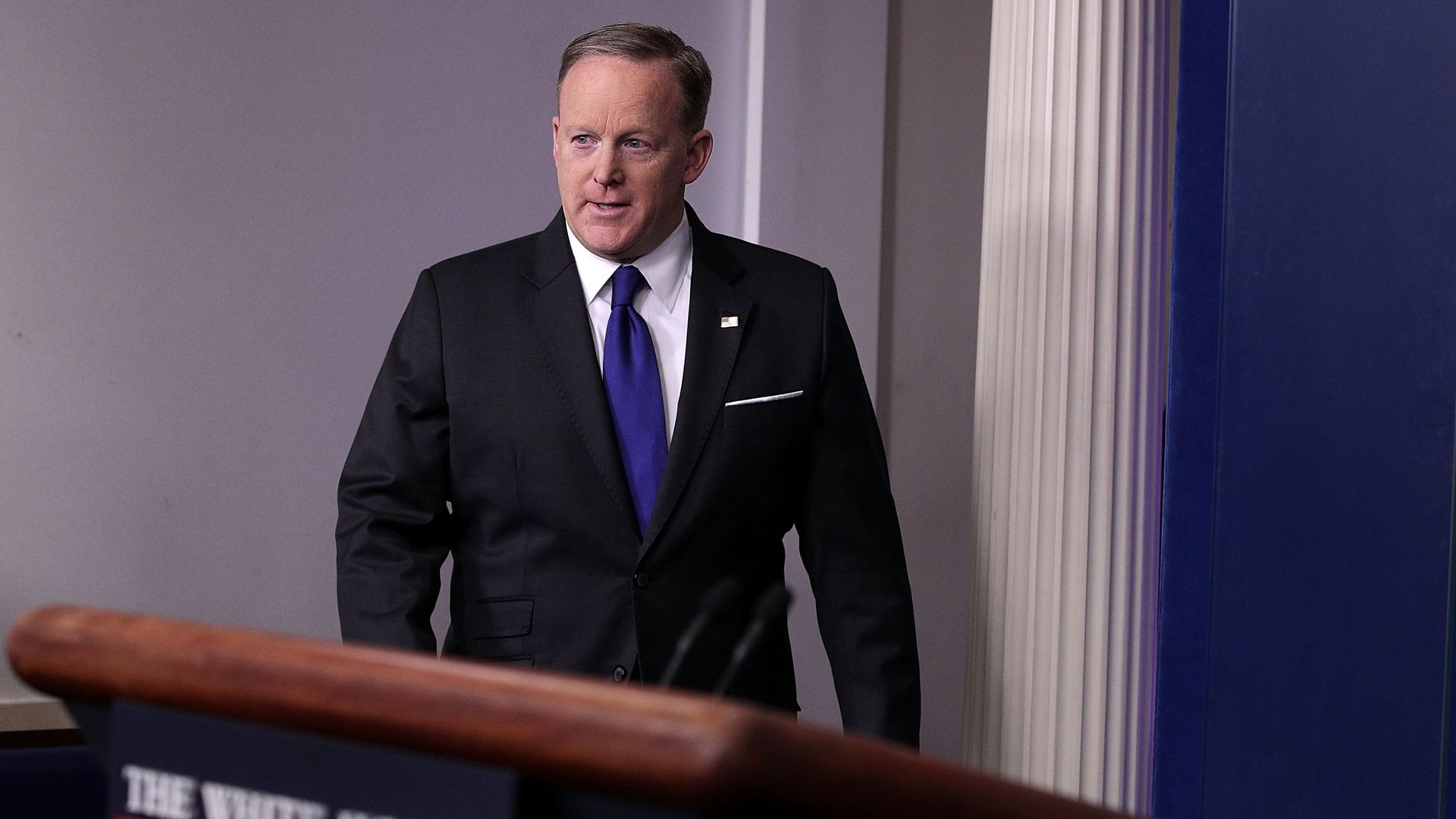
Here's a fresh window into his media mind, in this exclusive preview from Sean Spicer's book, The Briefing: Politics, The Press, and The President (Regnery), out July 24.
"[B]etween10:00 a.m. and noon, Sarah Huckabee Sanders and I would poke our heads into the Oval Office ... [Trump] was always full of questions, wanting background on where a story came from and, of course, curious to know what we were going to say about it. And he was never shy about giving us directions."
World leaders are learning to play President Trump using his own set of predictable negotiating tricks. The most vivid example of this: French President Emmanuel Macron bragging to Trump that he was jamming him by stealing "The Art of the Deal" techniques, Axios has learned.
The scene: Perched on white leather armchairs in their bilateral meeting on the sidelines of the NATO Summit in Brussels, Trump and Macron soon turned to the unavoidable subject: The expanding trade war between the United States and Europe.
Not since the Bill Clinton sex scandals of the 1990s has the national conversation focused on a president's personal life on so many fronts so often.
And not since the 1990s has sex been part of a federal investigation stirring calls for impeachment: Kristin Davis, known as the "Manhattan Madam" for the high-end prostitution ring she ran in the 2000s, says Robert Mueller's prosecutors have notified her that he wants to interview her — probably about her close friend, Roger Stone, she tells the WashPost.
The Department of Justice has released redacted documents pertaining to the surveillance of former Trump campaign adviser Carter Page, who in 2016 was believed by the FBI to be an agent of Russia, the New York Times reports.
Why it matters: The wiretapping warrant on Page was issued and renewed several times under the Foreign Intelligence Surveillance Act (FISA), and has been heavily criticized by President Trump and Republicans in Congress as an abuse of power by the FBI. The documents appear to show that the FBI properly disclosed its sources of information and that it relied on more than just the controversial Steele dossier, contradicting claims of abuse made by Chairman of the House Intelligence Committee Devin Nunes.
Friends of Michael Cohen have noticed that since Trump's Helsinki press conference with Vladimir Putin he's been more openly questioning Trump's fitness to be president. "It's one thing for him [Cohen] to be concerned about his suitability to be president," a knowledgeable source told me. "It's quite another thing to be concerned about his [Trump's] loyalty to his country."
The source added that Cohen was sending a public signal to this effect when he tweeted, on Monday after Trump's Helsinki press conference: "As I said to @ABC @GStephanopoulos, "I respect our nation's intelligence agencies who determined that Russia, had in fact, interfered or meddled in our democratic process. I repudiate Russia's effort...and call on all Americans to do the same."
In today's hyper-polarized political climate, a formerly-used term has come back into rotation to describe those with serious disdain for the president: "Trump Derangement Syndrome."
The big picture: This isn't the first episode of wide-spread "derangement;" the late conservative columnist Charles Krauthammer coined the term "Bush Derangement System" in 2003. And, of course, it made its rounds when Barack Obama took office.
In a Saturday morning tweet, President Trump went after Michael Cohen for allegedly taping their discussion about a potential payment to former Playboy model Karen McDougal who claimed she had an affair with Trump, calling the taping "inconceivable" and "perhaps illegal." Trump stood by his claim that he has done nothing wrong.
Since the dawn of humans, we have faced one inexorable challenge — how to support the rise and — in the last half century or so — explosion of the population. But, in a momentous reversal, that age-old challenge is changing: the population of most countries is shrinking — for many of them at an alarming pace — and at the same time aging.
Much of the world teeters on the cusp of a childless, elderly future.
One point that's often lost in heated debate is that immigration could be vital in helping countries to have enough young workers in the economy to support their aging populations.
The bottom line:The control of borders is a serious political problem, but experts are eyeing legal immigration as one solution to a future demographics challenge. As nations age, many will be short of workers to support social programsrelied on by the older population.