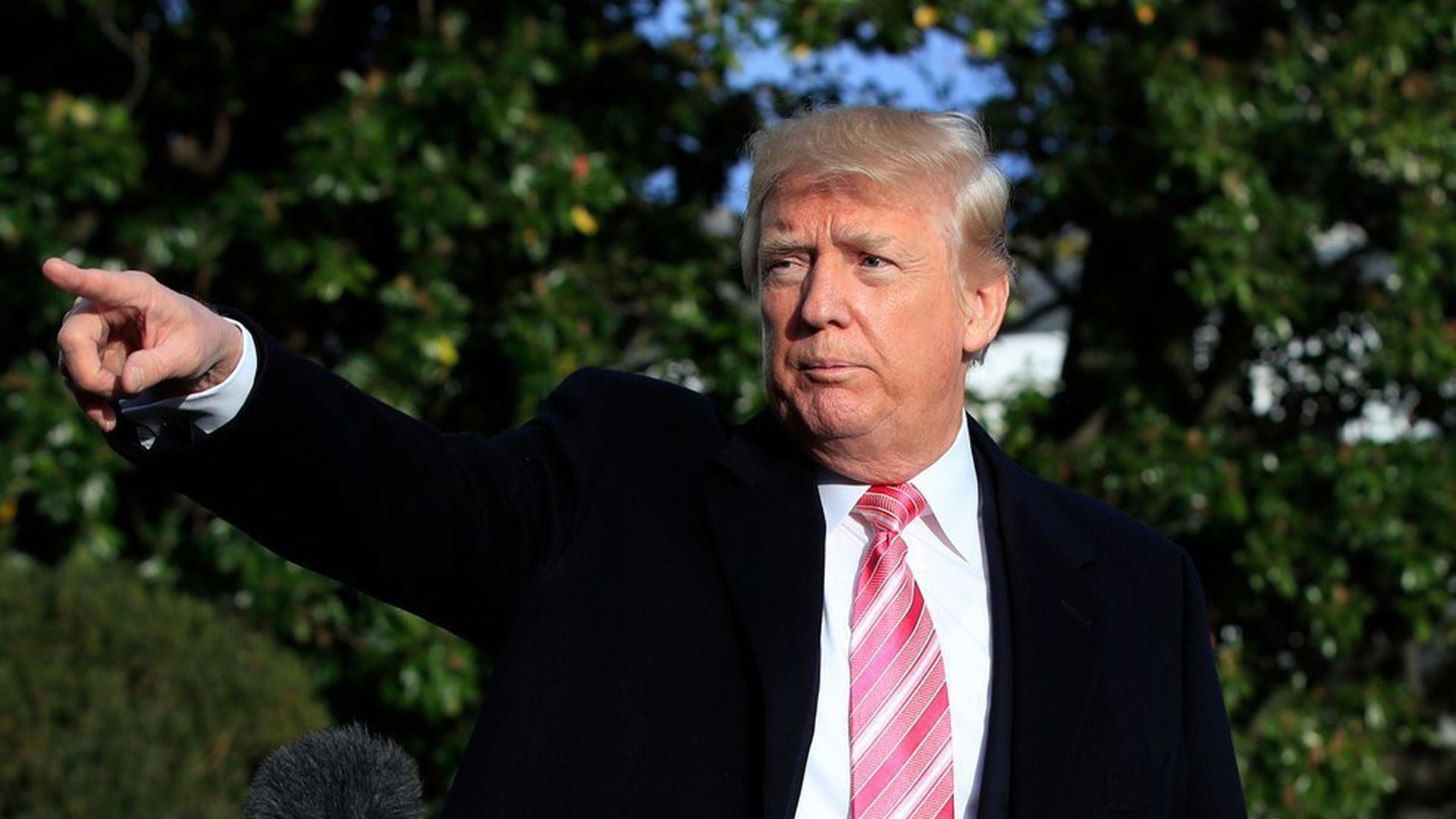
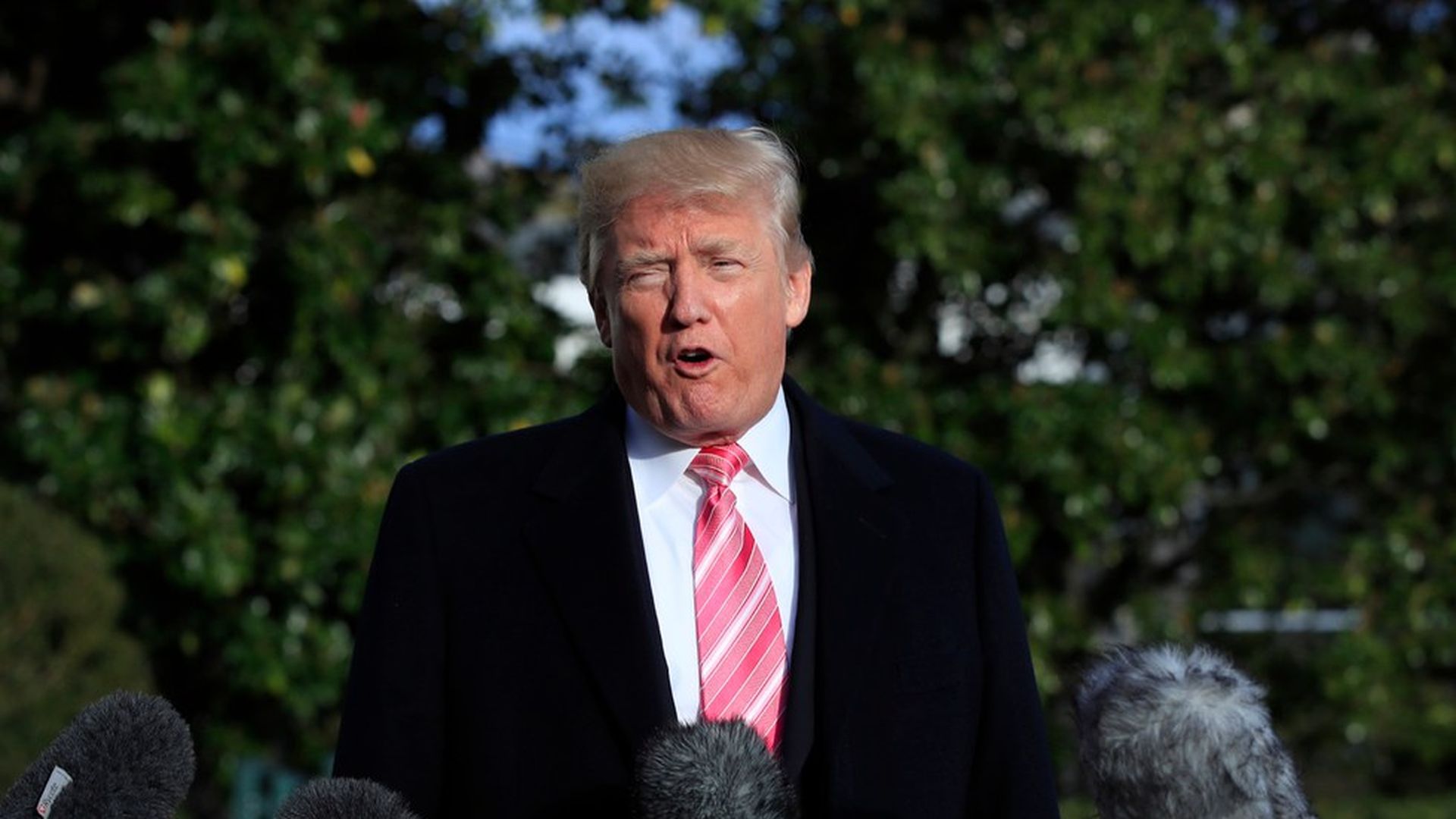
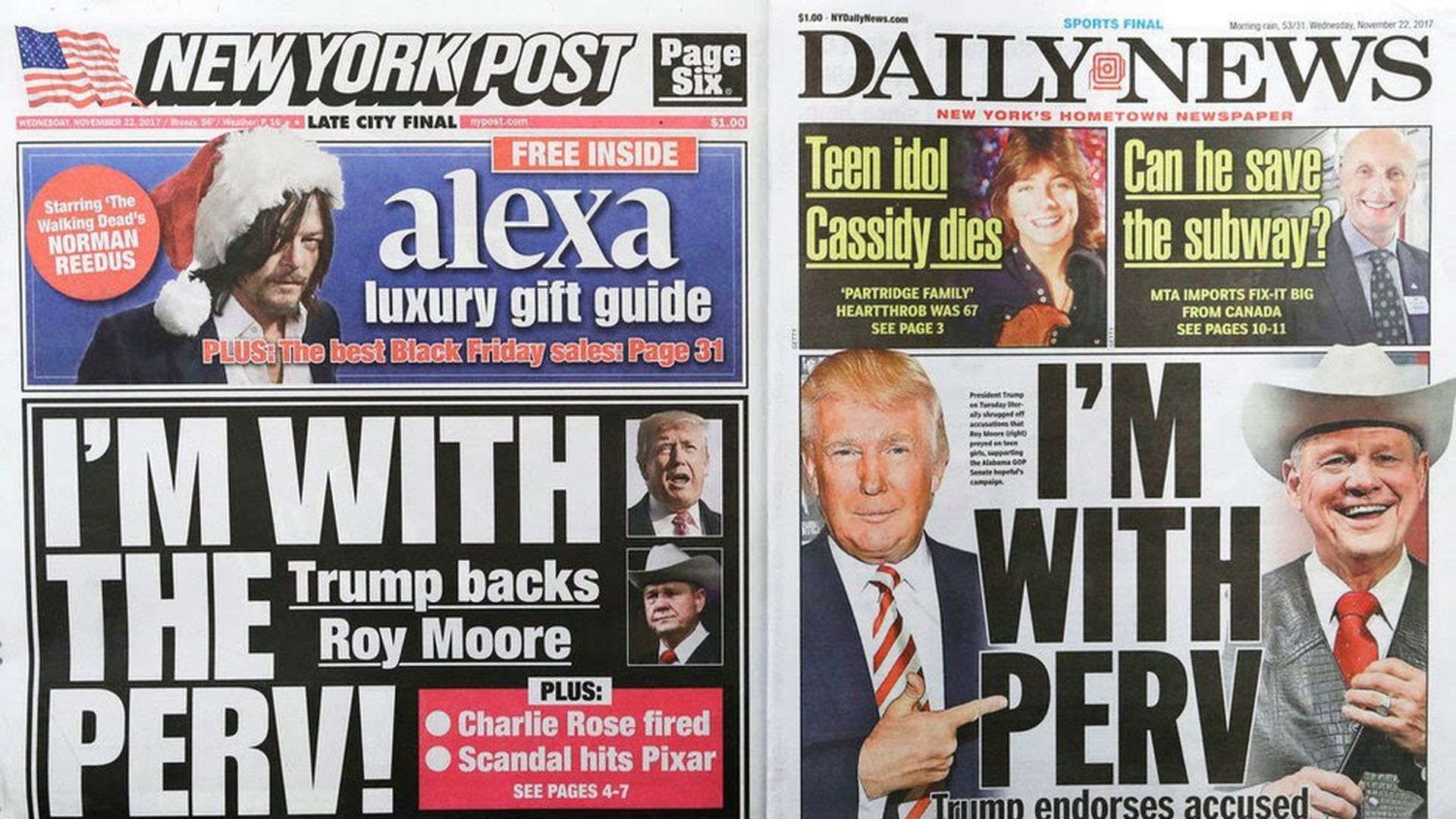
This week, Donald Trump defended Alabama Senator candidate Roy Moore in the face of several sexual harassment and assault charges, drawing attention to the fact that Moore has denied the accusations (and contending that electing a Democrat would be much worse).
Why it matters: While the President has not commented on every high-profile allegation, there is a clear pattern in his comments — Democrats get his quick condemnation, while Republicans and allies get his support. And let's not forget, Trump has himself been accused by at least 11 women of sexual assault or harassment.
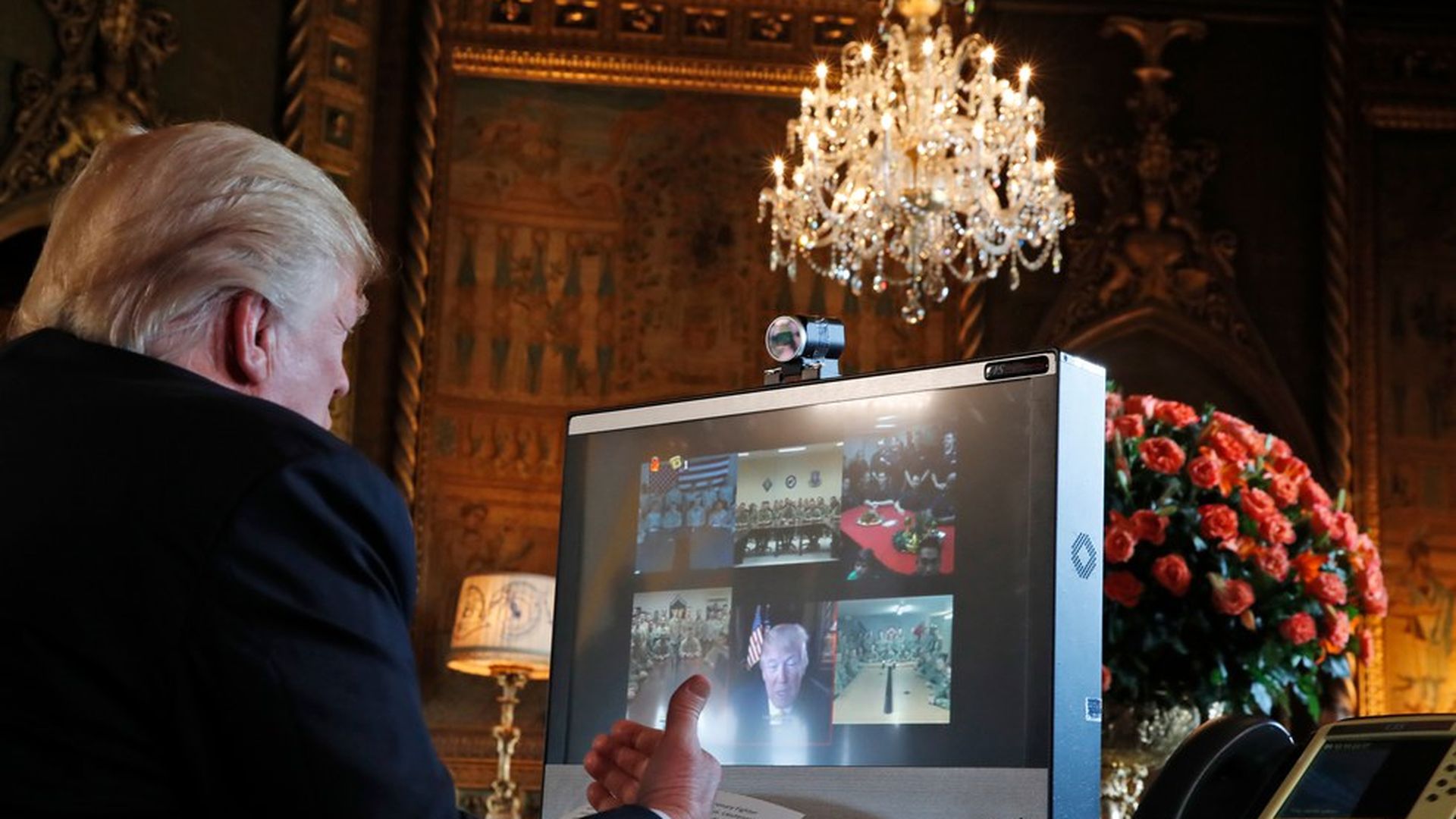
Trump addressed U.S. service members stationed abroad by video conference today, telling them they're "very, very special people to me, and to everyone in this country."
Trump's overall message: The military is succeeding because he's letting them "fight to win," and the economy back home is doing great too.
Over the next month, we're likely to see careers of multiple members of Congress thrown into peril over new sexual claims. Newsrooms are throwing serious resources into this story and victims feel liberated. This is the beginning, not the end, of a story that will upend the Capitol.
Below we take a look at the allegations of sexual misconduct plaguing both parties.
Donald Trump was a symptom, not the cause, of our cancerous politics — and the disease is metastasizing. Signs of it spreading are everywhere: in politics, in media and in business.
Without the calming influences in those spheres, there are no checks on the forces reshaping the national discourse. People talk about how they are worried that what's happening now will be normalized. They've got it backwards. This is now normal. And it will only get worse.
Donald Trump was a symptom, not the cause, of our cancerous politics — and the disease is metastasizing. Signs of it spreading are everywhere: in politics, in media and in business.
Without the calming influences in those spheres, there are no checks on the forces reshaping the national discourse. People talk about how they are worried that what's happening now will be normalized. They've got it backwards. This is now normal. And it will only get worse.
The cable news channel you watch is now a statement of your politics. Once a bipartisan issue, feelings about Russia are now a marker of right vs. left. Thirty million people even believe it's acceptable to hold neo-Nazi views.
The partisan gap in the concerns of Americans about U.S.-Russian relations has widened — and flipped — since Trump was elected last year, per a Pew Research report.
Democrats and Republicans generally agreed on whether Russia posed a threat to the U.S. until the Trump era. Now 63% of Democrats see Russia as a threat, compared to 38% of Republicans.
A September poll found that Trump has 98% approval with Republicans who voted for him in both the primary and the general. Trump has an almost magical hold on his voters. He makes regular deposits in the Bank of Base, and has a nice balance.
Immigration and Customs Enforcement officials said at a tech industry conference last week they are seeking algorithms that can "conduct ongoing social media surveillance" of visa holders that are considered high risk, according to ProPublica.
Why it matters: The announcement of the program, later named "Visa Lifecycle Vetting," spurred backlash from civil liberty groups and immigrants. ProPublica notes that, taken in conjunction with Trump's calls for "extreme vetting" and his campaign proposal for a Muslim ban, there is concern it could be discriminatory toward Muslim visa holders. Acting deputy association director for information management at ICE Homeland Security Investigations, Alysa Erichs, said the goal is to have "automated notifications about any visa holders' social media activity that could 'ping us as a potential alert.'"
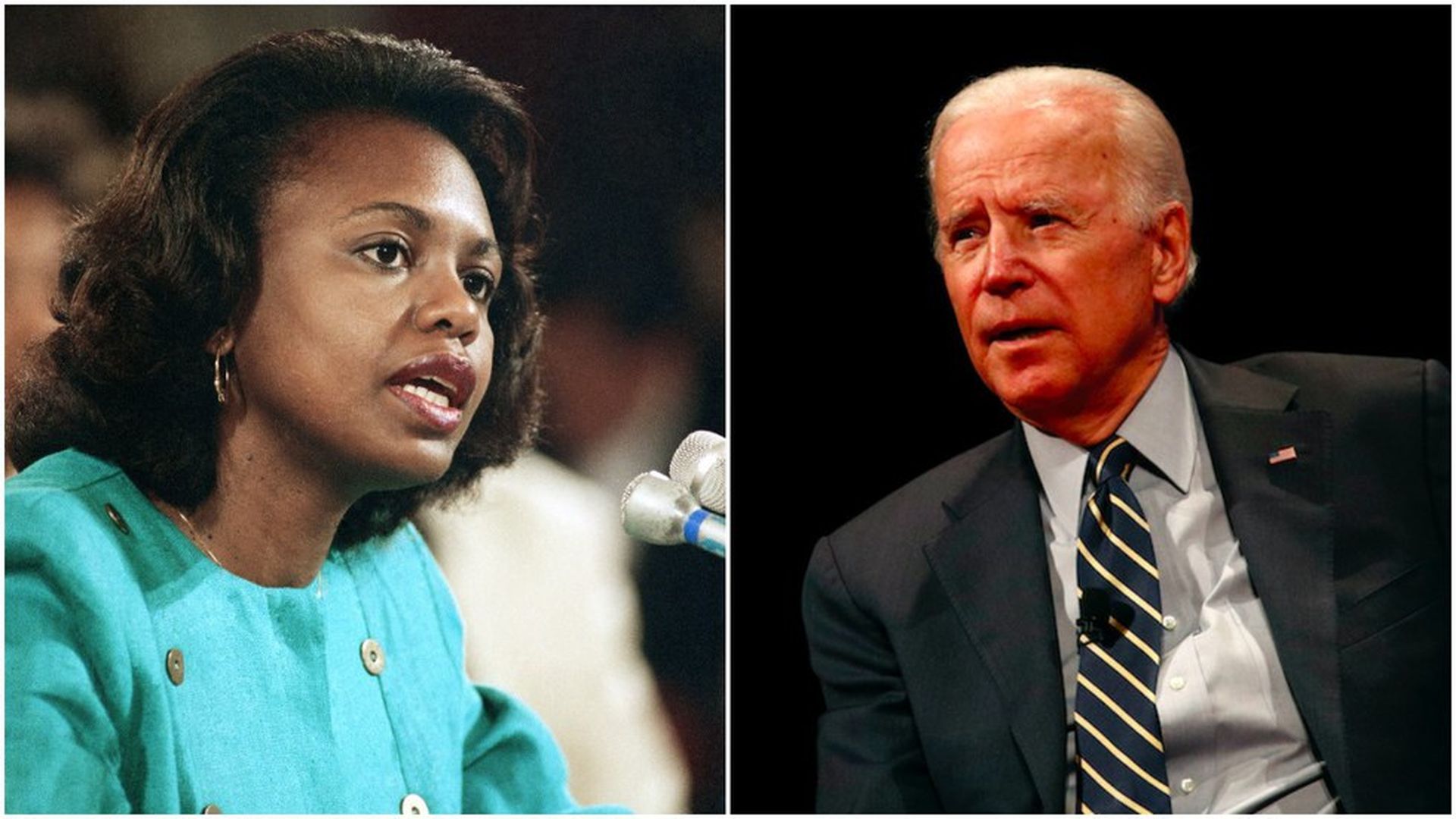
A new look at Anita Hill's 1991 testimony against now-Supreme Court justice Clarence Thomas puts a harsh spotlight on Joe Biden's handling of her allegations of sexual harassment. Biden was the chairman of the Senate Judiciary Committee at the time, and the Washington Post magazine reports that Hill believes Biden hasn't taken responsibility for how unfairly she was treated.
Why it matters: Here's what Hill told the Post: “[W]omen were looking to the Senate Judiciary Committee and his leadership to really open the way to have these kinds of hearings. They should have been using best practices to show leadership on this issue on behalf of women's equality. And they did just the opposite."
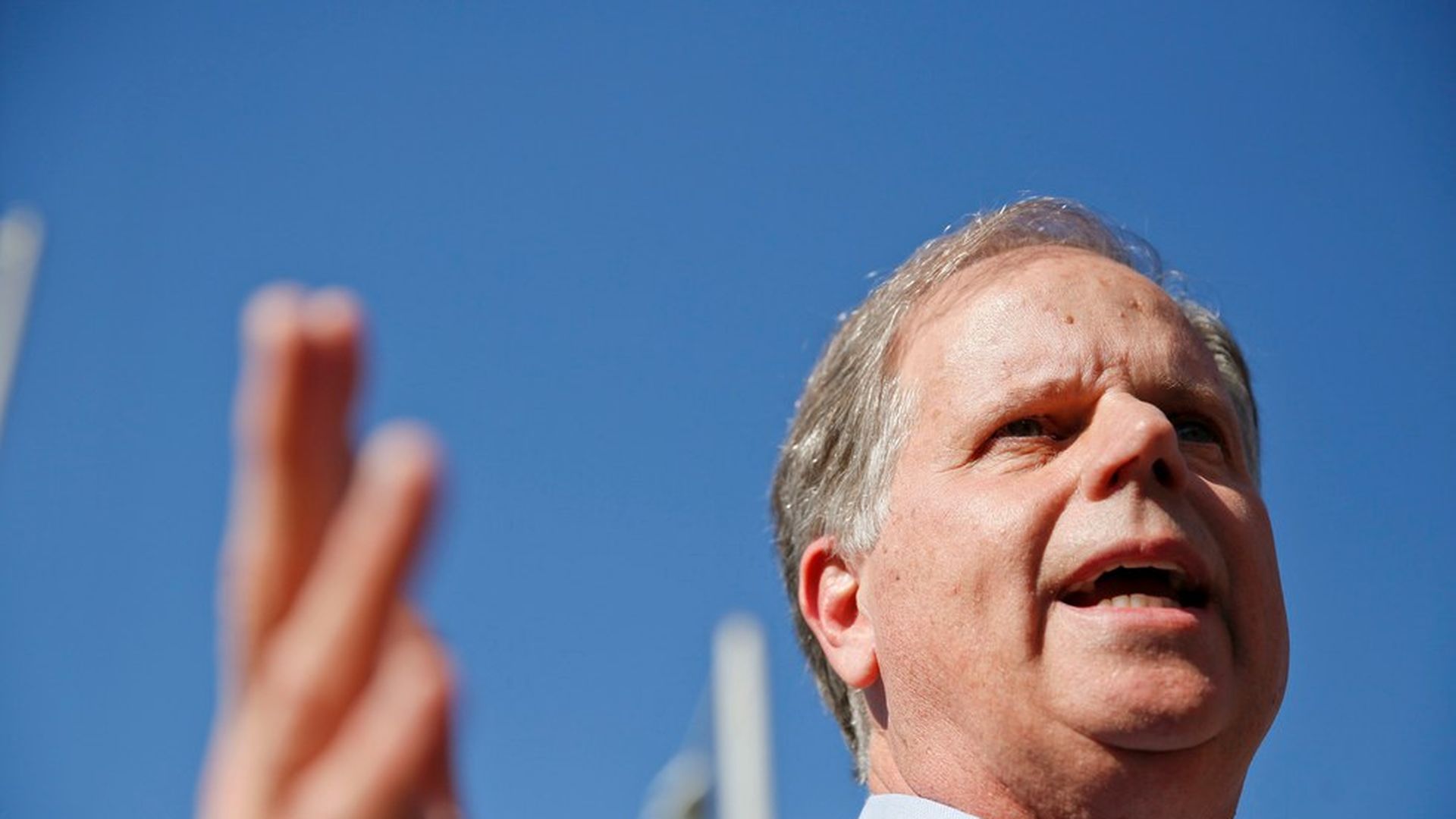
Doug Jones, the Democratic nominee for Senate in Alabama, is a long-time attorney best known for his successful prosecution of Ku Klux Klan members for a 1963 church bombing. He's also a first-time candidate. That's part of the reason Democrats think he might be able to pull out an upset victory over scandal-plagued Republican candidate Roy Moore in a state that hasn't elected a Democrat to statewide office since 1992.
Today is the deadline to apply for the 2019 Diversity Immigrant Visa Program lottery. President Trump has called on Congress to "terminate" the program, after it was reported that alleged Manhattan attacker Sayfullo Saipov entered the U.S. from Uzbekistan on a diversity visa.
The big picture: Trump said he favors replacing the program with "merit-based immigration" and "extreme vetting," and he blamed Democratic Sen. Chuck Schumer for shepherding the program through Congress, but the existing system does include a vetting process and received bipartisan support when it was passed. Here are the big questions surround the program, and their answers:
"President Trump's vision of a 'big, beautiful' wall along the Mexican border may never be realized. ... But in a systematic and less visible way, his administration is following a blueprint to reduce the number of foreigners living in the United States," the WashPost's Maria Sacchetti and Nick Miroff point out on A1.
Why it matters: The moves could change the U.S. immigration system "for generations to come."
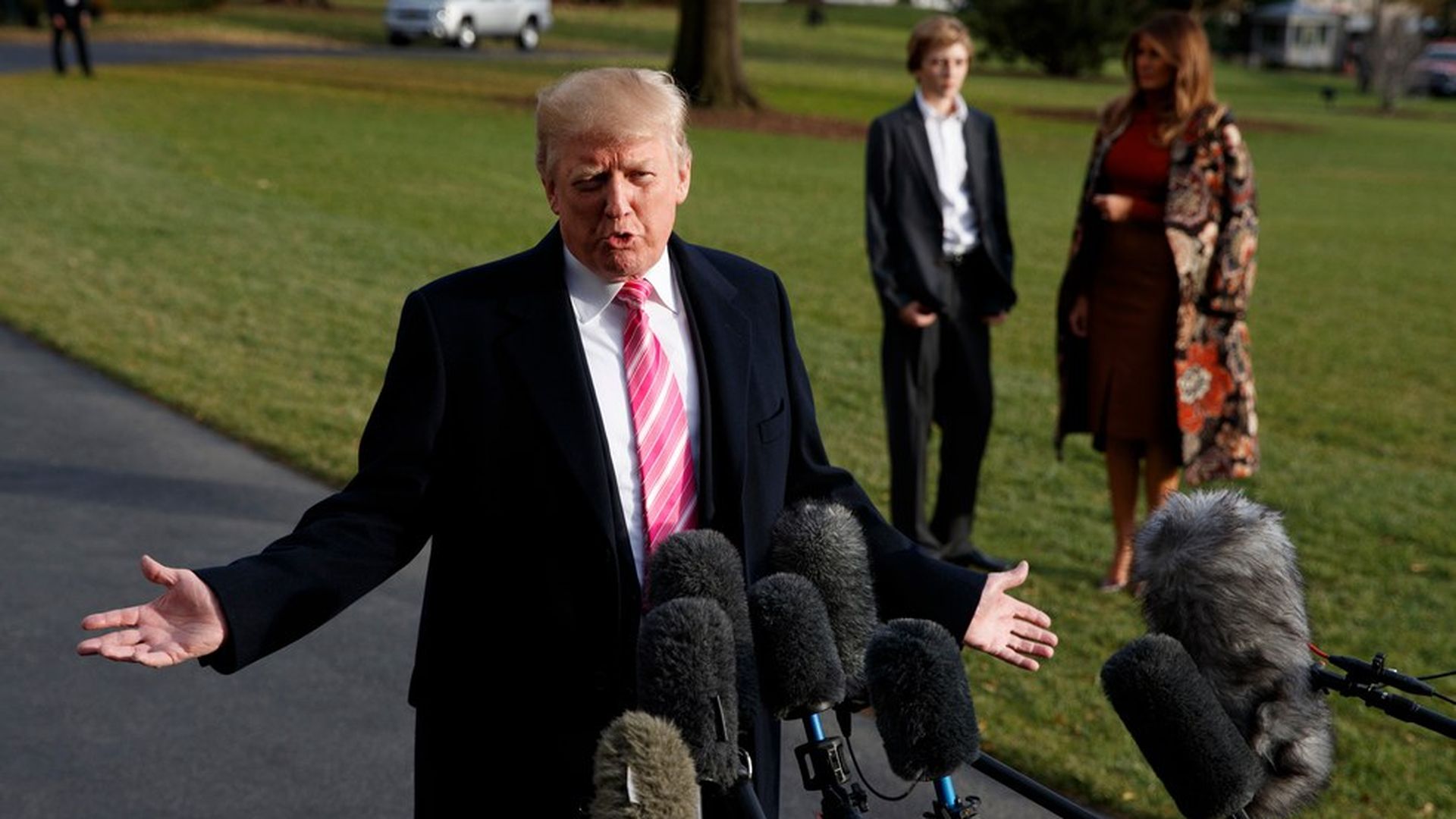
A source close to Trump described what led to the president's statement yesterday boosting Roy Moore, delivered on the South Lawn as the first family headed to Mar-a-Lago for Thanksgiving:
"He basically said we can't lose an Alabama seat when we've got such a slim majority already. ... Said he doesn't know what's true and what's not, but some of the stuff is clearly political. You've got Gloria Allred somehow involved. You've got a guy who's been in the spotlight for decades and run for office a bunch of times, and this never comes out until four weeks before an election."
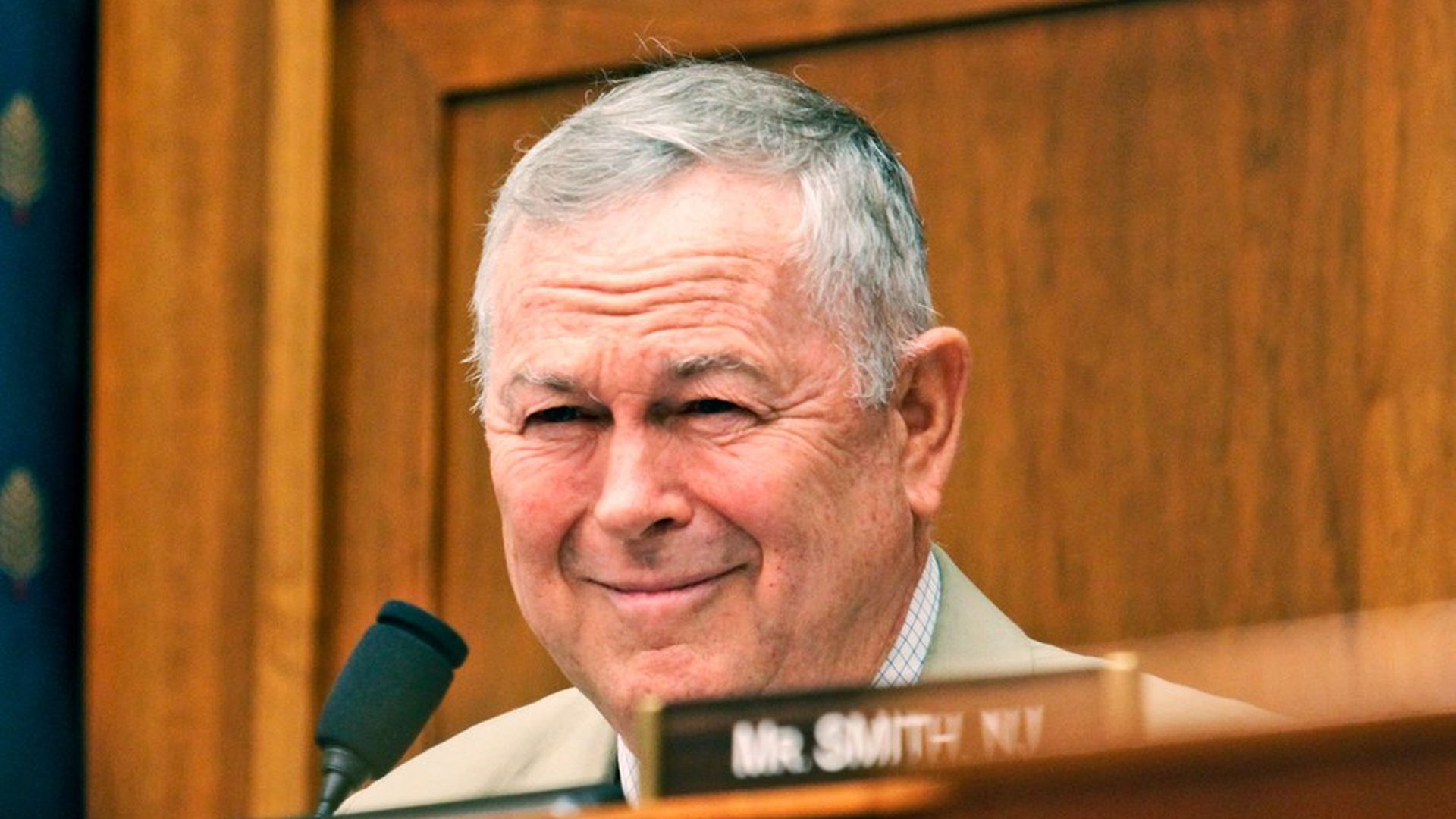
California Congressman Dana Rohrabacher has come under scrutiny in recent months from special counsel Robert Mueller and the Senate Intelligence Committee for his close ties to the Kremlin, according to the New York Times. One eye-catching line: "the F.B.I. warned him in 2012 that Russia regarded him as an intelligence source worthy of a Kremlin code name."
Why it matters: Rohrabacher, a Republican, had no role in President Trump's election, but there have been several instances of him "showing up" at moments relevant to the Russia investigation, per the Times. His position as chairman of the House Foreign Affairs subcommittee on Europe, Eurasia and Emerging Threats is also a point of concern for some.


/2017/12/15/1513307096928.gif?w=3840)
/2017/12/16/1513388339820.gif?w=3840)