
Axios Generate

September 05, 2023
🐣 Good morning! Today's newsletter has a Smart Brevity count of 1,283 words, 5 minutes.
🎹 This week in 1987, synth-pop geniuses Pet Shop Boys released the album "Actually," which provides today's intro tune...
1 big thing: Earth likely just had its hottest summer on record
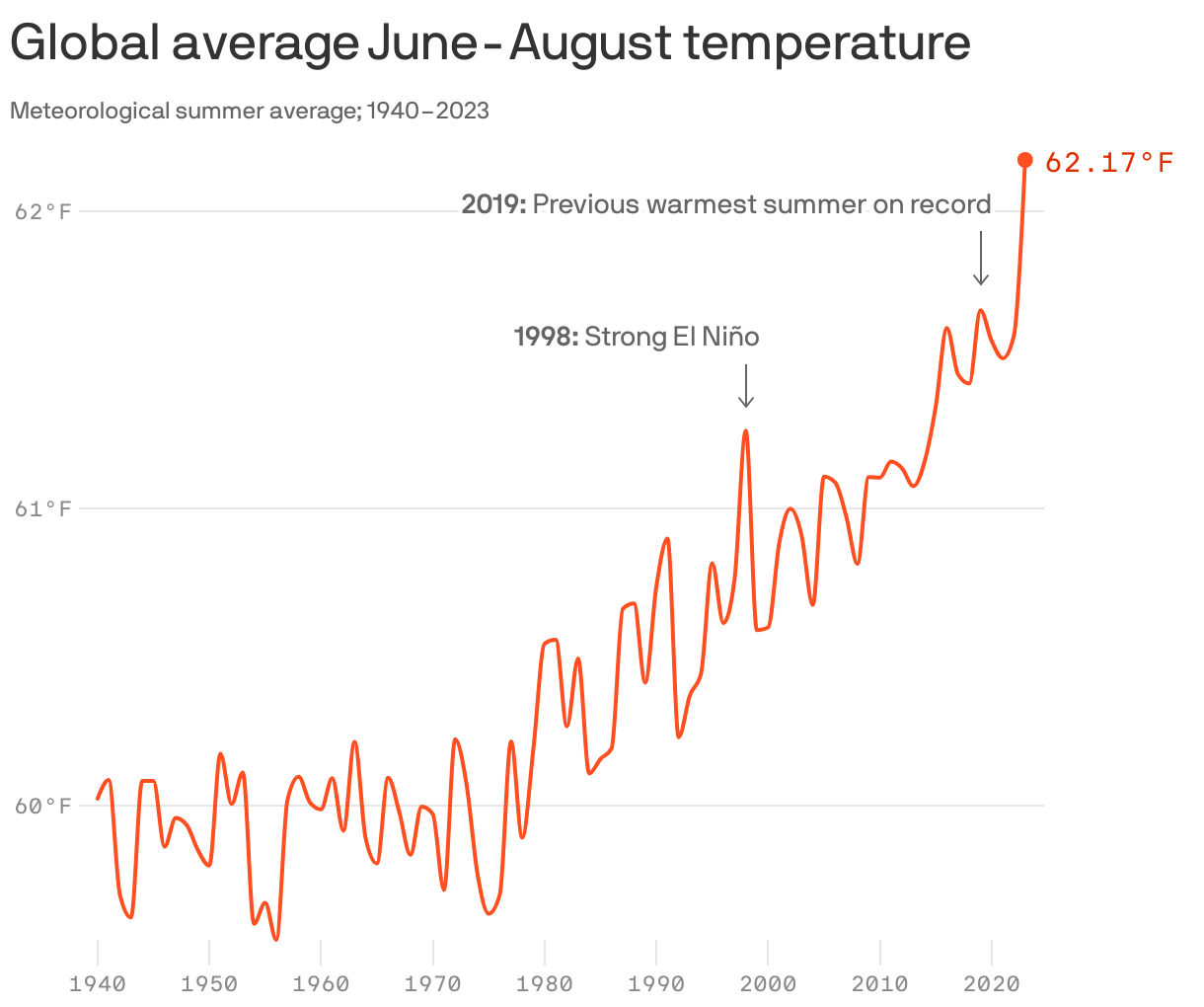
The first batch of temperature data is in for August — and not only did the globe have its hottest such month on record, but the month may have also secured meteorological summer's place in the history books, Andrew writes.
The big picture: The unmistakably large jump in the June-August global average temperature is a telltale reflection of deadly heat waves and record-warm oceans.
- According to preliminary data from the Copernicus Climate Change Service's ERA5 data set, the global average surface temperature for June through August was about 0.65°C (1.17°F) above the 1991-2020 average.
- This beat the previous record warm summer of 2019 by nearly 0.3°C (0.54°F).
- August alone had a global average surface temperature of 0.71°C (1.29°F) above the 1991-2020 average, crushing the previous record in 2019.
- June and July were also record-warm months, with July ranking as the warmest month on record since the dawn of the instrument era in the 19th century.
Zoom in: Numerous U.S. cities in the southern tier set records for their hottest June-through-August periods.
- They include: New Orleans, Miami, Houston, Corpus Cristi and Phoenix. Many others had a top-10-warmest meteorological summer on record, including Dallas, Atlanta and Austin.
- Globally, Australia had its warmest winter on record since reliable records began there in 1910, and all-time winter heat records were set in South America.
- Europe saw repeated, scorching heat waves that broke all-time seasonal records in Spain, France, Italy, Greece, and Switzerland.
Of note: In Japan, August was the country's hottest month of any month on record. The nation also saw its hottest summer, according to the Japan Meteorological Agency.
Between the lines: Global ocean temperatures are also at record highs, with significant consequences for people on land, since warmer oceans add more moisture and heat to storms.
- For example, record warmth in the Gulf of Mexico elevated summer air temperatures from Miami to Houston and also provided fuel needed for Hurricane Idalia to rapidly intensify when approaching Florida last week.
- Record warm waters are also causing coral bleaching and mortality from the Florida Keys to the Caribbean.
The intrigue: The burning of fossil fuels is increasing the amounts of heat-trapping greenhouse gases in the air, resulting in much of the warming seen this summer.
- A periodic El Niño event in the tropical Pacific Ocean is also adding additional heat to the air and oceans.
What's next: Global climate monitoring centers will release their official data in the next two weeks that are likely to confirm the preliminary picture.
2. 🏃🏽♀️Catch up fast on LNG and oil

Illustration: Annelise Capossela/Axios
🤝 Commonwealth LNG, which is developing an export project in Louisiana, announced a 20-year deal to supply Swiss-based multinational MET Group, Ben writes.
- Why it matters: The U.S.-Europe LNG trade is expanding as nations seek to replace Russian supplies.
- State of play: Elsewhere, U.S. LNG company Venture Global announced plans to expand its export capacity from 70 million metric tons annually to 100 million.
👀 "Workers at two giant natural-gas operations run by Chevron in Australia are planning a two-week strike starting Sept. 14, said Offshore Alliance, a partnership between two local unions," the Wall Street Journal reports.
- Why it matters: Australia is a major exporter. Work stoppages would have ripple effects on global markets.
🛢️ Crude oil prices are around their highest levels this year, with Brent crude topping $88 per barrel after slipping slightly this morning.
- What we're watching: Saudi Arabia, which is expected to imminently announce whether it's extending supply curbs another month.
3. A big lithium deal moves closer to fruition

Albemarle Corporation spokesman Marcelo Valdebenito holds a bottle of processed lithium carbonate at a lithium mine in Chile. Photo by John Moore/Getty Images
From the sign of the times files: U.S.-based multinational lithium heavyweight Albemarle may be on the cusp of a $4.3 billion acquisition of Australia's Liontown Resources, Ben writes.
Why it matters: It's one event in a wider competition to secure supplies of various EV battery materials.
- The bid for more Australian lithium comes as some other lithium-rich countries are asserting more state control over deposits.
🗞️ Driving the news: Liontown signaled Monday its board would back the proposal, which Albemarle called its final offer, with plans to provide a "limited period of exclusive due diligence."
However, it's not yet a binding agreement. Liontown's recommendation to shareholders rests on the absence of a better offer.
What they're saying: "We see the offer as bullish for lithium, signalling that the largest producer is keen to secure more supply at a premium, or has a bullish view on long-term price with low jurisdictional risk," Citigroup analysts said, per Reuters.
🧮 By the numbers: The global lithium market saw $48B in sales last year, up from just $1.6B in 2015, the WSJ reports, citing Benchmark Mineral Intelligence data.
4. Ocean carbon removal receives fresh support

Illustration: Aïda Amer/Axios
Boldface names in the climate and oceans worlds are calling for new guardrails on the young — but growing — ocean carbon removal industry, Andrew writes.
Why it matters: Ocean-based carbon removal is an area of increasing interest for scientists and entrepreneurs, but it is a regulatory gray zone.
- Potential projects range from restoring coastal ecosystems to using minerals to enhance seawater's ability to absorb carbon dioxide.
The big picture: Ocean-based carbon dioxide removal projects carry the potential to damage delicate ecosystems already harmed by climate change.
- An oceans carbon removal letter out Monday, organized by the nonprofit Ocean Visions Institute, is signed by top climate researchers including Columbia University's James Hansen, Stanford's Arun Majumdar and Zeke Hausfather of Stripe, along with the leaders of the Woods Hole Oceanographic Institution and Scripps Institution of Oceanography.
- The more than 200 signatories call for "safeguards to mitigate any unintended or adverse consequences," independent third-party review of testing and "inclusive" government oversight.
5. A flashy look at growing EV competition

Image courtesy of BMW
The big IAA Mobility 2023 in Germany is providing automakers the latest chance to show off future electric wares — and highlighting growing competition with China, Ben writes.
Driving the news: BMW and Mercedes showed off new concepts and production architecture.
- The photo above is BMW's Vision Neue Klasse, a look at its next generation of EVs that begin arriving in 2025.
- BMW is vowing Neue Klasse will provide huge gains in range and charging speeds.
- Mercedes unveiled its Concept CLA Class to provide "close to production" insight, vowing 466 miles of range and the ability to add nearly 250 of those miles in 15 minutes of charging.
Why it matters: The two are "making their biggest push yet into electric cars in a bid to fend off rising competition from Chinese players and catch up with U.S. giant Tesla," CNBC reports.
State of play: Chinese EV makers are announcing expansion plans.
- For instance, Xpeng said Monday it's entering the German market next year.
- Via Bloomberg, the number of Chinese automakers at this year's show more than doubled compared to 2021.
ICYMI: A few days ago Tesla unveiled a redesigned Model 3.
6. 👀 On our radar this week: AI and Africa
🧠 The Senate's energy committee will gather Thursday to review "recent advances in artificial intelligence and the Energy Department's role in ensuring U.S. competitiveness and security in emerging technologies," Ben writes.
- What we're watching: For more specifics on DOE's role in the Biden administration's AI oversight. Also: any discussion of AI's role in emerging energy and climate tech — and the emissions linked to powerful computing needed for AI applications.
🌍 A major multinational African climate summit is underway as public and private parties look to scale finance for low-emissions energy and adaptation.
- The big picture: Many African nations are highly vulnerable to climate change yet have played little role in causing it.
- What we're watching: Specifics from the summit declaration later this week in Kenya. Bloomberg reports African leaders are expected to endorse a tripling of power generated from renewables to 60%.
- Sobering stat: "Only 2 percent of global investment in renewable energy has been in Africa, where nearly a billion people have little or no access to electricity," the New York Times reports.
Did someone forward you this newsletter? Welcome, and please sign up.
🙏 Thanks to Chris Speckhard and Chuck McCutcheon for edits to today's edition, along with the talented Axios Visuals team.
Sign up for Axios Generate

Untangle the energy industry’s biggest news stories


