Charlotte's growth is pricing out its local businesses

Add Axios as your preferred source to
see more of our stories on Google.

Photo: Axios archives
Support local while you can. Your favorite small business might be days away from closing, and you don't even know it yet.
Why it matters: Charlotte is one of the fastest-growing cities in the country, and we're reaping the benefits in the form of fancy New York bagel and ice cream chains, Los Angeles-based salad chains, and Texas-based burger chains. Meanwhile, local owners are drowning in debt, struggling to pay rent and doing what they can to stay open.
Driving the news: From Essex in Uptown to Resident Culture in South End, several locally owned restaurants and bars either closed or announced their closures within the last few weeks, many of them citing economic conditions as the primary reason.
- The recent closures span neighborhoods throughout the city — SouthPark, NoDa, Ballantyne and Elizabeth, among others.
"This is a dynamic market and running restaurants is super challenging and there's a cyclical nature to it. There's a natural churn."— Michael Smith, President & CEO at Charlotte Center City Partners, told our news partners at WBTV.
Yes, but: It's not just restaurants and bars struggling.
- In May, the founders of local clothing brand Girl Tribe Co. detailed their challenges in a now-deleted post. Their South End brick-and-mortar store is roughly breakeven, they told Tiny Money founder Ted Williams, adding that customer acquisition costs have soared 100% year-over-year.
- "Since approximately 2022, we've been experiencing significant challenges due to unprecedented rental rate increases and declining revenue," says Frank Pietras, president of Infinity's End Inc., a locally owned smoke shop since 1969 with six Charlotte locations. Pietras says some landlords have proposed doubling his rent in the last five years.
The big picture: No two business closures are the same.
- In some cases, old leases expire, and businesses are priced out of spaces deemed more valuable by the market.
- Other businesses never recovered from losses they experienced during the pandemic, which is still sending ripple effects in the form of worker shortages, social disengagement and decreased foot traffic.
And this is not an issue that is unique to Charlotte.
- Tariffs are affecting nearly every industry — from coffee to beer.
- Everything is more expensive — groceries, rent, home prices — limiting customers' disposable income.
- "That said, Charlotte is still much more affordable than many of our competing cities," says Charles Thrift of Thrift Commercial Real Estate. "Charlotte has really strong sales, amazing population growth, and relatively lower rent."
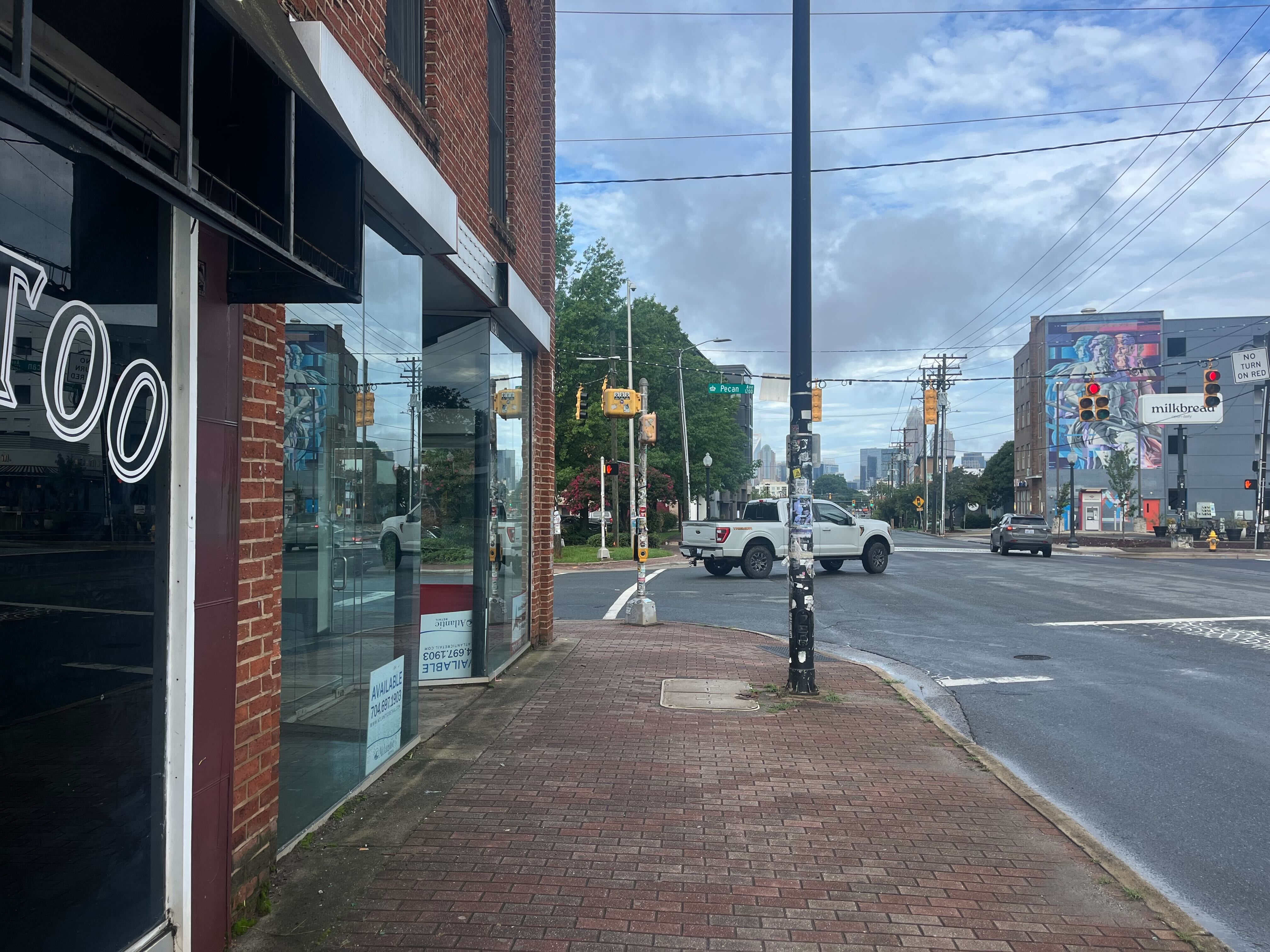
Zoom out: As developers buy land and lease spaces to businesses that can afford the rising rent, some worry that neighborhoods are losing their identities.
Case in point: In Plaza Midwood, the Commonwealth development recently announced a slew of national chains will open at the heart of the neighborhood.
- Many of those chains have local counterparts nearby. South Block, a smoothie and acai bowl spot out of D.C., will be within walking distance of locally owned Smooth Monkey. New York-based Van Leeuwen Ice Cream will be down the street from dairy-free ice cream shop Seemingly Overzealous.
- It's a fear-turned-reality for nearby residents, who voiced concerns about this exact scenario years before building began. Despite the intake of public feedback and a promise to preserve Plaza Midwood's personality, only one of the 18 tenants announced at the mixed-use development is locally owned — Harriet's.
- We reached out to Charlotte-based developer Crosland Southeast for a statement regarding local tenants at Commonwealth. They declined to comment.
Reality check: Landlords are charging market rates, and we live in a capitalist society. It's up to business owners to adapt and consumers to support them.
What they're saying: A developer investing millions in a property needs assurance of business viability when going to a bank for a loan, says Adam Williams, Principal at RebelRebel, a local commercial real estate firm representing both tenants and landlords.
- "You have to do a bank deal or medical office deal to be able to take a chance on the sous chef or the guy that makes the best bartender cocktails," Williams says.
Zoom in: Some areas prioritize local businesses. Camp North End, a 76-acre mixed-use development in Charlotte's North End, primarily comprises local retail tenants.
- The developer uses a model called "percentage rent" to lower fixed costs and share revenue based on sales performance.
Go deeper: How Camp North End bets on local businesses
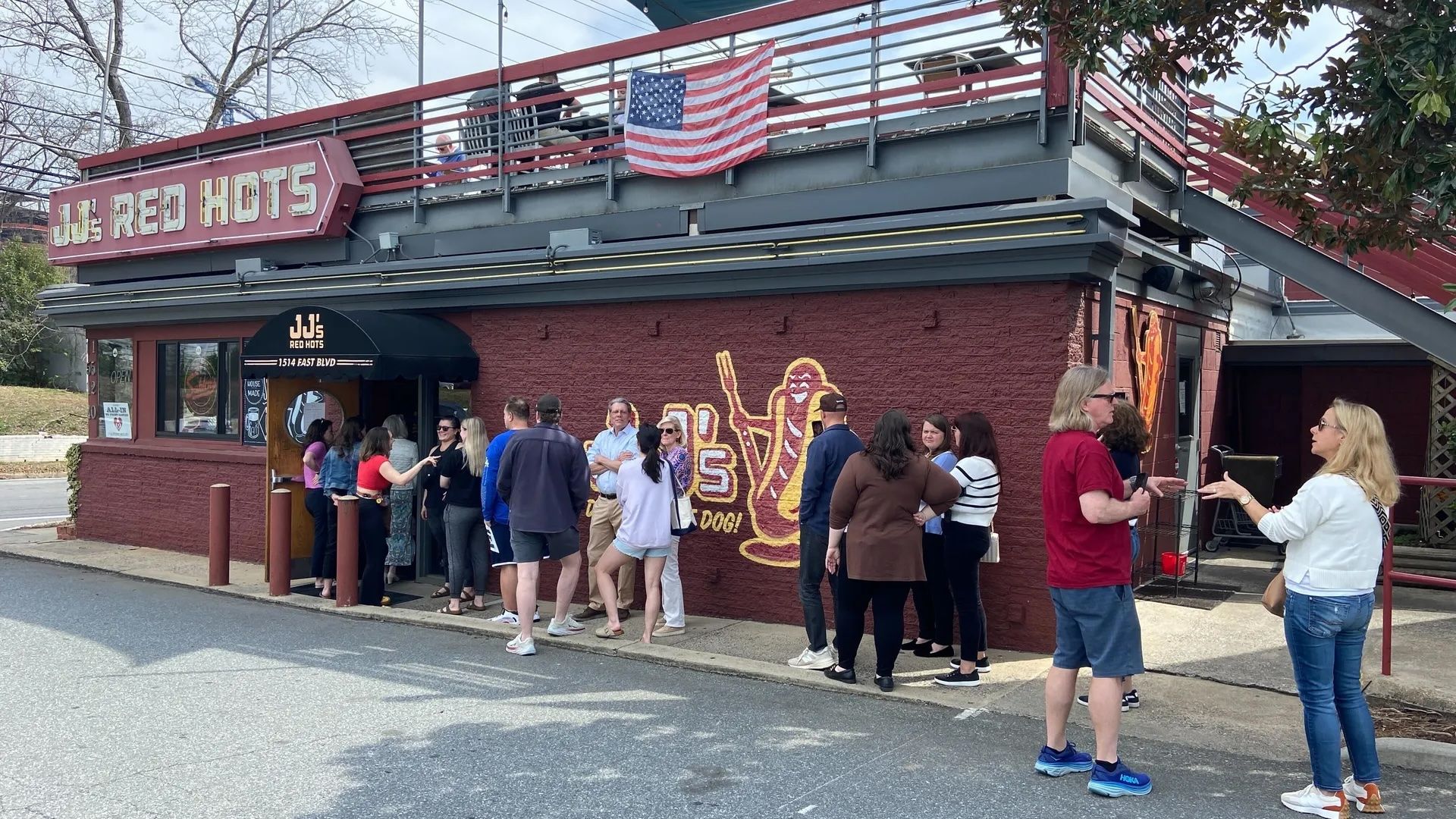
The intrigue: Often, Charlotteans don't show up for their favorite establishments until it's too late.
- It's become a tradition of sorts to line up outside a soon-to-close restaurant to give it one last go. We saw it with JJ's Red Hots, Green's and Price's Chicken Coop — some of Charlotte's oldest restaurants.
"I've lived in Austin, Chicago, New York — all bigger cities — and [people there] support small businesses way more than Charlotte does."— Christa Csoka, chef-owner of The Artisan's Palate
The Artisan's Palate is an all-day café/wine bar/restaurant/art gallery in NoDa. Local business owners like Csoka are adapting their business models to the post-pandemic world.
- Their popular drag brunches, "Women of Whiskey" dinner series and other events are what's keeping the business afloat, Csoka says.
- "We have a great community of customers, artists, musicians, etc. But we are still struggling," she adds.
Between the lines: Supporting local businesses doesn't always mean opening your wallet. Boosting them through word of mouth, an online review, or even a share on social media can go a long way.
- Google reviews and Instagram followers are how people "decide if they're going to trust you or not," says Corri Smith, owner and founder of Black Wednesday marketing agency. "If you've got no Google reviews, people are like 'I'm not sure about this business,' especially when they're comparing you to the business ... that has 9,000 reviews."
- Google and Yelp reviews carry a lot of weight for local businesses, which can suffer from one-star reviews — even if they're made quickly or carelessly.
The bottom line: With approximately 117 people moving to the Charlotte area daily, it can be hard for local spots to stand out in a sea of nationally recognized chains.
- Charlotte has plenty of original concepts and local gems. You just have to know where to look.
Start with these guides: Best Restaurants, Best Bars, Latino and Hispanic-owned businesses, Black-owned businesses, Camp North End guide, Best Pizza, Best Ice Cream and Best Brunch.