The maker of a widely used abortion drug today asked the Supreme Court to review an August appeals court decision that curtailed access to the pill.
Why it matters: The request gives justices an opportunity to rule on the availability of mifepristone for medication abortion less than two years after the high court struck down federal protection of the procedure.
Medication abortions account for more than half of the abortions in the U.S., and 98% of those used mifepristone.
Driving the news: Danco Laboratories, mifepristone's manufacturer, said the decision raises questions about whether a single federal court can limit abortion access in states that protect it.
"The risks and confusion that result from the Fifth Circuit's decision are not ones that women, teenage girls, and the public health system should be forced to bear without this court's review," the company wrote in its petition.
The decision also "destabilizes the pharmaceutical and biotechnology industries" by challenging the Food and Drug Administration's authorization of the pill, Danco wrote.
The Department of Justice also asked for a Supreme Court review hours later, citing "destabilizing practical consequences" from the decision and "its serious legal errors."
Catch up quick: A three-judge panel of the 5th U.S. Circuit Court of Appeals ruled in August that the FDA failed to take into account safety concerns when it made mifepristone more easily accessible in 2016.
The panel at the time partially blocked a lower court ruling that struck the FDA's approval of the drug, which was granted in 2000.
The pill remains widely available under an order the Supreme Court issued in April that maintained the status quo while legal challenges to the FDA's authority play out.
If the Supreme Court takes the case, it will likely hear it during the term that starts next month.
The White House should create a national patient safety team to help reduce high levels of dangerous care in the medical system, presidential advisers recommended Thursday.
The big picture: Progress in addressing preventable harms like medication errors and hospital-acquired infections has been "unacceptably slow," necessitating a White House-ledinitiative to improve patient safety, the President's Council of Advisors on Science and Technology wrote in a report.
Health care providers would be explicitly prohibited from making medical decisions that discriminate against people with disabilities under a new rule proposed by the Biden administration.
Why it matters: Unequal treatment in medical settings is still prevalent despite anti-discrimination laws, and the pandemic brought this problem to the forefront.
Cardiac arrests suffered by LeBron James' son Bronny this summer and Buffalo Bills safety Damar Hamlin earlier this year put a public spotlight on a scary heart risk for some young athletes.
While those high-profile incidents helped drive interest in the use of electrocardiograms (EKGs or ECGs) in routine physicals for student athletes to help prevent similar cardiac events, experts caution overusing EKGs could create unnecessary risk.
Thousands of HIV/AIDS patient advocates meeting in Washington, D.C. this week are confronting the possibility that Congress won't renew the government's flagship effort to fight the disease, the President's Emergency Plan for AIDS Relief, or PEPFAR.
Why it matters: PEPFAR has traditionally drawn bipartisan support. But this year, it's been caught up in abortion politics and charges that it's being used to fund a radical social agenda abroad.
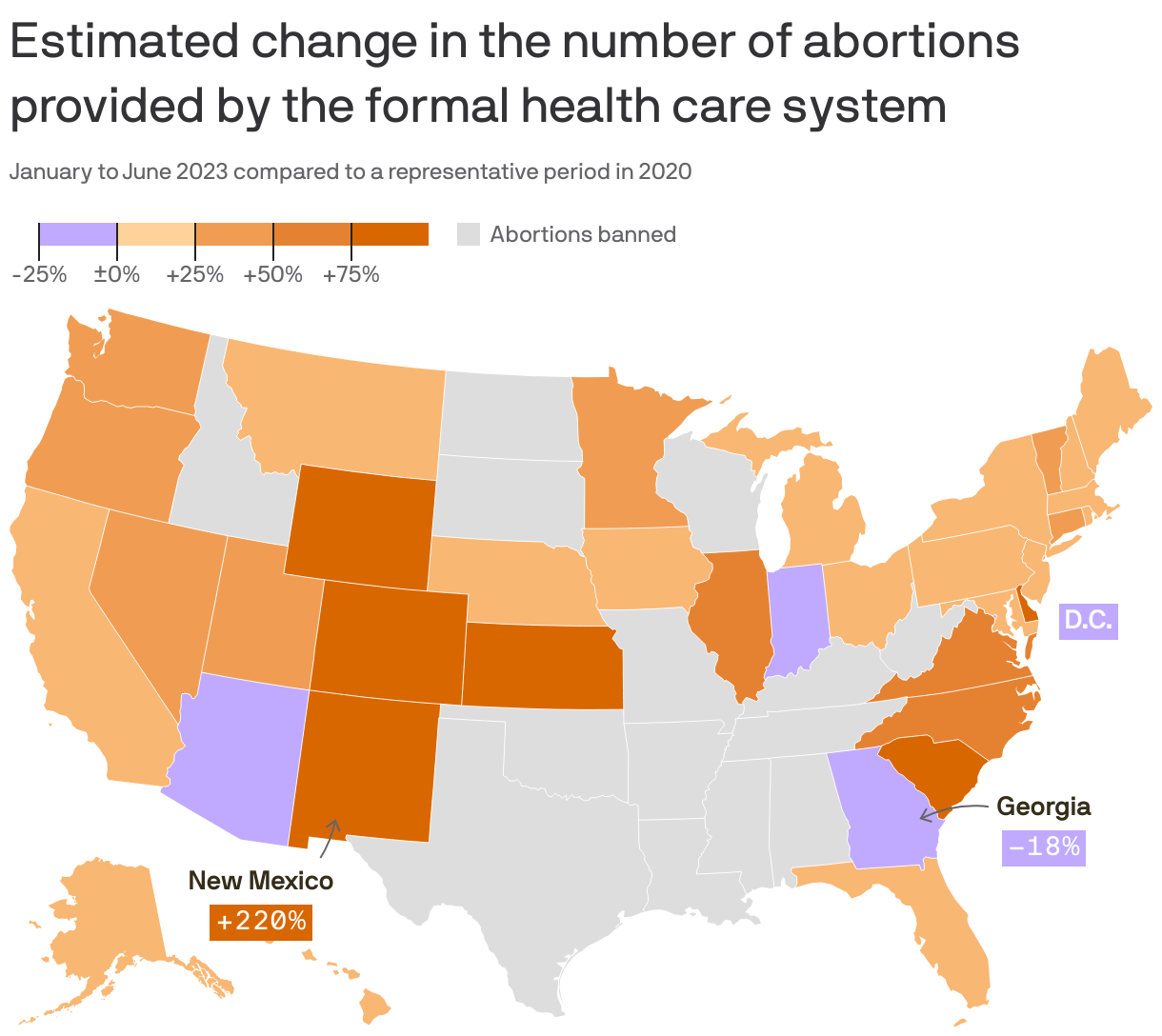
Note: 2020 value is 50% of the abortion caseload for each state in that year; Data: Guttmacher Institute; Map: Axios Visuals
States geographically near ones that banned abortion after Roe v. Wade was overturned saw sharp increases in the number of procedures performed, likely due to an influx of border-hopping patients, according to a new analysis from the Guttmacher Institute.
Why it matters: Patients are proving highly motivated to travel to get the care they need in the face of state bans, according to Guttmacher, a research organization that supports abortion rights. But for some, that involves overcoming logistical and financial challenges.
State inspectors who likely will help enforce the Biden administration's new nursing home staffing requirements are facing their own workforce shortages.
Why it matters: The Biden administration says its newly proposed staffing ratios could improve patient care, but the program's success may depend on a nursing home oversight apparatus that's already struggling to keep up with inspections.





/2023/09/07/1694116024059.gif?w=3840)