The decision by the Federal Trade Commission to block DNA sequencing giant Illumina's $7.1 billion purchase of Grail puts the focus on how much power one company should wield in the burgeoning cancer detection market.
Driving the news: The FTC on Monday rejected the deal, saying the combination of Grail — which makes liquid biopsy test — with Illumina, the only provider of sequencing for multi-cancer early detection (MCED) tests will "stifle competition and innovation in the U.S. market."
Inflation and higher health spending helped drive monthly premiums for Affordable Care Act coverage up an average of 3.4% between 2022 and 2023, reversing a trend of recent declines, according to a new report from the Urban Institute and the Robert Wood Johnson Foundation.
Why it matters: Some of the increase was also attributed to uncertainty over whether Congress would extend or make permanent premium subsidies, which complicated insurers' decision making. Extending subsidies would incentivize healthy people who choose to buy coverage previously deemed unaffordable.
Hospitals routinely charge less to patients who pay in cash and seek to recoup the difference from commercially insured patients in markets where they can exert leverage, according to a new Johns Hopkins study published in Health Affairs.
Why it matters: The analysis for 70 services — drawn from data reported by 2,379 hospitals as of September 2022 — provides another window into the opaque world of hospital pricing and could be a data point for employers in their negotiations with insurers or directly with providers.
Nonprofit hospitals that paid their board members offered less charity care than facilities that didn't, per a new Health Affairsanalysis.
Why it matters: Nonprofit hospitals are required to offer charity care in exchange for their tax-exempt status. But the sector has come under scrutiny for its pricing practices and for saving more in tax exemptions than it provides in uncompensated care.
Why it matters: Despite the large number of people who are unable to have children, access to fertility treatments remains scarce due to "high costs, social stigma and limited availability," said WHO Director-General Tedros Adhanom in the report.
Federal health officials are rolling out a new "National Cancer Plan" today as a framework for pursuing President Biden's Cancer Moonshot goals — including cutting the cancer death rate in half within 25 years, HHS officials told Axios first.
Why it matters: It offers a glimpse at how the National Cancer Institute will pursue those and other goals under new director Monica Bertagnolli, who took over six months ago.
The Biden administration continues to grapple with an awkward tension when it comes to Medicare Advantage: MA plans typically offer more generous benefits than traditional Medicare does, and they also cost taxpayers more money.
That's despite the fact that privately administered Medicare was created to save the government money.
Why it matters: A fiscal 2024 Medicare Advantage rule released on Friday aims to crack down on what experts say are inappropriate — and at times potentially fraudulent — insurer billing practices, and could force plans to decide between cutting benefits and lowering their own profits.
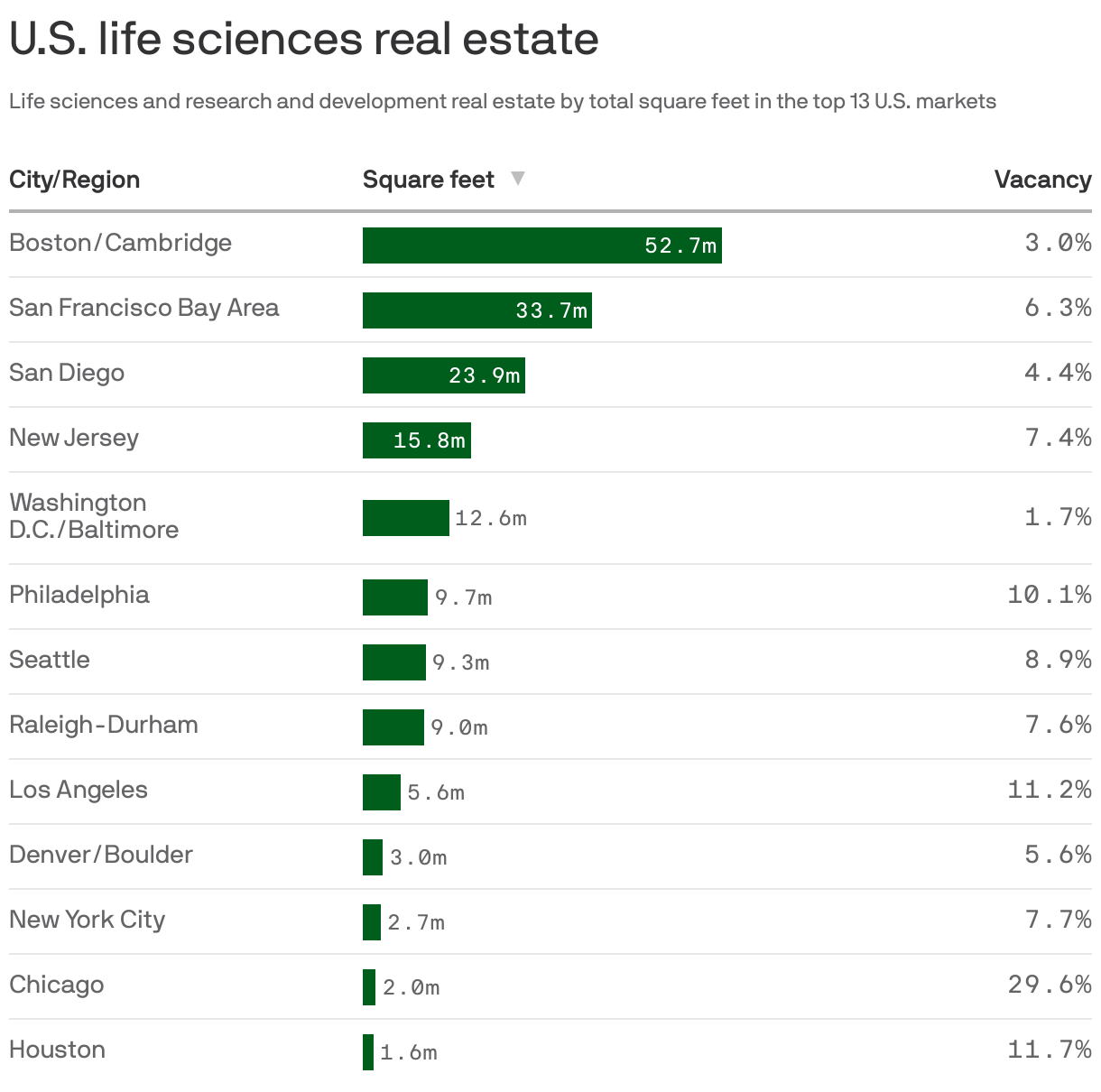
The inventory of U.S. life sciences laboratories and R&D sites jumped by nearly 50% in five years to 181.7 million square feet as of the fourth quarter of 2022, according to a CBRE report provided first to Axios.
CBRE forecasts the properties will consume 220 million square feet by 2025 as new construction is completed, with nearly a third of the future space already pre-leased, according to the 2023 U.S. Life Sciences Outlook.
Though bank turmoil is likely to slow venture capital funding, initial public offerings, and job growth, there's still a bevy of clinical trials for new drugs, federal funding, and ample cash reserves — at least for biotech's bigger players.
The industry's vacancy rate, which rose to 5.7% in the fourth quarter from 5.1% in the third quarter of 2022, is still low compared to many other sectors.
By the numbers: Boston and Cambridge, Mass. remain hubs with 52.7 million square feet of inventory and 15.3 million square feet of life sciences space under construction.
Only 3% of that space is vacant after booking the largest leases of 2022. Both Takeda and AstraZeneca leased about 600,000 square feet of space, respectively, in Cambridge.
The San Francisco Bay Area, which has about 33.7 million square feet of space, also has among the fastest-growing inventories with 9.3 million square feet under construction.
Chicago, which has less than 2 million square feet of life science inventory also has the most space available with a nearly 30% vacancy rate.