After being blindsided by her father's laborious death, marketing executive Jessica McGlory started Guaranteed, a company that aims to give families a better way to care for loved ones in their last days.
Why it matters: A recent report from watchdog group Private Equity Stakeholder Project suggested that for-profit hospice agencies have been tied to lower standards of care, fewer patient visits, higher rates of hospitalization and poorer worker compensation than their nonprofit counterparts.
Older Latinos — especially those who are noncitizens or live in poverty — are often kept from the health care resources advertised to help Americans age comfortably, researchers and advocates told Axios.
That's partly because of financial and language barriers, and because they're so much more likely to be uninsured. But there's also a cultural responsibility families feel to handle the caregiving themselves, which can mean avoiding the programs that could help them — or not knowing they exist.
More than a year after one of the most controversial drug approvals in FDA history, seniors and their loved ones may be on the cusp of having a new drug on the market that slows the progression of Alzheimer's disease.
Why it matters: Seniors desperate for relief from the debilitating disease were the real losers in the debacle over Biogen's Alzheimer's drug — which was approved through a fast-tracked process over the objection of prominent scientists.
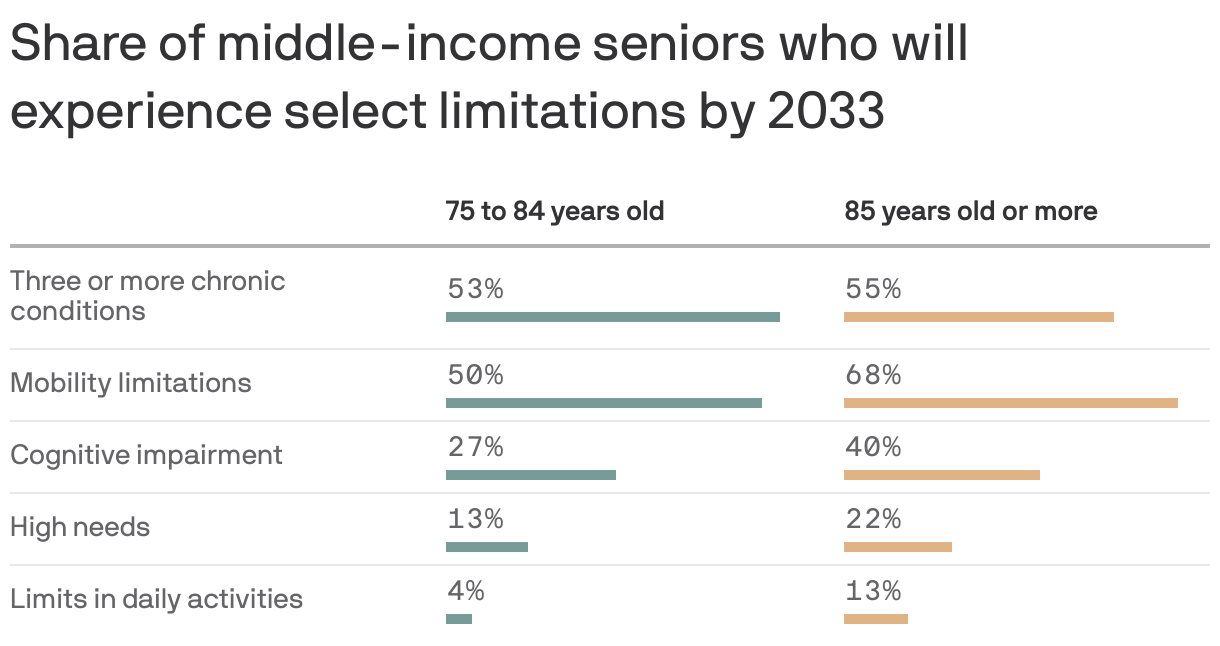
Data: NORC; Note: The study examined individuals 60 years and older, as they will be 75 or older in 2033. High needs is defined as having three or more chronic conditions and one or more limitations in activities of daily living. Table: Tory Lysik/Axios Visuals
Long-term care will become an increasingly elusive need for aging baby boomers in the next decade, forcing some to spend down their assets in order to qualify for Medicaid.
Why it matters: The population of middle-class seniors in America will increase 89% to 16 million by 2033, according to data from NORC at the University of Chicago.
Aging baby boomers in the U.S. are living longer and have better financial safety nets than previous generations. They're also more likely to be divorced, live far away from their children and be living with debt and a chronic condition.
Why it matters: The U.S. is not well-equipped to handle the largest generation of elderly adults in human history, experts say. That's because of an already strained long-term care industry, fewer caregivers to assist with their needs and a world that just isn't designed for them.
A financial arms race is forming in senior care as private capital pours into the reshaping of elder care.
Why it matters: The perceived dangers of private equity entering senior care have largely focused on nursing homes, but the truth is, the dollars are flowing elsewhere.
Jackson, Mississippi has moved one step closer to engaging federal oversight for long-term water solutions after more than 150,000 people faced outages and weeks of unsafe drinking water during the city's most recent water crisis.
Driving the news: The city council voted this week to approve a 12-month legal agreement with the Environmental Protection Agency (EPA) to enable its involvement as Jackson works to build a self-sustaining water system.
Influenza activity is elevated across the country just as Americans prepare for Thanksgiving gatherings and travel, per updated data from the Centers for Disease Control and Prevention released Friday.
The big picture: The flu hospitalization rate is at the highest for this time of year in more than a decade — since the 2010-2011 season.
Elizabeth Holmes on Friday was sentenced by a California judge to 11 years and three months in prison for defrauding investors in her failed blood-testing company, Theranos.
Why it matters: This is the end of a years-long saga that saw the celebrated startup founder become a cautionary tale of Silicon Valley's "fake it 'til you make it" culture.
The Alliance of Hippocratic Medicine, an anti-abortion group, on Friday filed a lawsuit against the Food and Drug Administration to overturn the agency's approval of abortion pills.
Why it matters: It's the latest effort from an anti-abortion group to curtail access to abortion in the post-Dobbs era.
The Food and Drug Administration on Thursday approved the first treatment that can delay the onset of Type 1 diabetes.
Why it matters: The new drug, called Tzield (teplizumab-mzwv), can delay the onset of stage 3 Type 1 diabetes in adults, and in pediatric patients 8 years and older who have stage 2 Type 1 diabetes, per the FDA.
Cancer screening rates and diagnoses had yet to bounce back to pre-pandemic levels by the end of 2021, a new analysis published in JAMA Oncology shows.
👀 What they found: Using a set of nationally representative, all-payer data claims from analytics company Trilliant Health, researchers found that "screening quickly rebounded after the initial stages of the pandemic; however, the longer follow-up time reveals that gaps in preventive cancer screening returned and worsened."
The study adds data to provider anecdotes about patients being diagnosed with later-stage cancers after putting off screening during lockdowns.
They've also seen that patients have been slow to return to regular cancer screenings and check-ups as the pandemic has eased.
The pandemic caused a 30-year high in U.S. births at home in 2021 as people avoided hospitals that were being swamped with COVID-19 cases, the Centers for Disease Control reported on Thursday.
Why it matters: The findings offered another view of the pandemic’s effects on maternal health and how, of the nearly 52,000 home births recorded last year, the greatest increases were among Black and Hispanic women.
An effort to lower the cost of insulin for privately insured patients faces long odds in the lame duck session, Axios' Peter Sullivan reports.
Why it matters: More than 1 million Americans have to ration insulin because of the cost, according to an October study in the Annals of Internal Medicine.