Tuesday's health stories

Trump to give nod to tax credits as part of Obamacare replacement
Donald Trump will not give a definitive blanket endorsement to the House GOP's Obamacare replacement plan in his speech to Congress tonight, according to sources familiar with the speech. The view internally is that the current plan — drafted by both House and Senate leadership — is going to struggle to get out of Congress. It would be foolish for Trump to walk all the way down the plank and utter the sentence: "I support the health care plan drafted by the House."
What Trump is expected to do: Signal a receptivity to the House plan, especially to the key concept of tax credits. This is a win for House and Senate leadership, especially Speaker Paul Ryan.

GOP trying to get a grip on their Obamacare strategy
It's been a hectic day for Republicans and Obamacare. First the leaked draft of the replacement plan is discounted by a member of leadership.
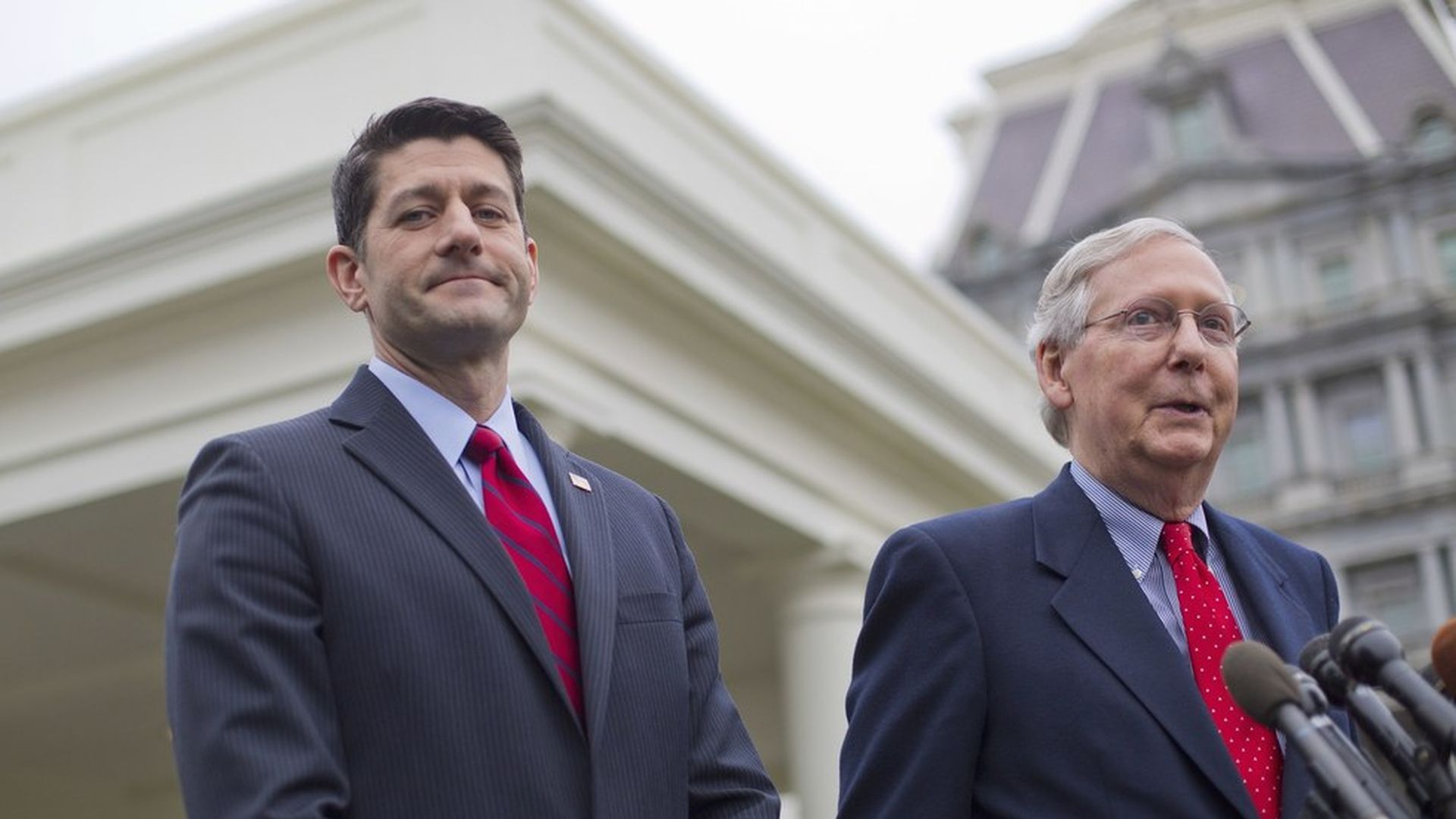
Paul Ryan tells reporters "there are no rival plans," and that the House, Senate and White House are all working together.
And Mitch McConnell calls for Senate Republicans to meet about it tomorrow afternoon, Politico reported.

121 retired military officers appeal to Congress on foreign aid
A group of 121 retired three and four star flag and general officers sent a letter to Congressional leadership and the Trump administration yesterday asking them not to cut funding foreign aid.
"The State Department, USAID, Millennium Challenge Corporation, Peace Corps and other development agencies are critical to preventing conflict and reducing the need to put our men and women in uniform in harm's way."
Background: Office of Management and Budget officials told reporters yesterday that Trump's budget plans will include "a large reduction in foreign aid," according to an ABC report. Foreign aid is one percent of U.S. spending.

Trump's speech: the reality versus the spin
The White House is casting President Trump's speech tonight as "an optimistic vision for all Americans."
Here's the reality: The Obamacare repeal and replace process is buckling under enormous strain. Tax reform is a mess, too. But let's stick with healthcare as it's the first priority for Republicans. House GOP leaders need much more from Trump than a gauzy vision speech. They need a specific, forceful declaration of support for the House's Obamacare repeal and replace plan.

How Obamacare tax credits compare to Trumpcare
The leaked draft of the GOP Obamacare repeal and replacement plan would swap out the law's income-based premium subsidies with tax credits that vary by age. They'd start at $2,000 a year for young adults under age 30, increasing for different age groups. The maximum would be $4,000 a year for people age 60 and older.
We were curious how that would change the amount of federal assistance different people would receive, so we used the Kaiser Family Foundation's subsidy calculator to compare the two. Here's what we found.
Data: GOP draft bill, Kaiser Family Foundation ACA premium calculator, Department of Health & Human Services; Methodology: Income ranges based on percent of federal poverty level. 150% = $18,090, 250% = $30,150, 500% = $60,300. Columbus area code: 43201, Prescott: 86301, Tampa: 33601; Chart: Andrew Witherspoon / Axios

Drug firm Janssen feels pressure to be transparent
Janssen, a drug company owned by Johnson & Johnson, published its first-ever "transparency report" Monday. It covers a wide range of topics, from pricing to clinical data, reflecting the growing pressure pharmaceutical companies face from patients and the public who are worried and angry about rising drug costs. Janssen said it raised list prices by 8.5% in 2016 and the net price increase, after $11 billion in rebates and discounts, was 3.5%.
The takeaway: There's a lot of P.R. material, naturally. But the report also reinforces the drug industry's main talking points right now: That others in the drug supply chain are getting sizable portions of drug price increases, and that net prices are below medical inflation. Janssen even mapped out a flow chart of how drugs get from them to consumers.
Yes, but: Drug companies still set the prices, and the fact that net price increases are below medical inflation masks the fact they are still outpacing broader economic inflation, which is why people are feeling the pinch in their wallets.

Why Anthem has so much clout in health care talks
Since the November election, Anthem, the national insurer with the most at stake in the Obamacare marketplaces, and affiliated Blue Cross insurers have been meeting with top Republicans leading the charge to repeal Obamacare, per Reuters. That gives them a lot of influence with the Trump administration as it cracks down on Obamacare regulations that have hurt the company's profits — and as it meets with health insurance executives this morning.
Here's what Anthem's CEO, Joseph Swedish, has been pushing for:
- Tighter enrollment rules after losing money on people who waited to signup for Obamacare until they were sick. (This was the subject of the administration's first Obamacare rule.)
- Changes in the way payments for the sickest patients are calculated.
- An extension to the discontinuation of plans after 2017 that were issued before Obamacare and don't meet the law's coverage requirements.

Trump: "Nobody knew health care could be so complicated"
After meeting with governors, President Trump has come to an important conclusion: Reforming the health care system is immensely difficult.
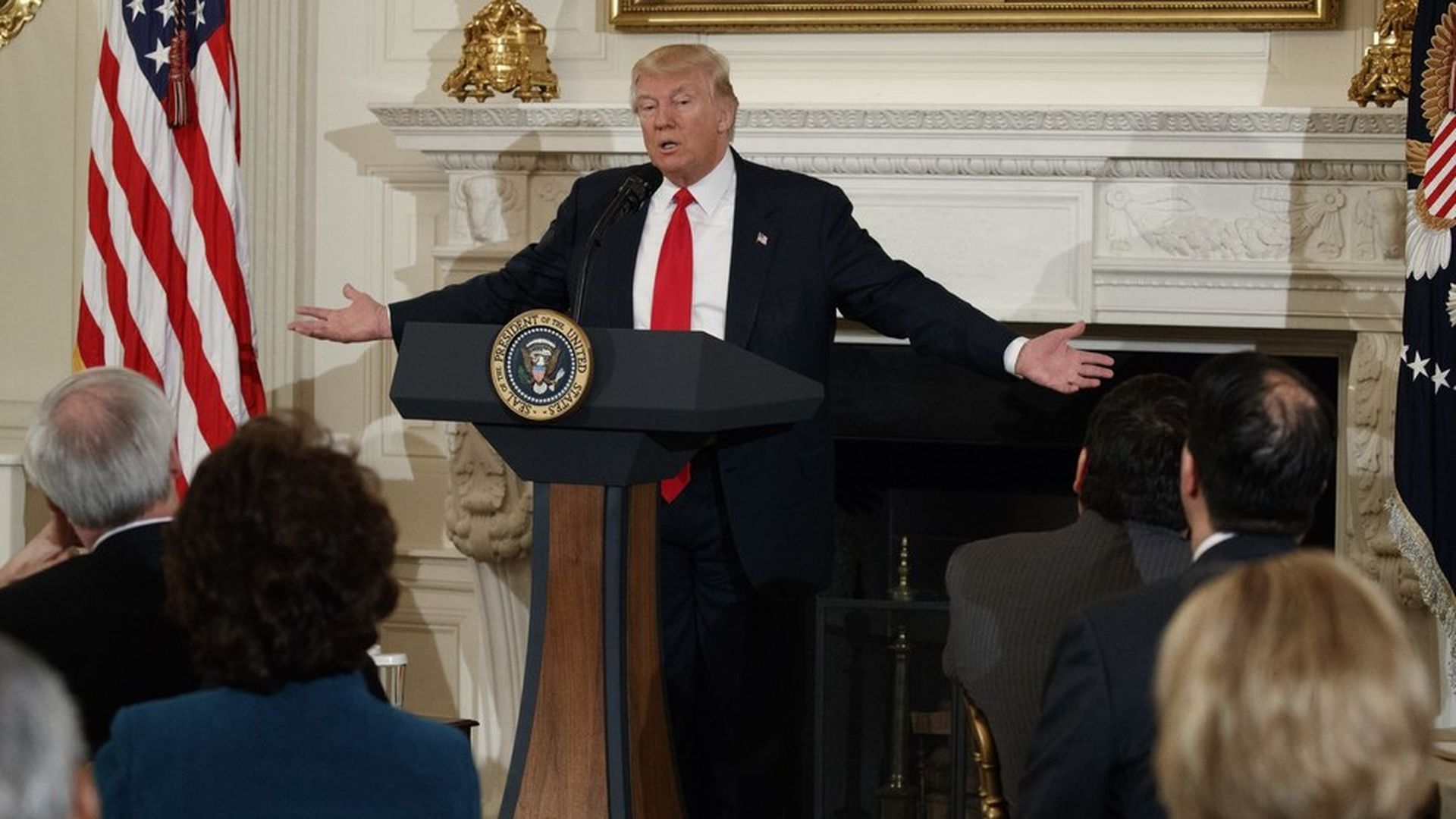
We have come up with a solution that's really, really – I think – very good. Now I have to tell you, it's an unbelievably complex subject. Nobody knew health care could be so complicated.
Trump said he's spent time discussing the issue with Govs. Scott Walker, Rick Scott and Chris Christie.
“Nobody knew that health care could be so complicated." https://t.co/XweLPEQ9UQ— Justin Green (@JGreenDC) February 27, 2017