The stakes in regulating digital assets now go far beyond cryptocurrencies, as the technology begins to reshape how money moves, financial markets operate and countries control their currencies.
Why it matters: The central challenge for governments is allowing the useful features of digital assets into mainstream finance while protecting financial stability, according to a new report from the World Economic Forum and Boston Consulting Group.
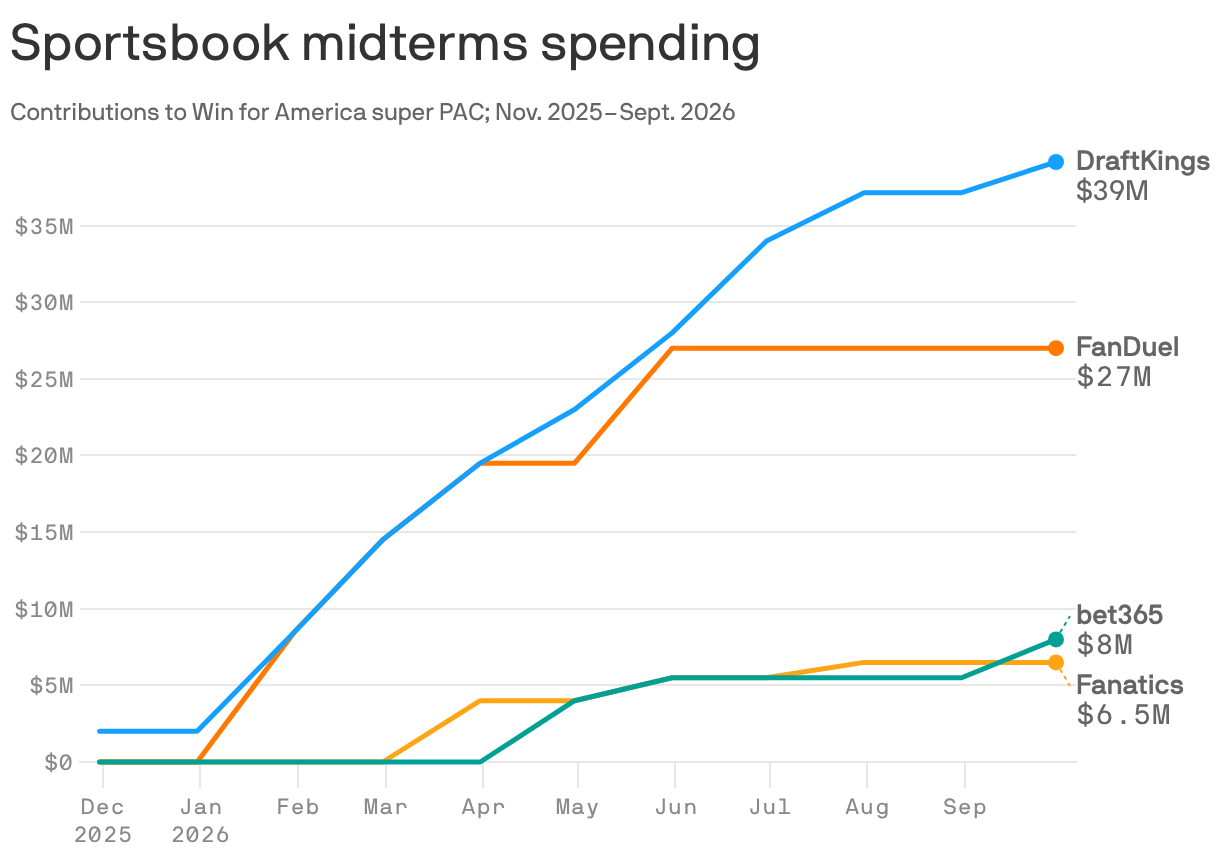
Four of America's biggest sportsbooks have poured more than $80 million into a political operation seeking to influence state elections ahead of the midterms, according to Federal Election Commission data reviewed by Axios.
Why it matters: Sportsbooks are ramping up their political spending as they seek broader legalization and navigate a growing rivalry with prediction markets.
The Federal Reserve left interest rates unchanged Wednesday, with two officials dissenting, including Lisa Cook, the governor President Trump is seeking to fire.
Why it matters: Fed officials have signaled they may raise rates again by year-end but are in no hurry, preferring to move gradually with more data in hand.
The U.S. economy will likely show the strongest overall growth in a year when third-quarter data is released Thursday, powered by consumer spending and AI investment.
Driving the news: The Commerce Department's initial release of Gross Domestic Product data is scheduled for Thursday at 8:30am ET.
Analysts surveyed by Bloomberg anticipate that it will show a 3.2% annual rate of growth in the July-through-September quarter; the Federal Reserve Bank of Atlanta's GDPNow tracker pegs it at 3.3%. Either result would be the most rapid GDP growth since the third quarter of 2025.
Electric vehicle charging is getting tantalizingly close to effortless, as I discovered on a recent road trip through the Pacific Northwest.
But every time I thought we'd finally arrived at charging nirvana, some little annoyance reminded me that we're not quite there yet.
Why it matters: Public charging has long been one of the biggest obstacles to EV adoption. Now, automakers are finally eliminating some of the hassles that keep many drivers tethered to gasoline.
America is in the midst of its strongest productivity surge in decades. The evidence is more ambiguous about how much AI is the reason.
Why it matters: Companies are pouring hundreds of billions of dollars into AI, a massive bet that the technology will deliver sweeping productivity gains across the economy.
But so far, the productivity gains may have more to do with less sexy developments, including the more intensive use of capital equipment and a post-pandemic surge in entrepreneurship now paying dividends.
Honda is urging the U.S., Canada and Mexico to coordinate policies to keep Chinese automakers from gaining a foothold in the American market — even as it acknowledges their arrival is ultimately inevitable.
Why it matters: Chinese automakers are expanding rapidly around the world with inexpensive, technologically sophisticated vehicles, putting pressure on established carmakers to move faster and slash costs.
If Democrats gain full control of Congress next week, as many polls and prediction markets suggest they will, private equity could once again find itself in the political crosshairs.
The big picture: Private equity has become a rhetorical punching bag for a number of Democratic House and Senate candidates, including in debates and on the stump, as an affordability bête noire.
Instacart shares hit an all-time high on Monday, before a slight Tuesday pullback, following reports that the grocery delivery giant is nearing a sale to DoorDash.
Zoom in: Both the WSJ and Reuters put around a $17 billion price on the prospective deal, which would work out to over $70 per Instacart share, although neither said if DoorDash would pay all cash or cash and stock.
A senior Treasury official who played a key role in the Trump administration's trade negotiations with China is leaving the department for Netflix, Axios has learned.
The big picture: The departure comes as Treasury Secretary Scott Bessent helps steer Trump's sweeping overhaul of U.S. trade policy.
The cybersecurity world braced for catastrophe after AI uncovered critical flaws in the web's foundational code, but the anticipated wave of automated attacks has surprisingly struggled to get off the ground.
Why it matters:Millions of hacking attempts have yielded few successful attacks, an apparent lucky break due to the degree of difficulty of building attacks on the bugs. The defense work at many companies to address the issue also appears to have helped.
The last week has unfolded in ways that remind some researchers of the Y2K phenomenon, a software problem in 1999 where warnings of Armageddon helped rally companies to engineer a solution in time.
Three brothers, including two prominent real estate agents, were sentenced Tuesday to 30 years in prison each for their roles in a decade-long sex trafficking and sexual abuse scheme, the Department of Justice said.
The big picture: The sentencing follows the March convictions of Tal Alexander, 40, and twins Oren and Alon Alexander, 39, of Miami, on multiple federal sex offenses, including conspiracy to commit sex trafficking.