EV charging keeps teasing me with glimpses of nirvana

Add Axios as your preferred source to
see more of our stories on Google.
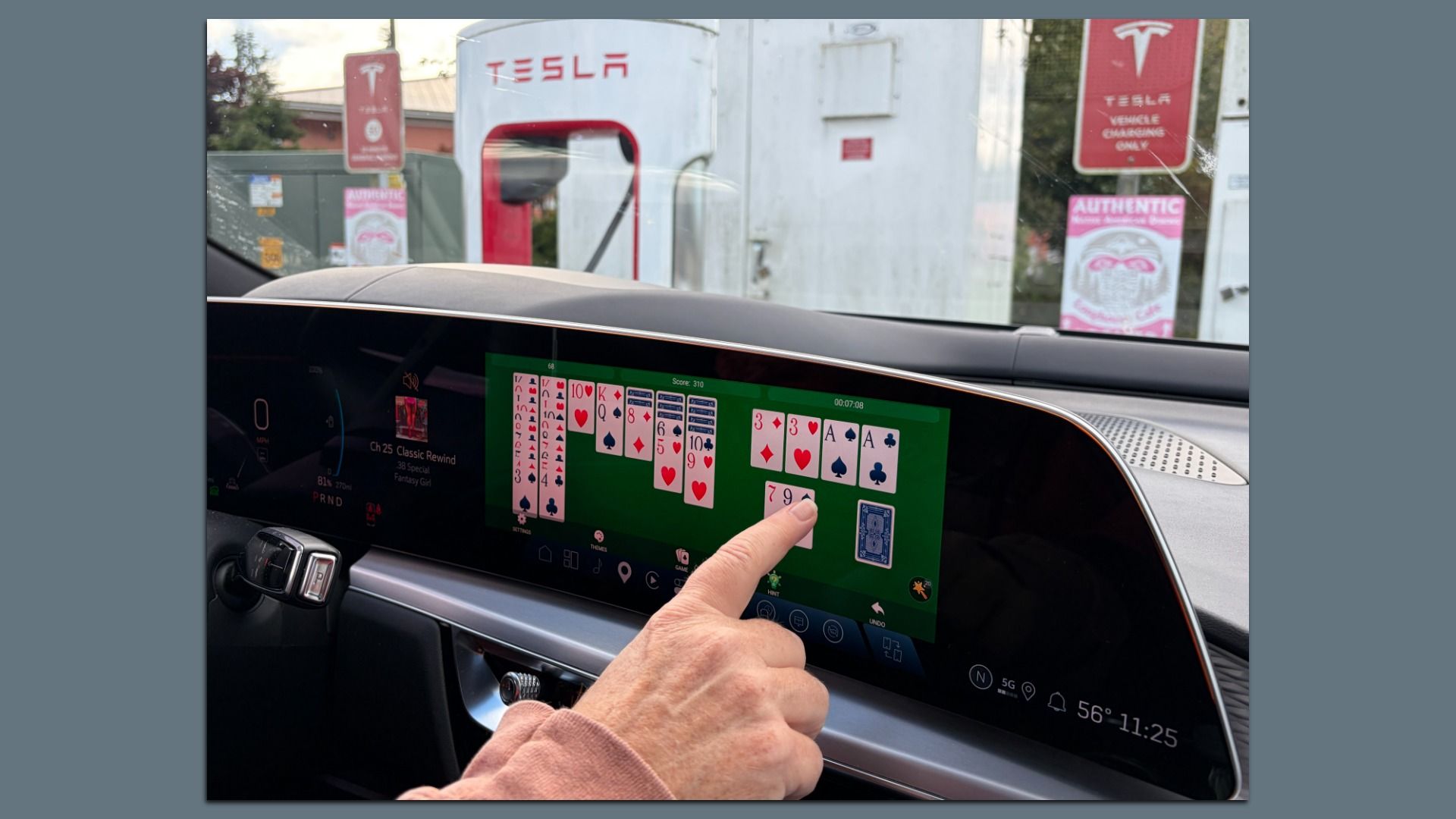
I entertained myself playing Solitaire on the Lyriq's enormous touchscreen while charging at a Tesla Supercharger. Photo: Bill Rapai for Axios
Electric vehicle charging is getting tantalizingly close to effortless, as I discovered on a recent road trip through the Pacific Northwest.
- But every time I thought we'd finally arrived at charging nirvana, some little annoyance reminded me that we're not quite there yet.
Why it matters: Public charging has long been one of the biggest obstacles to EV adoption. Now, automakers are finally eliminating some of the hassles that keep many drivers tethered to gasoline.
What we did: My husband and I spent two weeks exploring the Oregon Coast and Washington's Olympic Peninsula in a 2026 Cadillac Lyriq on loan from General Motors' press fleet.
- I worried about finding fast-chargers in remote areas, especially within the sprawling Olympic National Park. That wasn't really an issue, though, thanks to the Lyriq's 300-plus mile driving range.
- And I was eager to test GM's new Energy Pass, which streamlines the charging experience — a major pain point for EV drivers — by bringing multiple charging networks into one app, something other carmakers do, too.
How it works: You only have to enroll once in Energy Pass and add a payment method.
- Then you can find, activate and pay for charging at participating networks, including Tesla, Electrify America, IONNA and Chargepoint. EVGo is coming soon.
- At some chargers, you just click a button on GM's app to start the session.
- It's even easier at networks that support Plug & Charge: You plug in the cable and walk away. The car and charger recognize each other, and payment happens automatically.
Zoom out: Tesla has long set the standard for such a seamless experience at its Supercharger network.
- Now the rest of the industry is catching up by adopting Tesla's North American Charging Standard (NACS), and gaining access to its network.
- Even cars like the 2026 Lyriq, which use the older CCS standard, can charge at many Superchargers with an adapter. (The 2027 Lyriq will have a NACS port to make it even easier.)
Yes, but: Charging speeds in the Lyriq were sometimes disappointing.
- There were other frustrations, too. Tesla's notoriously short Supercharger cables couldn't reach the Lyriq's front-left charging port unless we parked awkwardly, taking up two spaces.
- And unlike gas stations, most charging sites offered no protection from the elements. Only one stop — at an IONNA station — had a lighted canopy overhead.
What they're saying: GM officials said we likely didn't sufficiently precondition the car's battery.
- If you plug in an EV when the battery is cold, it will take longer to charge. Using the car's built-in navigation system will automatically prepare the battery ahead of the next charging stop, they said.
The bottom line: EV charging has improved enormously since my first EV road trip in 2023.
- I've glimpsed nirvana. Now I just want to experience it at every stop.
