President Trump is invoking an unused provision of the 1930 Smoot-Hawley Tariff Act to impose additional tariffs on Canada over alleged discrimination against U.S. exports.
Why it matters: As the Supreme Court limits Trump's ability to wield tariffs and a temporary tariff stopgap expires, the president is turning to a rarely used tariff authority.
The Trump administration keeps finding new ways to wage trade wars. As one novel tariff authority nears its expiration, it's testing another — threatening huge duties on Canadian goods under a never-before-used law.
Why it matters: The administration's willingness to test new trade authorities makes tariff policy harder for businesses, investors and foreign governments to handicap.
A new way of measuring America's homeownership rate finds that it is far lower than commonly understood, especially for young adults.
Why it matters: Housing is the largest source of wealth for many Americans, and the new measure finds that barely half of adults have access to that piggy bank.
Three months into the Iran war, bond market traders are tuning out President Trump's posts on his personal social media site, Truth Social, analysts say.
Why it matters: Researchers from JPMorgan show that for the most part, his social media posts are noise, with very little ability to move the market.
A white separatist group is openly planning a network of whites-only settlements across rural America that aim to withstand legal challenges by operating essentially as private clubs.
Why it matters: The communities are launching in the Ozarks, Appalachia and the South as the Trump administration has backed off prosecuting many civil rights cases.
The Trump administration said Monday that it will impose an additional 50% tariff on certain Canadian goods — including hockey sticks, wine and cement — accusing Canada of discriminating against U.S. exports.
Why it matters: The move ratchets up tensions in an increasingly bitter trade dispute between two of the world's closest economic partners.
WASHINGTON — Addressing the cost of housing in the U.S. will require cooperation from local governments, targeted policy changes and sustained investment, said leaders in government, business and advocacy.
Axios' Nathan Bomey and Neil Irwin moderated the July 16 roundtable discussion. The event was sponsored by Citi.
5 big takeaways from the conversation:
The new law, which went into effect this month, is "a reflection of the magnitude of this issue" and a rare example of what Democrats and Republicans can agree on as a priority, Rep. Sam Liccardo (D-Calif.) said.
"Connecting the federal government with the state and local governments will be a longer-term challenge," Bipartisan Policy Center executive vice president Dennis Shea said, but necessary to ensure all communities benefit from the legislation.
The Department of Housing and Urban Development should monitor how local communities use the funds they're granted, said Sara Bronin, founder of the National Zoning Atlas and CEO of Land Use Labs.
Leaders at the state level are focusing on cultivating pro-housing local leaders and improving salience as an "electoral issue for young families," said Haley Lemieux, chief of staff at the Maryland Department of Housing and Community Development.
"Homeownership and housing are two separate issues," Vested Communities founder Jason Boseck said, and policy should extend to address renters' needs such as incorporating shared equity. The conversation also included mentions of housing vouchers and preserving existing affordable housing.
Content from the sponsor's remarks:
In opening remarks, Citi head of enterprise services and public affairs Edward Skyler said housing innovation in the U.S. isn't living up to its potential.
In the next five years, Citi is "going to work with for-profit developers [and] nonprofit developers that are doing supportive housing service as well."
Blackstone-backed Jersey Mike's Subs said on Monday that it plans to sell 13.8 million shares in an IPO priced between $21 to $25 apiece, giving it a market cap of between $6.7 billion to $7.8 billion.
Why it's the BFD: There's hope that if the public market digests the offering well a feast of restaurant IPOs could follow.
AMC Entertainment shares soared Monday after a blockbuster showing for "The Odyssey" and a strong earnings report signaled that the movies have completed a journey of their own — back from the brink.
If the U.S. experiences an AI-fueled productivity boom over the coming years, it will mean stronger growth — but, at least under current tax policies, that would have limited benefits for the U.S. fiscal outlook, per a new analysis.
Why it matters: With the U.S. public debt high and rising rapidly, and the political will to reduce deficits by traditional means — spending cuts and tax increases — nowhere to be found, it would be awfully fortunate if America could grow its way out of its fiscal predicament.
New modeling from the Budget Lab at Yale, however, suggests that in an AI-driven productivity boom, the fiscal situation would improve, but not by the leaps and bounds one might expect.
Andy Burnham is the U.K.'s seventh prime minister in a decade, inheriting an economy constrained by weak growth, high debt and years of political turmoil.
Why it matters: Burnham is promising to remake Britain's economy just as growth has stalled, inflation remains elevated and public finances are stretched.
A new 106,054-square-foot mix of retail, dining and service tenants is coming to Durbin Park this fall.
The plan: The Berkeley at Durbin Park will act as a new grocery-anchored retail center, serving one of Northeast Florida's fastest-growing communities.
Regency Centers will develop and own the site in the Durbin Park area of St. Johns County, Florida.
No, we're not talking about Social Security. "Generational" is how some analysts describe the current transfer of money from hyperscalers to chipmakers.
Why it matters: The chip stock boom that preceded the current malaise was based on that simple reality, which is reflected in the above chart.
In short, the massive investments that hyperscalers are making in "compute" are pumping cash into the coffers of the companies that make the products they need — computer chips foremost among them.
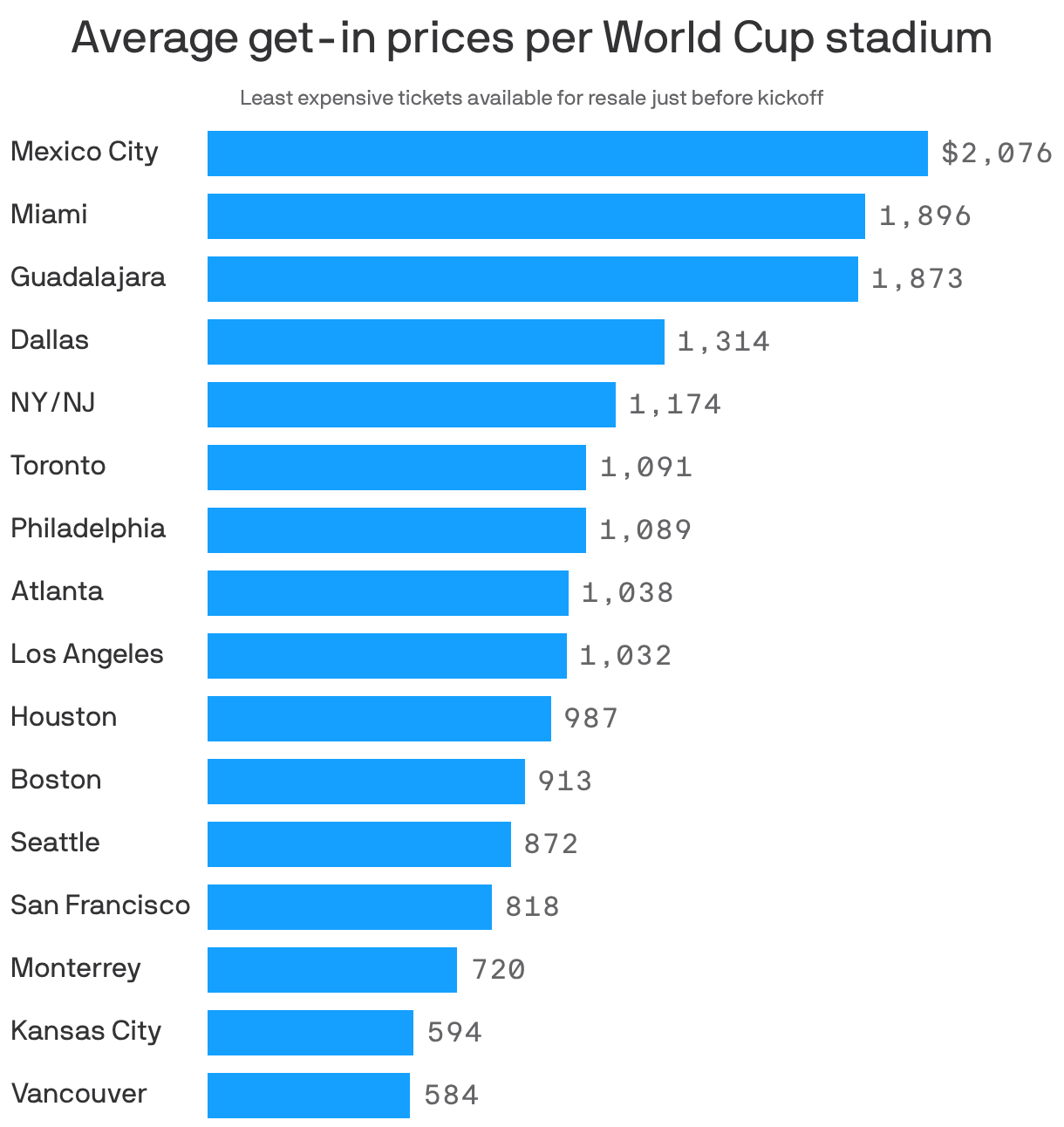
Data: TicketData.com; Chart: Brad Jennings/Axios. Note: Excludes championship final and third-place match.
Even the "cheap seats" at most World Cup games were expensive, with last-minute prices reaching thousands of dollars for some matches.
The big picture: Get-in prices ranged from just over $300 for a group-stage match in Atlanta to nearly $7,500 for Sunday's final in East Rutherford, N.J.