Trump administration ends "segregated facilities" ban in federal contracts

Add Axios as your preferred source to
see more of our stories on Google.
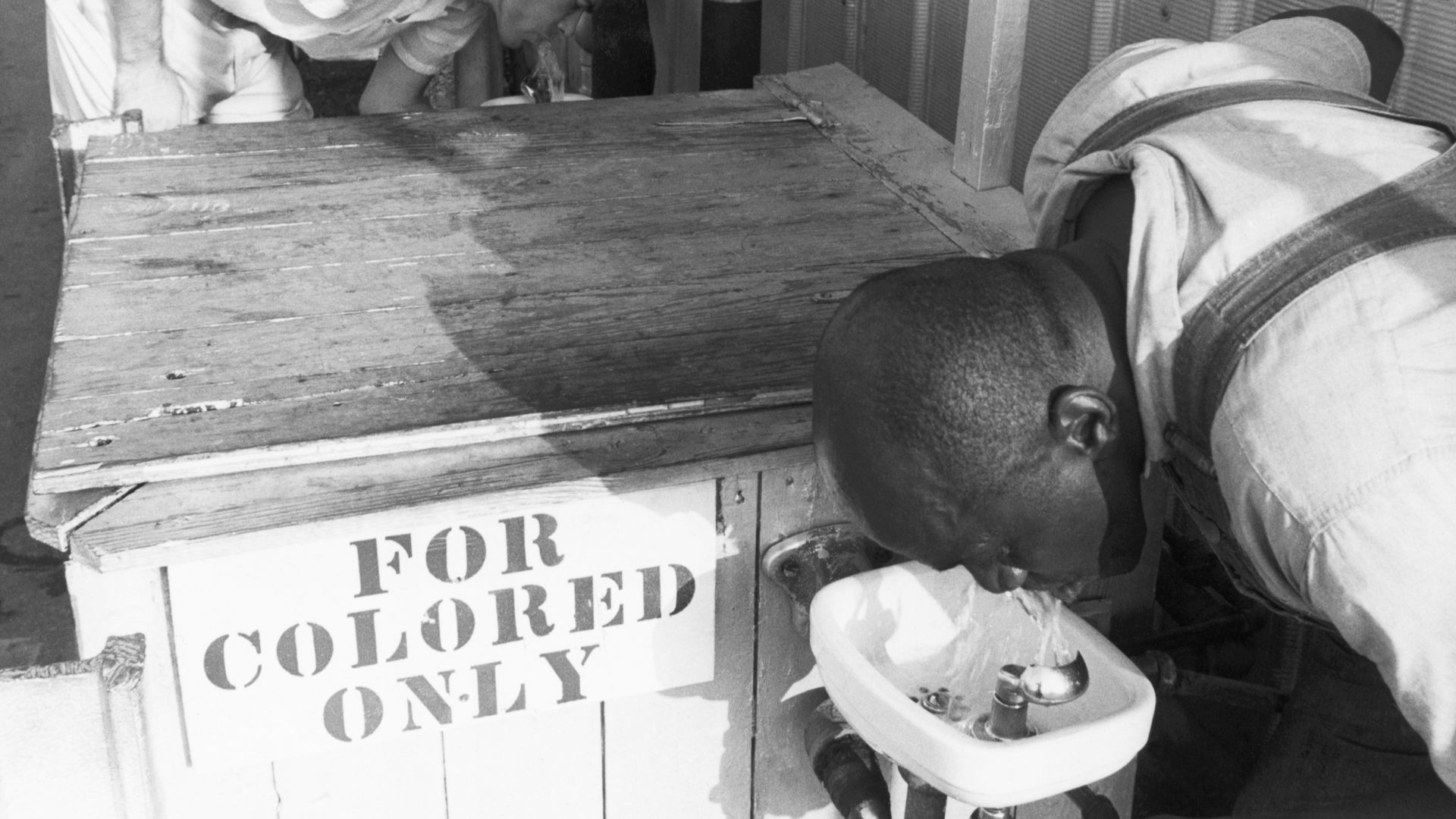
Segregated drinking fountain in use in the American South. Photo: Bettmann Archive/Getty Images
The Trump administration has announced the federal government will no longer unequivocally prohibit contractors from having segregated restaurants, waiting rooms and drinking fountains.
Why it matters: The change announced last month in an overlooked public memo is a symbolic move, first reported by NPR, and comes after President Trump revoked President Lyndon Johnson's decades-old order diversity and affirmative action practices in the federal government.
The big picture: The Civil Rights Act of 1964, as well as many state laws, still makes segregated facilities illegal in all businesses, including federal contractors.
Yes, but: Critics say the recent change sends a message about the government's priorities and potentially eliminates a crucial enforcement tool.
- The change follows the Trump administration's reinterpretation of Civil Rights-era laws to focus on "anti-white racism," rather than discrimination against people of color.
Zoom in: A public memo the General Services Administration issued said the change was needed after Trump revoked LBJ's 60-year-old executive order requiring federal contractors to refrain from employment discrimination.
- The memo also addresses Trump's executive order on gender identity.
- A clause in the Federal Acquisition Regulation (FAR) said contractors can't "maintain or provide for its employees any segregated facilities."
- The memo stated that when issuing new solicitations or contracts, agencies could no longer include the clause about the "Prohibition of Segregated Facilities."
- FAR defined segregated facilities as work areas, restaurants, drinking fountains, transportation, housing and others.
Zoom out: Federal agencies have already started adopting the changes.
- The Department of Homeland Security and the National Institutes of Health, for example, have issued notices not to consider the segregation clause in the future.
What they're saying: "As our nation unfortunately becomes more divided and polarized, the last thing we need is any effort that could be perceived as allowing racial segregation," Ibrahim Hooper of the Council on American-Islamic Relations (CAIR) said in a statement.
- Hooper said the nation must not "turn back the clock" when racism was written into law.
A General Services Administration spokesman said the Civil Rights Act of 1964 must still be followed.
- "Having additional duplicative regulations in the FAR places (an) unnecessary burden on American companies from doing business with the federal government. This is why reforming the FAR is such a high priority for GSA and this administration," the agency said in a statement.
- "We are moving at the speed of need to quickly undo the damaging policies of the past administration."
Flashback: Before the Civil Rights Act of 1964, businesses and public facilities in the American South practiced a rigid form of racial segregation with signs directing whites and Black Americans to restrooms and entrances.
- In Texas, signs ordered whites, Black Americans and Mexican Americans into separate restrooms and facilities.
- Young civil rights activists challenge those segregation laws with "sit-ins" and nonviolent demonstrations.
Context: LBJ's 1965 order gave the Secretary of Labor the authority to ensure equal opportunity for people of color and women in federal contractors' recruitment, hiring, training and other employment practices.
- It required federal contractors to refrain from employment discrimination and take affirmative action to ensure equal opportunity "based on race, color, religion, and national origin."
The bottom line: Businesses and contractors can't segregate against members of protected classes, but it will be up to the federal government to investigate alleged violations.
- The immediate economic cost for contractors is now lifted and opens the door to potentially segregate transgender people or other people if contractors believe they won't face punishment.
Editor's note: This story has been updated with comment from GSA spokesman.
