The era of powerful pharmacy chains dominating the American drug landscape is fading.
Why it matters: CVS, Walgreens and Rite Aid long held a tight grip over prescription fulfillment, but they're losing their footing to a multitude of competitors, including mail-in options, online pharmacies and big-box stores.
Republican Senate challengers gathered at a crypto event in New York City yesterday to make the case for a light touch on crypto policy.
Why it matters: We're at a political inflection point in this election, with Democrats suddenly striking a conciliatory tone and Republicans reminding blockchain denizens which party's always been there for them.
Case in point: Semafor reported last week that Sen. Elizabeth Warren (D-Mass.) now says she never had a problem with a little crypto trading.
And of course, Vice President Kamala Harris recently name-checked the industry as one to support, albeit with caution.
There's a "zero percent" chance that the SEC's fights against companies like Coinbase and Uniswap Labs will be dropped if Harris wins the election, at least not to the thinking of Joshua Rivera, general counsel at Blockchain Capital.
Why it matters: SEC chair Gary Gensler has become a political lightning rod.
Between the lines: On a panel about the U.S. policy outlook for digital assets yesterday at Messari Mainnet, I raised the prospect of cases dropping under a friendlier administration.
"The expectation is that the Senate is going to flip to red. She's not going to remove Gensler and try to appoint another chair under a Republican Senate," Rivera said, referring to Harris. "From my perspective, it's a net negative."
World Liberty Financial, the decentralized finance project supported by the Trump Organization, is open for sign-ups from accredited investors and people outside the U.S. as of yesterday
Reality check: Will anyone tell you what you are signing up for? No.
This tweet is all that's new, that anyone knows.
Inside the room: One rumor is that the project is a fork of the biggest money market on Ethereum and other chains, Aave.
Yesterday at Messari Mainnet, I asked Stani Kulechov, CEO of Avara, the company that launched and manages the Aave codebase, if that was true. He said it was not an Aave fork.
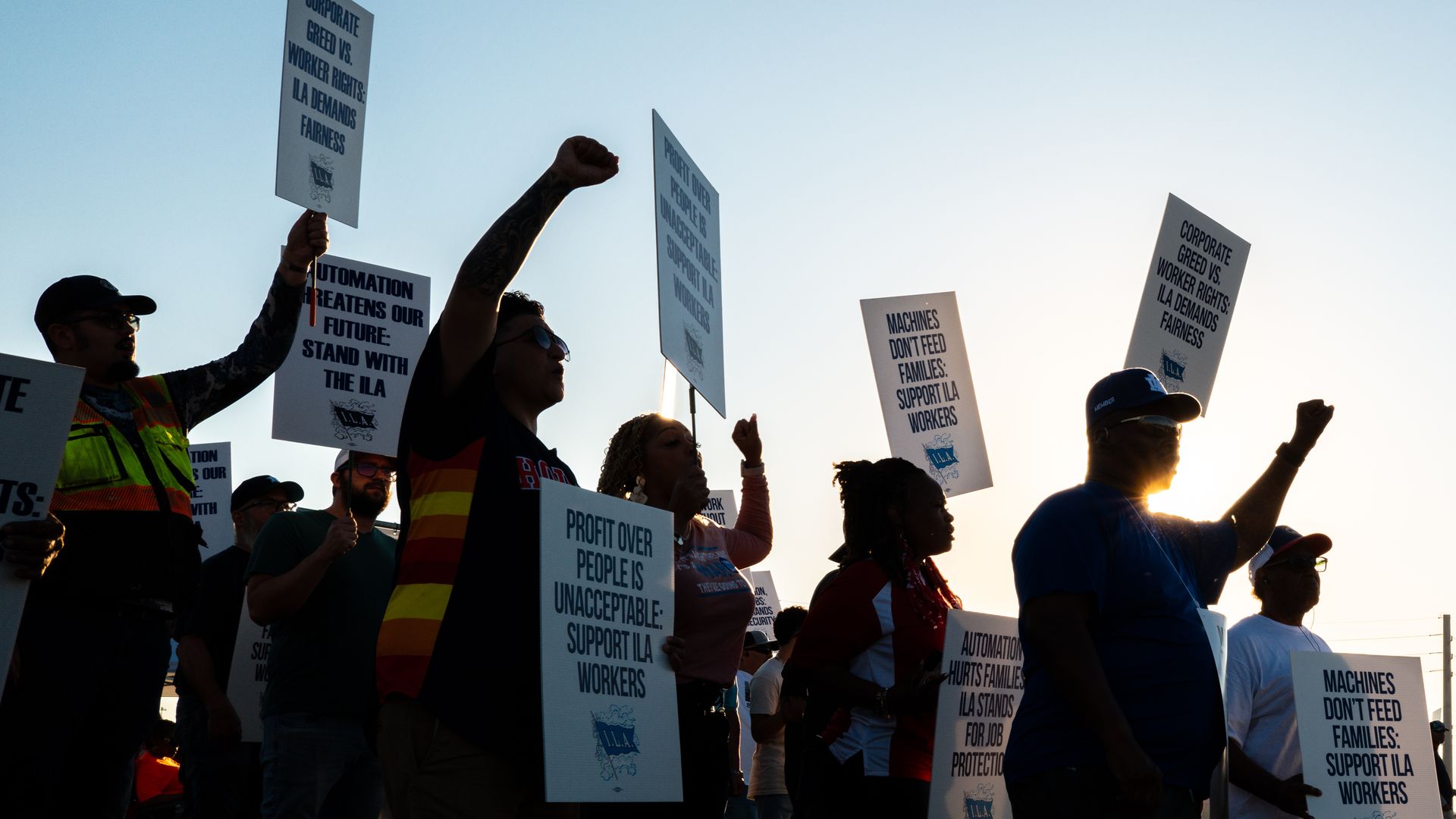
As thousands of dockworkers from major ports spanning Maine to Texas walk off the job to strike, consumers could feel the effects when they shop.
Why it matters: A protracted contract battle between the International Longshoremen's Association and the United States Maritime Alliance could strain supply chains ahead of the holiday shopping blitz just as slowing inflation had consumers weighing spending more.
The U.S. labor marketis slowing, but economic growth is not — a confusing combination that muddles the picture of what might be ahead for the economy.
Why it matters: Assessing which data gives the truer reflection of the state of the economy is crucial to appropriately setting the policy dials — neither cutting rates too fast as to reignite inflation nor so slowly as to allow a more serious downturn to take root.
Americans have never been wealthier. That's thanks in large part to the way in which they jumped feet-first into the stock market as soon as the pandemic hit.
Why it matters: Retail investors, it turns out, didn't panic when confronted with market volatility, as they were in March 2020.
Thousands of unionized dockworkers at 14 major ports stretching from Maine to Texas went on strike just after midnight Tuesday, after failing to come to terms on a new labor contract.
Why it matters: A work stoppage that lasts more than a few days will snarl supply chains, raising the prospect of higher prices and shortages of everything from auto parts to bananas as the U.S. heads into the holidays — and a presidential election.