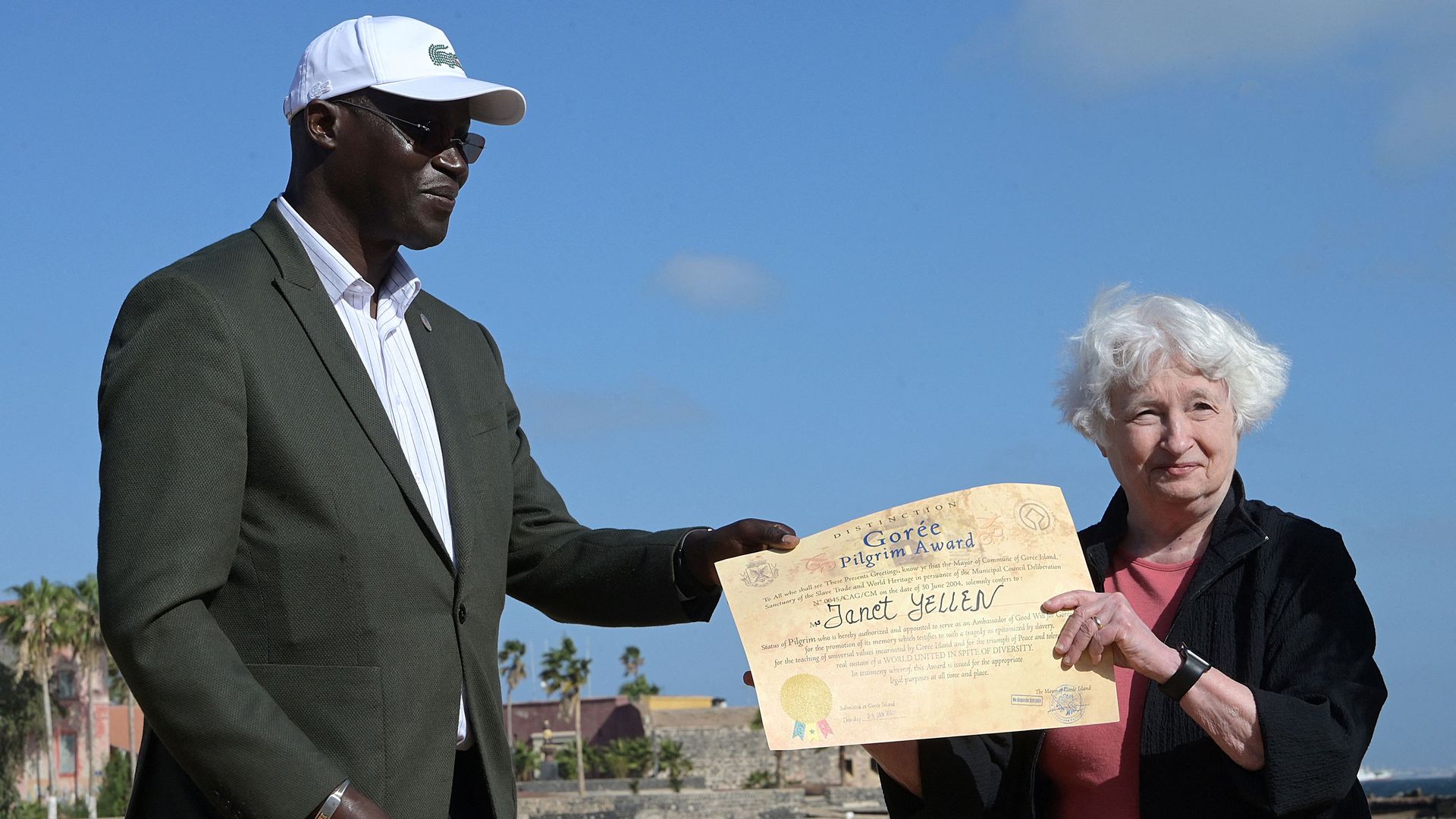
DAKAR, Senegal — On a trip to Gorée Island, Treasury Secretary Janet Yellen condemned the horrors of human bondage while honoring the suffering and spirit of enslaved Africans — as well as their descendants in the United States.
Why it matters: Yellen used the visit to the "House of Slaves" memorial to emphasize the central theme of her 10-day trip: Africa and the U.S. are intimately linked.
A potential default on the federal debt "would impose a self-imposed calamity in the United States and the world economy," Treasury Secretary Janet Yellen said in an interview with AP Saturday.
Driving the news: Yellen said she expects that Congress will eventually vote to raise the debt limit, after the Treasury Department announced this week that the U.S. has reached its $31.4 trillion debt ceiling.
The latest artificial intelligence systems dominated the tech conversation in Davos with a mix of excitement and worries over how they will reshape the future of work.
Why it matters: Past waves of automation have targeted entry-level jobs. But generative AI systems like ChatGPT and Dall-E 2 raise fears for knowledge workers, including those in the C-suite.
Global economists are warning that once-rare economic shocks may become more frequent.
That was the worrisome undercurrent of conversations among attendees at this week's World Economic Forum in Davos, Switzerland — where some of the world's richest and most powerful people returned in droves for the first full-fledged Davos since 2020.
In a San Francisco federal courtroom earlier this week, a jury was told its job isn’t to determine whether Tesla CEO Elon Musk’s 2018 tweets about taking the company private were false.
Rather, the group must decide on his state of mind at the time.
Why it matters: The legal concept of scienter, or the required state of mind to be held liable for certain actions, is central to white-collar crimes like fraud.
Despite the rise of social media and the ubiquity of the creator economy, most Gen Z-ers are interested in the same traditional careers as generations before them.
Driving the news: Young people today are more likely to job-hop, but they are also looking for stability by pursuing careers as CEOs, doctors and engineers, according toa new Axios/Generation Lab study.
Pent-up demand is driving travelers to frequent flyer programs and rewards credit cards, but airlines are making it harder to cash in on popular perks.
The big picture: Now that people are packing flights again there are fewer and less appealing rewards to go around.
As the shift to remote work becomes permanent for more people, countries around the world have introduced visas to attract foreign — and often rich — remote workers.
Driving the news: Last month, Indonesia launched its "second home visa" that allows wealthy travelers to stay and work in the country for up to 10 years, the Jakarta Post reported.